1st Indian Cavalry Division
The 1st Indian Cavalry Division was a specialized formation of the British Indian Army established at the onset of the First World War. Serving under the allegiance of the British Crown, this division played a unique role in the conflict, transitioning between traditional cavalry duties and the grueling reality of trench warfare on the Western Front.
Formed in September 1914, the division was part of the larger Indian Cavalry Corps. Its journey began in Bombay, India, from where it sailed for France on October 16, 1914, under the leadership of Major General Hew Fanshawe. This deployment occurred just over two months after Britain entered the war, bringing Indian soldiers into one of the most challenging military environments in history.
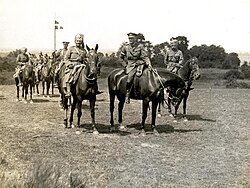
Key Facts
- Active Period: September 1914 – March 1918.
- Primary Theatre: The Western Front (France and Belgium).
- Major Engagement: The Battle of Cambrai (November 1917).
- Renaming: Became the 4th Cavalry Division on November 26, 1916.
- Final Disposition: Disbanded in March 1918; Indian units were redeployed to Egypt.
Operational History and Challenges
While designated as a cavalry division, the unit spent significant portions of the war serving as infantrymen in the trenches. The division was primarily held in reserve, waiting for a strategic breakthrough that would allow for a traditional cavalry charge. In the interim, they provided dismounted parties for essential trench duty.
The division faced severe sociological and leadership hurdles. A high number of early officer casualties proved devastating. Because British officers who possessed the necessary knowledge of the soldiers' languages, customs, and psychology were difficult to replace, the cohesion of the units suffered. This loss of leadership, combined with the alien and harsh environment of the Western Front, significantly impacted the division's later performance.
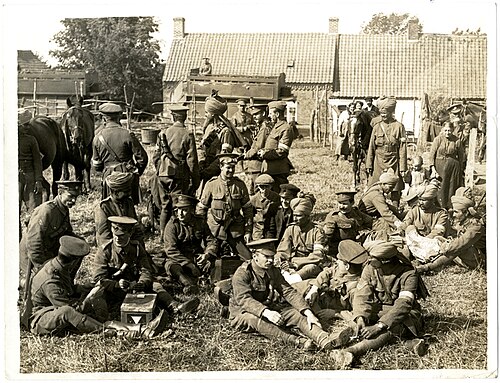
The Battle of Cambrai
One of the division's most notable actions occurred in November 1917 during the Battle of Cambrai. The division fought as a cohesive unit during the German counter-stroke, which took place between November 30 and December 3.
Order of Battle
The division's structure evolved throughout the war, consisting of several brigades and artillery support. The following table summarizes the primary components of the division.
| Brigade | Notable Units | Artillery Support |
|---|---|---|
| 2nd (Sialkot) Cavalry Brigade | 17th Lancers, 6th King Edward's Own Cavalry, 19th Lancers | Q Battery, Royal Horse Artillery |
| 3rd (Ambala) Cavalry Brigade | 8th (King's Royal Irish) Hussars, 9th Hodson's Horse, 30th Lancers | A Battery, Royal Horse Artillery |
| 8th (Lucknow) Cavalry Brigade | 29th Lancers, 36th Jacob's Horse, 1st King's Dragoon Guards | U Battery, Royal Horse Artillery |
| 5th (Mhow) Cavalry Brigade | 6th (Inniskilling) Dragoons, 2nd Lancers, Central India Horse | A Battery, Royal Horse Artillery |
The Transition to the 4th Cavalry Division
On November 26, 1916, the 1st Indian Cavalry Division was officially renamed the 4th Cavalry Division. This designation remained until March 1918, when the division was disbanded. Following the disbandment, the British units remained in France, while the Indian regiments were transferred to Egypt. There, they joined the Yeomanry Mounted Division to form the 1st Mounted Division, which was later renamed the 4th Cavalry Division.
Frequently Asked Questions
When was the 1st Indian Cavalry Division formed?
The division was formed in September 1914 at the outbreak of the First World War.
Why did the division struggle with performance in later stages of the war?
The division suffered from a large number of early officer casualties. The loss of British officers who understood the language and psychology of the Indian soldiers, combined with the alien environment of the Western Front, hindered their effectiveness.
Did the division always fight as cavalry?
No. Although they were a cavalry division, they frequently served as dismounted infantry in the trenches of the Western Front.
What happened to the Indian units after March 1918?
After the division was broken up in March 1918, the Indian regiments were sent to Egypt to help form the 1st Mounted Division.
Which major battle did the division participate in?
The division fought as a unit during the German counter-stroke of the Battle of Cambrai from November 30 to December 3, 1917.