Earth's Orbit: Dynamics, Seasons, and the Solar Journey
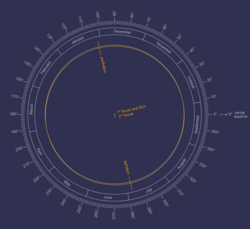
Every year, our planet embarks on a massive journey through space, traveling approximately 940 million kilometers (584 million miles) to complete a single revolution around the Sun. This movement, known as Earth's orbit, is not a perfect circle but an ellipse—an elongated oval shape. Because the eccentricity (the measure of how much an orbit deviates from a perfect circle) is only 0.0167, the orbit is nearly circular, keeping the center of the orbit relatively close to the center of the Sun.

As viewed from above the Northern Hemisphere, Earth moves in a counterclockwise direction. This orbital path maintains an average distance of 149.60 million kilometers (92.96 million miles) from the Sun, a distance that takes light about 8.317 minutes to traverse.
The Mechanics of Orbital Motion
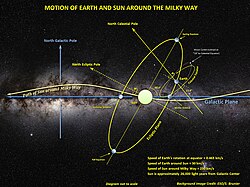
Earth's speed through space is staggering. It maintains an average orbital speed of 29.78 km/s (107,208 km/h). To put this velocity into perspective, Earth could cover its own diameter in just 7 minutes or reach the distance to the Moon in approximately 4 hours. This constant motion causes the Sun to appear to move eastward against the background of stars at a rate of about 1° per solar day.

The specific direction in which Earth is pointed during its solar orbit at any given moment is referred to as the apex of the Earth's way. Furthermore, Earth's gravitational reach is defined by its Hill sphere—a region with a radius of about 1,500,000 kilometers. Within this sphere, Earth's gravity is the dominant force, allowing it to hold onto objects like the Moon.

From Geocentrism to Heliocentrism
The way we understand our place in the solar system has changed dramatically over history. For centuries, the geocentric model placed Earth at the center of the universe. This was eventually challenged by heliocentrism, the scientific model that places the Sun at the center, with Earth and other planets orbiting it.
While Aristarchus of Samos proposed heliocentric ideas as early as the third century BC, it was Nicolaus Copernicus in the 16th century who provided a comprehensive discussion of the model. This "Copernican Revolution" successfully explained the apparent retrograde motion of planets—the phenomenon where planets seem to move backward in the sky—by demonstrating that such motion is merely a perspective effect caused by Earth's own movement.
Why We Experience Seasons
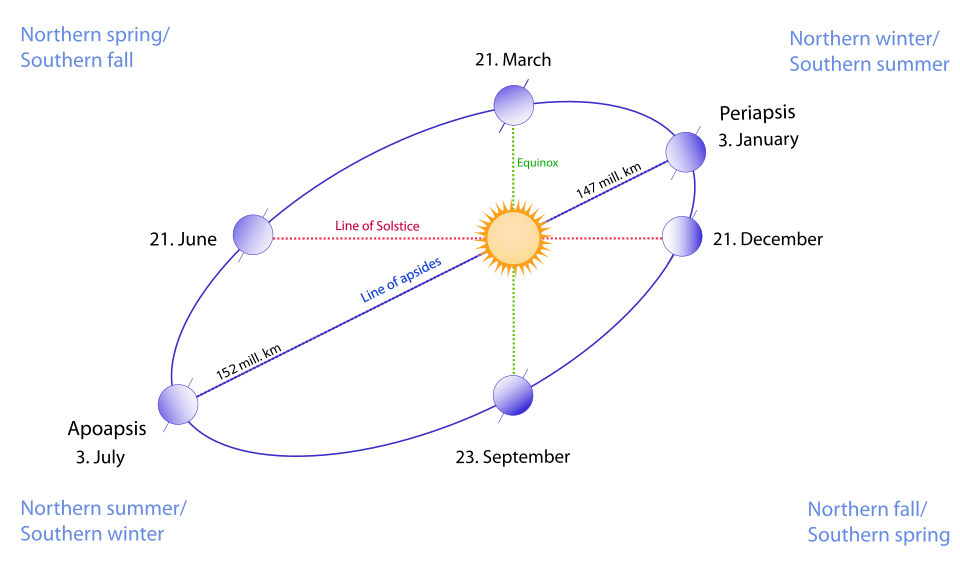
A common misconception is that seasons are caused by the distance between the Earth and the Sun. In reality, seasons are driven by Earth's axial tilt, also known as the obliquity of the ecliptic. As Earth orbits, this tilt causes different parts of the planet to receive varying amounts of solar radiation throughout the year.
The Role of Solstices and Equinoxes
Astronomers divide the year into four parts using specific orbital points:
- Solstices: The two points where the Earth's axial tilt is at its maximum toward or away from the Sun.
- Equinoxes: The two points where the Earth's tilted axis is perpendicular to the line connecting the Earth and the Sun.
In the Northern Hemisphere, the summer solstice occurs near June 21, while the winter solstice occurs near December 21. The spring and autumnal equinoxes occur around March 20 and September 23, respectively. Because of the tilt, the seasons in the Southern Hemisphere are the exact opposite of those in the Northern Hemisphere.
Distance vs. Tilt: Perihelion and Aphelion
While tilt dictates the seasons, the Earth's distance from the Sun does fluctuate. The point where Earth is closest to the Sun is called perihelion (occurring around January 3), and the farthest point is aphelion (occurring around July 4). Interestingly, Earth is actually closest to the Sun during the Northern Hemisphere's winter. This distance change results in a 7% difference in total solar energy reaching Earth, but the effect of the axial tilt remains the primary driver of seasonal weather patterns.
Key Facts
- Average Orbital Speed: 29.78 km/s (107,208 km/h).
- Orbital Period: 365.256 days (one sidereal year).
- Average Distance to Sun: 149.60 million km (92.96 million miles).
- Orbital Shape: Ellipse with an eccentricity of 0.0167.
- Primary Cause of Seasons: Earth's axial tilt (obliquity).
- Hill Sphere Radius: Approximately 1,500,000 km.
Orbital Data Summary
| Parameter | Value (Metric) | Value (Imperial/Other) |
|---|---|---|
| Semimajor Axis | 149.60 × 10⁶ km | 92.96 × 10⁶ mi |
| Perihelion | 147.10 × 10⁶ km | 0.98329 AU |
| Aphelion | 152.10 × 10⁶ km | 1.0167 AU |
| Eccentricity | 0.0167086 | N/A |
| Average Speed | 29.78 km/s | 107,208 km/h |
The Future of Earth's Orbit
For a long time, mathematicians sought to prove the long-term stability of the Solar System. While many models suggest Earth's orbit will remain relatively stable for long periods, modern research has introduced complexity. In 1989, Jacques Laskar's work suggested that the orbits of the inner planets can become chaotic. He noted that even a tiny error in measuring Earth's current position—as small as 15 meters—would make it impossible to accurately predict Earth's exact orbital position in more than 100 million years.
Frequently Asked Questions
Does being closer to the Sun make it summer?
No. Earth reaches perihelion (its closest point to the Sun) in early January, which is winter for the Northern Hemisphere. Seasons are caused by the Earth's axial tilt, not its distance from the Sun.
What is the difference between a solstice and an equinox?
A solstice occurs when the Earth's tilt toward or away from the Sun is at its maximum. An equinox occurs when the tilt is perpendicular to the Sun's rays, resulting in nearly equal day and night lengths.
What is the Hill sphere?
The Hill sphere is the region of space around Earth where its gravity is stronger than the gravity of the Sun. It defines the zone within which Earth can successfully hold onto moons and other orbiting objects.
Why do the seasons reverse between hemispheres?
Because the Earth is tilted on its axis, when the Northern Hemisphere is tilted toward the Sun, the Southern Hemisphere is tilted away. This results in summer in the north and winter in the south simultaneously.
Is Earth's orbit a perfect circle?
No, Earth's orbit is an ellipse. However, because its eccentricity is very low (0.0167), it is very close to being a circle.