Dürer's Rhinoceros: The Woodcut That Defined a Species
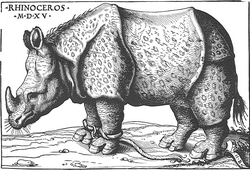
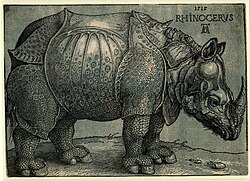
In 1515, a creature arrived in Lisbon that sparked a sensation across Europe. It was an Indian rhinoceros, the first living specimen seen on the continent since the days of the Roman Empire. While the artist Albrecht Dürer never laid eyes on the animal himself, he created a woodcut—a relief printing technique where a design is carved into a block of wood—that would dictate the visual identity of the rhinoceros for nearly three centuries.
Dürer's work is a fascinating study in how information traveled in the Renaissance. Based on a written description and a rudimentary sketch, the image became a definitive reference, blending biological observation with artistic imagination and classical lore.
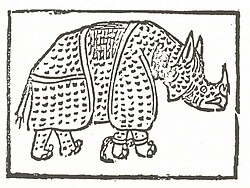
The Journey of Ulysses the Rhinoceros
The animal, named Ulysses, was a diplomatic gift from Sultan Muzaffar Shah II of Cambay (modern Gujarat) to Afonso de Albuquerque, the governor of Portuguese India. Albuquerque forwarded the rhinoceros and its keeper, Ocem, to King Manuel I of Portugal. The animal traveled aboard the Nossa Senhora da Ajuda, arriving in Lisbon on May 20, 1515, after a 120-day voyage.
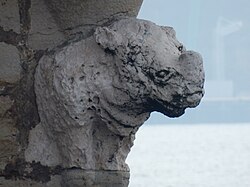
The arrival caused an immediate stir. Scholars and curious citizens flocked to see the beast, and letters describing the "fantastic creature" spread rapidly. The animal's presence even left a permanent mark on Portuguese architecture; the Belém Tower was later decorated with gargoyles shaped like rhinoceros heads.
A Royal Rivalry and a Tragic End
King Manuel I, eager to test the writings of Pliny the Elder—who claimed that elephants and rhinoceroses were bitter enemies—arranged a fight between Ulysses and a young elephant. However, the elephant fled in panic before any combat occurred.
Seeking to maintain papal grants for his explorations in the Far East, King Manuel gifted the rhinoceros to Pope Leo X in December 1515. Tragically, the ship wrecked during a storm near Porto Venere. Chained to the deck, the rhinoceros drowned. While its hide was recovered and stuffed, the living sensation ended there, though the animal appeared in contemporary works by Raphael and Giovanni da Udine.
!["Creation of the animals" by Raphael, 1518–1519, a fresco on the second floor of the Palazzi Pontifici in the Vatican. A rhinoceros appears to the right of the tree, with an elephant [possibly Hanno] to the left.](/images/d1/5b/d15b94a4dbda56f1b4676a02f6e9480750305a89b49b5bd94d671a7cf47f087c.jpg)
The Creation of the Iconic Woodcut
Dürer created his image in Nuremberg after receiving a letter and a sketch from Lisbon. He translated these sources into a pen-and-ink drawing, which was then carved into a woodblock by a specialist craftsman known as a Formschneider.
![Preparatory study for the rhinoceros print by Albrecht Dürer, 1515 (British Museum: SL,5218.161 ). The inscription bears an incorrect date (1513) for the arrival of the rhinoceros in Lisbon, which actually occurred in 1515.[19]](/images/df/48/df4850a4f370576c830a6bf748c986a1bae3b7c5bab441f9386891cef9fa8bc1.jpg)
The resulting print included a German inscription that mirrored Pliny's accounts, describing the rhinoceros as the "mortal enemy of the elephant" and claiming it was almost invulnerable, with skin like a speckled tortoise. Dürer added imaginative details, such as armor-like plates and a small extra horn on its back, which were not biologically accurate but gave the creature a powerful, imposing presence.
Competing Visions: Dürer vs. Burgkmair
Dürer was not the only artist to tackle the subject. Hans Burgkmair also produced a woodcut around 1515. Burgkmair's version was more realistic, omitting the fanciful armor and including the actual shackles used to restrain the animal. Despite this accuracy, Dürer's more dramatic and powerful composition eclipsed Burgkmair's in popularity.
Legacy and Influence in Art and Science
For over 250 years, Dürer's rhinoceros was accepted as a true representation. It was used as an emblem by Alessandro de' Medici and influenced sculptures in Paris and the bronze doors of the Pisa Cathedral.
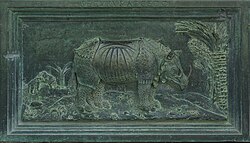
The image's dominance only began to fade in the mid-18th century. The arrival of Clara the rhinoceros, who toured Europe in the 1740s and 1750s, allowed artists like Jean-Baptiste Oudry and George Stubbs to produce life-size, accurate portraits. By 1790, explorer James Bruce dismissed Dürer's work as "wonderfully ill-executed," though he noted that the image had fundamentally skewed the public's perception of the animal.
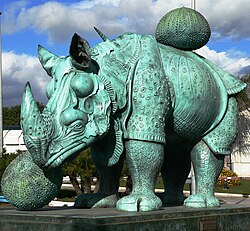
Even in the 20th century, the woodcut's influence persisted, serving as a direct inspiration for the surrealist works of Salvador Dalí.
Key Facts
- Artist: Albrecht Dürer (1515).
- Source: Based on a written description and sketch; Dürer never saw the animal.
- Subject: An Indian rhinoceros named Ulysses.
- Impact: Regarded as an accurate representation until the late 18th century.
- Fate of the Animal: Drowned in a shipwreck off the coast of Italy while being transported to Pope Leo X.
- Market Value: A first-edition print sold for $866,500 at Christie's in 2013.
| Attribute | Details |
|---|---|
| Year Created | 1515 |
| Medium | Woodcut |
| Dimensions | 23.5 cm × 29.8 cm |
| Primary Influence | Pliny the Elder's accounts |
| Successor Images | Portraits of Clara the rhinoceros (1740s) |
Frequently Asked Questions
Did Albrecht Dürer ever see the rhinoceros?
No, Dürer never saw the actual animal. He based his woodcut on a sketch and a written description sent to him in Nuremberg from Lisbon.
Why is the image considered inaccurate?
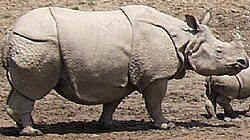
Dürer included fanciful elements, such as armor-like plates and a small horn on the animal's back, which do not exist on a real Indian rhinoceros.
What happened to the rhinoceros that inspired the print?
The rhinoceros, named Ulysses, drowned in a shipwreck near Porto Venere, Italy, while being transported as a gift from King Manuel I to Pope Leo X.
How long did the public believe Dürer's image was real?
The woodcut was regarded as a true representation of a rhinoceros into the late 18th century, before more live specimens were brought to Europe and painted accurately.
Who was the other artist that drew the rhinoceros in 1515?
Hans Burgkmair also created a woodcut of the rhinoceros. His version was more biologically accurate than Dürer's, but it never achieved the same level of fame.