Nuremberg Chronicle: The Masterpiece of Early Printing
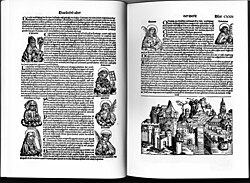
The Nuremberg Chronicle stands as one of the most ambitious publishing projects of the late 15th century. An illustrated encyclopedia of world history, it blends biblical narratives with secular accounts, mythological creatures, and detailed histories of ancient cities. Completed in 1493, this work is a premier example of an incunabulum—a term used to describe books printed using movable type before the year 1501.
Depending on the language, the work is known by different names. Latin scholars call it the Liber Chronicarum ('Book of Chronicles'), while German speakers refer to it as Schedelsche Weltchronik ('Schedel's chronicle of the world') in honor of its author. In English, it is most commonly known as the Nuremberg Chronicle, named after the city where it was produced.
Key Facts
- Author: Hartmann Schedel, a physician and humanist.
- Publication Date: July 12, 1493 (Latin); December 23, 1493 (German).
- Illustrations: 1,809 woodcuts (645 original blocks).
- Printer: Anton Koberger, one of Germany's most successful early publishers.
- Structure: Divided into seven ages of world history.
- Format: Large folio size, measuring 18 by 12 inches.
Production and Authorship
The creation of the Chronicle was a massive financial and artistic undertaking. It was commissioned on December 29, 1491, by two Nuremberg merchants, Sebald Schreyer and his son-in-law Sebastian Kammermeister. They provided an advance of 1,000 gulden to cover paper, printing, and distribution costs.
The text was composed by Hartmann Schedel, a medical doctor and dedicated book collector. Schedel utilized his vast personal library—which included 370 manuscripts and 670 printed books—to compile the work. It is estimated that approximately 90% of the text was synthesized from existing works on theology, philosophy, science, and humanities, with only 10% being Schedel's original composition. He relied heavily on the Supplementum Chronicarum by Giacomo Filippo Foresti.
The production took place in Nuremberg, a major center of northern humanism and one of the largest cities in the Holy Roman Empire. The city's Council strictly regulated craft activities, ensuring high quality in the printing process managed by Anton Koberger.
The Art of the Woodcut
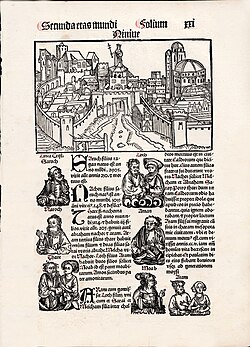
The Chronicle is renowned for its integration of text and imagery. The illustrations were provided by the workshop of Michael Wolgemut and his stepson Wilhelm Pleydenwurff. They employed specialist craftsmen known as formschneiders to carve the designs into woodblocks.
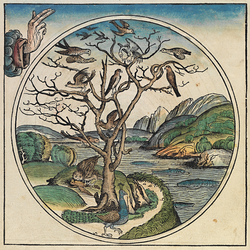
A point of historical interest is the involvement of Albrecht Dürer, who was an apprentice to Wolgemut from 1486 to 1489. While some experts attribute certain woodcuts to Dürer, there is no academic consensus because the artists did not sign their work in the Chronicle.
To manage the scale of the project, the illustrators used 645 original woodcuts, many of which were reused multiple times throughout the book with updated text labels. For example, a generic image of a king or a battle might appear in several different chapters. However, the city of Nuremberg was given a unique double-page illustration without text.
Hand-Coloring and Piracy
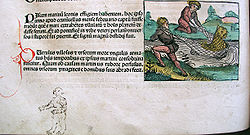
While the books were printed in black and white, many copies were later hand-tinted in watercolor by specialist shops. Some of these illustrations were even sold separately as individual prints.
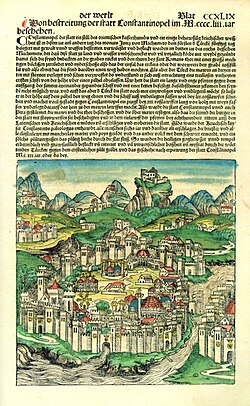
The book's immense success led to one of the first large-scale instances of literary piracy. Johann Schönsperger of Augsburg produced unauthorized editions between 1496 and 1500, capitalizing on the Chronicle's prestige without the consent of the original publisher.
Contents and Structure
The Chronicle organizes human and divine history into seven distinct ages:
- First Age: From the creation of the world to the Deluge.
- Second Age: Up to the birth of Abraham.
- Third Age: Up to King David.
- Fourth Age: Up to the Babylonian captivity.
- Fifth Age: Up to the birth of Jesus Christ.
- Sixth Age: From the birth of Christ to the author's present time (the most extensive section).
- Seventh Age: A vision of the end of the world and the Last Judgment.
![Woodcut from 1493 depicting the burning of Jews in the 14th century, today in the Jewish Museum of Switzerland in Basel[2]](/images/e5/fc/e5fc577084b516fdadb86053dd71a0264c2f957494be50e52c10243c5b1f3b36.jpg)
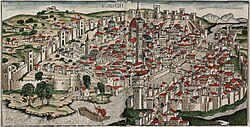
The work also includes detailed views of European and Near Eastern cities, some adapted from existing engravings, such as the view of Florence adapted from Francesco Rosselli.
Summary of the Nuremberg Chronicle
| Feature | Details |
|---|---|
| Original Title | Liber Chronicarum |
| Languages | Latin and German |
| Total Pages | 336 |
| Print Run | ~1,400-1,500 (Latin); ~700-1,000 (German) |
| Survival Rate | ~400 (Latin); ~300 (German) copies remaining |
| Illustrations | 1,809 total woodcuts |
Frequently Asked Questions
Who wrote the Nuremberg Chronicle?
The text was written by Hartmann Schedel, a humanist and medical doctor who lived in Nuremberg. He compiled the majority of the content from existing classical and medieval sources.
Did Albrecht Dürer illustrate the book?
Dürer was an apprentice in Michael Wolgemut's workshop during the early stages of the project. While it is possible he contributed to some designs, there is no definitive proof or consensus among art historians because the works were unsigned.
What is an incunabulum?
An incunabulum is a book printed using movable type during the earliest stages of printing, specifically those produced before the year 1501.
How were the illustrations produced?
The images were created using woodcuts. Designs were drawn onto woodblocks, which were then carved by specialist craftsmen called formschneiders. These blocks were then inked and pressed onto the paper.
Why are some copies of the Chronicle colored?
The books were originally printed in black and white, but many were later hand-colored with watercolors. This was often done by professional coloring shops or added by owners at a later date.