Albrecht Dürer: The Master of the Northern Renaissance
Albrecht Dürer (1471–1528) stands as one of the most influential figures of the Northern Renaissance. A polymath of the arts, Dürer was not only a master painter and printmaker but also a dedicated theorist who bridged the gap between the detailed naturalism of the North and the classical ideals of the Italian Renaissance. Born and based in the Free Imperial City of Nuremberg, his work achieved pan-European fame during his lifetime, largely due to the reproducibility and high quality of his prints.
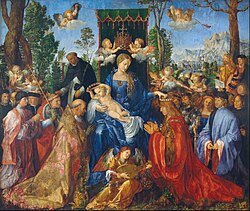
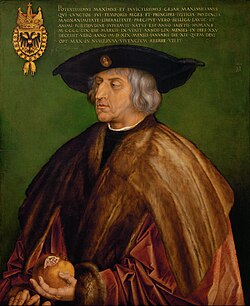
Dürer's career was marked by a relentless pursuit of technical perfection and intellectual depth. He maintained correspondence with the greatest minds of his era, including Erasmus, and was influenced by Italian masters such as Raphael, Giovanni Bellini, and Leonardo da Vinci. From 1512 onward, he enjoyed the prestigious patronage of Emperor Maximilian I, further cementing his status as the preeminent artist of the German-speaking world.
Key Facts
- Born: May 21, 1471, in Nuremberg, Holy Roman Empire.
- Died: April 6, 1528, in Nuremberg, aged 56.
- Specialties: Painting, printmaking (woodcuts and engravings), and art theory.
- Major Contribution: Blended German detail with Italian classical form and perspective.
- Notable Patron: Emperor Maximilian I.
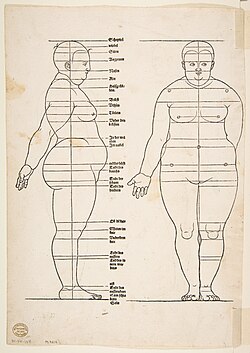
- Key Theoretical Works: The Four Books on Measurement and The Four Books on Human Proportion.
Early Life and the Wanderjahre
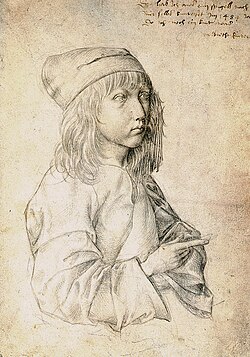
After completing his initial apprenticeship, Dürer embarked on his Wanderjahre—a traditional German custom of "gap years" where an apprentice traveled to learn diverse styles and techniques from other masters. Between 1490 and 1494, Dürer traveled through Frankfurt, the Netherlands, and Colmar. In Colmar, he connected with the family of Martin Schongauer, the leading engraver of Northern Europe.
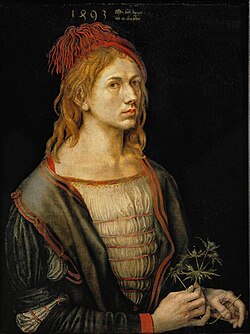
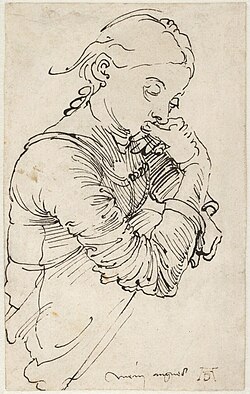
During his time in Strasbourg in 1493, Dürer was exposed to the sculpture of Nikolaus Gerhaert. It was during this formative period that he created his first painted self-portrait, intended for his fiancée back in Nuremberg.
The Rise of a Printmaking Giant
Upon returning to Nuremberg, Dürer revolutionized the medium of the print. Unlike many of his contemporaries, he treated woodcuts and engravings as independent works of art rather than mere illustrations. In 1498, he produced his celebrated series of sixteen designs for the Apocalypse and the engraving St. Michael Fighting the Dragon.
His mastery extended to nature and the human form. Between 1502 and 1503, he produced hyper-realistic watercolors, including the Young Hare and the Great Piece of Turf. His 1504 copper engraving Adam and Eve remains a landmark study in human proportion and classical beauty.
Masterworks and Intellectual Pursuits
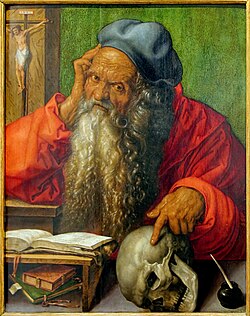
As Dürer matured, his work became increasingly theoretical. Between 1513 and 1514, he created three of his most famous engravings: Knight, Death and the Devil, St. Jerome in His Study, and the enigmatic Melencolia I. During this period, he briefly pivoted away from painting, noting that prints were more financially viable.
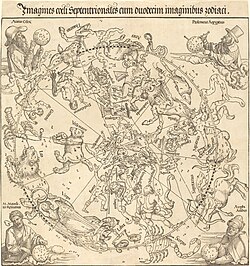
Dürer's curiosity extended to science and cartography. In 1515, he produced a famous woodcut of a rhinoceros based on a written description, despite never having seen the animal. He also created the first western printed star charts in 1515, demonstrating his skill in combining art with astronomical data.
Later Years and Theoretical Legacy
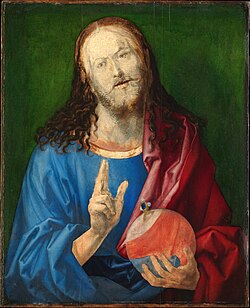
In his final decade, Dürer's output as a painter slowed, though he produced significant works such as the Salvator Mundi and The Four Apostles, the latter of which he gifted to the City of Nuremberg. His interests shifted toward the intellectualization of art. He authored The Four Books on Measurement (1525), the first mathematics book for adults written in German, which was later cited by Galileo and Kepler.
Dürer's relationship with the Reformation was complex. Some scholars suggest his 1523 woodcut of The Last Supper reflects Protestant sympathies, particularly through its focus on the Gospel and the Eucharistic cup. In his final years, he questioned the role of religious imagery, reflecting the broader theological shifts of the era.
Summary of Dürer's Artistic Contributions
| Category | Notable Examples | Key Significance |
|---|---|---|
| Printmaking | Apocalypse series, Adam and Eve | Elevated prints to high art; mastered copper engraving. |
| Painting | The Four Apostles, Self-Portraits | Integrated Italian perspective with Northern detail. |
| Theory | Four Books on Human Proportion | Systematized the study of human anatomy and geometry. |
| Science | Celestial Globe, Rhinoceros | Early fusion of artistic rendering and scientific observation. |
Frequently Asked Questions
Did Albrecht Dürer ever visit Italy?
Yes, Dürer made two journeys to Italy (1494–1495 and 1505–1507). These trips were crucial to his development, as they allowed him to study the works of Italian masters and learn the principles of linear perspective and classical proportion.
Why is Dürer's rhinoceros famous?
The rhinoceros woodcut is famous because it was based on a written description and a sketch rather than direct observation. Despite this, the image was so powerful and convincing that it was used in German science textbooks for centuries.
What were the Wanderjahre?
The Wanderjahre were traditional "gap years" for German apprentices. Dürer spent about four years traveling between 1490 and 1494 to learn different regional styles and techniques from various masters across Europe.
How did Dürer influence later artists?
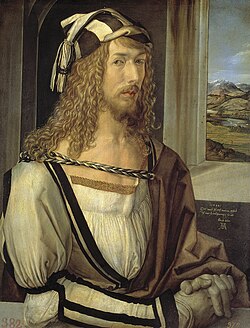
Dürer's influence is most evident in his self-portraits, which introduced a level of psychological depth and drama that inspired 19th and 20th-century painters. He also left a lasting legacy in the fields of mathematics and human proportion.
Was Dürer a Protestant?
While not an iconoclast, Dürer's later works, such as The Last Supper (1523), are often interpreted as showing Protestant sympathies and a questioning of the traditional role of saints in religious art.