Albertina: A Journey Through Vienna's Premier Art Museum
Located in the heart of the Innere Stadt (First District) of Vienna, Austria, the Albertina stands as one of the world's most prestigious art institutions. From its origins as a defensive fortification to its current status as a global cultural hub, the museum offers an unparalleled look at the evolution of graphic arts and modern masterpieces.
A World-Class Collection of Art and Graphics
The Albertina is most renowned for housing one of the largest and most significant print rooms in existence. This collection is a treasure trove for historians and art lovers alike, containing approximately 1 million old master prints—works created by the great artists of the past—and roughly 65,000 drawings. Beyond these, the museum preserves a vast array of architectural drawings, photographs, and modern graphic works.
In addition to its legendary print room, the museum features two significant collections of Impressionist and early 20th-century art on permanent loan. The institution continues to grow, notably acquiring the Essl Collection in 2018, which added 1,323 contemporary artworks by influential artists such as Cindy Sherman, Georg Baselitz, Maria Lassnig, Alex Katz, and Hermann Nitsch.
Masterpieces on Display
Visitors to the Albertina can encounter some of the most famous works in art history, including:
- Leonardo da Vinci: Study for the Last Supper (c. 1495)
- Albrecht Dürer: Young Hare (1502)
- Pieter Bruegel the Elder: The Painter and The Buyer (1565)
- Claude Monet: The Water Lily Pond (c. 1917–1919) and House Among the Roses (c. 1918)
- Henri de Toulouse-Lautrec: The White Horse "Gazelle" (1881)
The History of the Albertina: From Bastion to Palace
The museum's physical history is as rich as its art. The site was originally part of the Augustinian Bastion, one of the final remaining sections of Vienna's city fortifications (defensive walls). In the second half of the 17th century, it served as the Hofbauamt, or Court Construction Office.
In 1744, Emanuel Teles Count Silva-Tarouca refurbished the building into his private residence, known as the Palais Taroucca. It was later acquired by Albert Casimir, Duke of Teschen, who transformed the palace into his home and brought his extensive graphics collection from Brussels. The collection was further developed with the help of Count Giacomo Durazzo, the Austrian ambassador in Venice, who in 1776 presented nearly 1,000 pieces of art to the Duke and his wife, Maria Christina.
Over the following century, the building underwent several modifications, including interior decorations by Joseph Kornhäusel in the 1820s. By the time Archduke Albrecht, Duke of Teschen, resided there until 1895, the building was known as the Palais Erzherzog Albrecht.
Transition to a Public Institution
The 20th century brought dramatic changes to the museum. In early 1919, the new socialist government of Austria confiscated the building and the collection from Archduke Friedrich. By 1920, the prints and drawings were merged with the collection of the former Imperial court library, and the institution was officially renamed The Albertina in 1921.
The museum's history also includes a dark chapter during the Nazi era. Following the Anschluss (the 1938 merger of Austria into Nazi Germany), artworks stolen from Jewish collectors entered the collection. The Albertina continues to conduct provenance research to identify and restitute these stolen works.
Physical devastation occurred in March 1945, when USAAF bomb attacks heavily damaged the structure. The building was rebuilt in the post-war years and underwent a comprehensive modernization between 1998 and 2003. A distinctive roof designed by architect Hans Hollein was completed in 2008, marking the final reopening of the graphics collection.
Modern Expansions and Global Reach
The Albertina has recently expanded its footprint to better showcase modern and contemporary art. On May 27, 2020, Albertina modern opened as a dedicated museum for modern art, featuring over 60,000 works by 5,000 different artists.
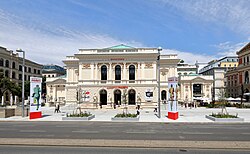
Furthering this expansion, the Albertina Klosterneuburg opened in April 2024, focusing on works created after 1945.
These expansions have helped the museum maintain its global appeal. In 2025, the Albertina welcomed 1,037,347 visitors, ranking it 74th among the most-visited art museums in the world.
Visitor Summary and Essential Information
For those planning a visit to this Viennese landmark, the following table provides a quick overview of the museum's key details.
| Category | Details |
|---|---|
| Location | Albertinaplatz 1, Vienna, Austria |
| Founder | Duke Albert Casimir |
| Established | 1805 |
| Current Director | Ralph Gleis |
| 2025 Visitor Count | 1,037,347 |
| Primary Collections | Old Master prints, drawings, Impressionist art, and contemporary works |
| Public Transit | U1, U2, U4 (Karlsplatz) |
| Parking | Operngarage |