Distillation: Principles, History, and Industrial Applications
Distillation, also known as classical distillation, is a fundamental separation process used to isolate the component substances of a liquid mixture. By utilizing selective boiling and the subsequent condensation of vapors in a still, this process separates two or more chemically discrete substances based on their different boiling points.
The mechanism relies on relative volatility—the tendency of a substance to vaporize. Distillation is highly versatile, operating across a vast range of pressures, from 0.14 bar (used for ethylbenzene/styrene) to nearly 21 bar (used for propylene/propane). While it is a time-tested solution for achieving high purity in chemical production, it carries a significant environmental footprint, accounting for approximately 25% of all industrial energy consumption due to the high energy requirements of phase changes.
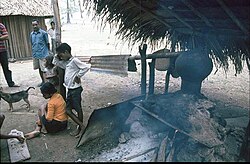
Beyond liquid mixtures, dry distillation (including thermolysis and pyrolysis) involves heating solid materials to produce gases that condense into fluid or solid products. This category includes destructive distillation and chemical cracking, where large hydrocarbon molecules are broken down into smaller ones.
Key Facts
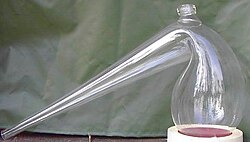
- Core Mechanism: Separates components based on differences in relative volatility and boiling points.
- Energy Impact: Consumes roughly 25% of total industrial energy globally.
- Pressure Range: Operates from as low as 0.14 bar to as high as 21 bar.
- Versatility: Capable of separating feeds with relative volatilities ranging from 1.17 to 81.2.
- Industrial Scale: Towers can reach heights of 90 meters and diameters of 16 meters.
The Evolution of Distillation
Ancient and Classical Origins
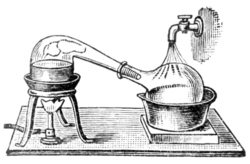
The roots of distillation stretch back to antiquity. Aristotle observed that water condensing from evaporating seawater becomes fresh. Early evidence of perfumery operations using distillation appears in Akkadian tablets dating to approximately 1200 B.C. In the 3rd century, alchemists like Zosimos of Panopolis utilized early distillation equipment.
![Distillation equipment used by the 3rd-century alchemist Zosimos of Panopolis[13][14] (as imagined by the anonymous illustrator of the 15th-century Byzantine Greek manuscript Codex Parisinus graecus 2327).[15]](/images/14/37/1437e5cb627727a8b1e800e4f0cbfc076ca93a38a76614d75b5c4d756dde5d4e.jpg)
The Islamic Golden Age
Medieval Muslim chemists significantly advanced the science. Figures such as Abū Bakr al-Rāzī (Rhazes) and Jābir ibn Ḥayyān (Geber) experimented extensively with various substances. Jābir's work on the fractional distillation of organic, animal, and vegetable substances became a primary source for later Western scholars like Roger Bacon. Furthermore, the distillation of wine to produce aqua ardens (ethanol) was documented by al-Kindī and al-Fārābī.
Developments in Asia and Europe
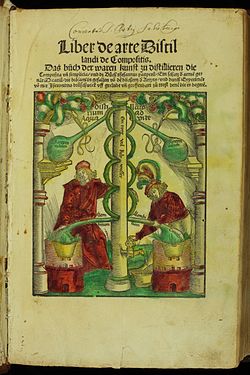
In China, archaeological evidence from the 12th century in Hebei province indicates the distillation of beverages during the Southern Song and Jin dynasties. In Europe, the 16th century saw the publication of the first dedicated text on the subject, Liber de arte distillandi de simplicibus (1500), by Hieronymus Brunschwig.
The Rise of Modern Chemical Engineering
The 19th century introduced critical technical improvements, including reflux and pre-heating. Aeneas Coffey's patented continuous still (1830) served as the archetype for modern petrochemical units. By the 20th century, the petroleum industry drove the creation of scientific design methods, such as the Fenske equation and the McCabe–Thiele method. The integration of powerful computers eventually allowed for the numerical simulation of complex distillation columns.
Types of Distillation Processes
Laboratory-Scale Methods
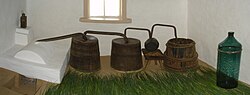
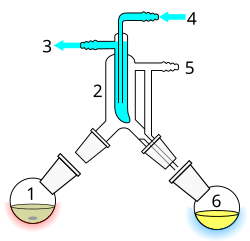
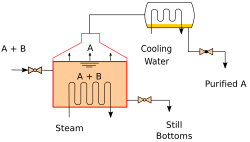
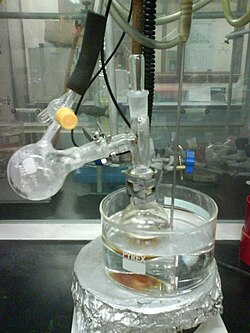
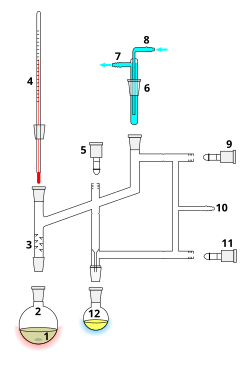
In a laboratory setting, simple distillation involves heating a liquid in a boiling flask, passing the vapor through a condenser (such as a Liebig condenser), and collecting the distillate in a receiving flask.
![Laboratory model of a still.1: The heat source to boil the mixture2: round-bottom flask containing the mixture to be boiled3: the head of the still4: mixture boiling-point thermometer5: the condenser of the still6: the cooling-water inlet of the condenser7: the cooling-water outlet of the condenser8: the distillate-receiving flask9: vacuum pump and gas inlet10: the receiver of the still11: the heat control for heating the mixture12: stirring mechanism speed control13: stirring mechanism and heating plate14: heating bath (oil/sand) for the flask15: the stirring mechanism (not shown, e.g. boiling chips or mechanical stirring machine)16: the distillate-cooling water bath.[1]: 141–143](/images/f1/5d/f15deae9ea1e6eda58df254787c7160916bb367465c32515ec4286e2471ba274.webp)
Other specialized laboratory techniques include:
- Fractional Distillation: Uses a fractionating column to achieve higher purity.
- Vacuum Distillation: Lowers the boiling point of substances to prevent thermal degradation. For example, dimethyl sulfoxide boils at 189 °C normally, but only 70 °C under vacuum.
- Steam Distillation: Used for temperature-sensitive materials.
- Short-path Distillation: Minimizes the distance the vapor travels to reduce loss.
Industrial-Scale Distillation
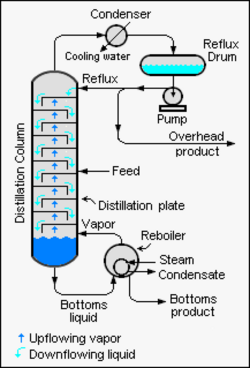
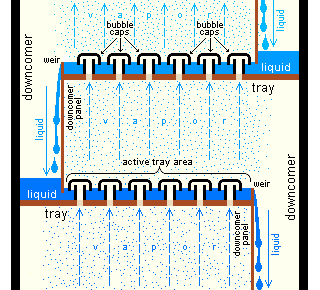
Industrial processes typically employ massive vertical cylindrical columns known as distillation towers. These towers use trays with bubble caps or packing materials to facilitate the separation of components.
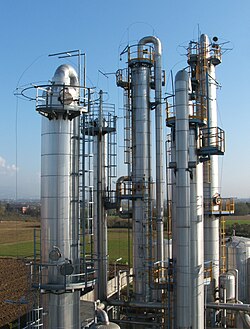
In crude oil refining, liquid outlets are placed at various intervals up the column. The "lightest" products (lowest boiling point) exit from the top, while the "heaviest" products (highest boiling point), known as the bottoms, exit from the base.
Summary of Distillation Methods
| Method | Primary Characteristic | Typical Application |
|---|---|---|
| Simple | Single vaporization/condensation cycle | Basic solvent separation |
| Fractional | Uses a column for repeated cycles | Petroleum refining, high-purity chemicals |
| Vacuum | Reduced pressure to lower boiling point | Heat-sensitive organic compounds |
| Dry | Heating solids to produce gas | Chemical cracking, pyrolysis |
| Steam | Introduction of steam to lower boiling point | Fragrance and essential oil extraction |
Frequently Asked Questions
![Large-scale, industrial vacuum distillation column[51]](/images/28/e8/28e8f11b2fd5cd3eddea411c8f198e97b250d6e9d2aa7014b9b4e5ad29f28dbc.jpg)
What is the difference between simple and fractional distillation?
Simple distillation is a single-stage process used for mixtures with widely different boiling points. Fractional distillation uses a fractionating column to allow for multiple vaporization-condensation cycles, enabling the separation of components with closer boiling points.
Why is vacuum distillation used?
Vacuum distillation reduces the pressure inside the system, which lowers the boiling point of the liquids. This is essential for substances that would decompose or react if heated to their normal boiling temperature.
What are "bottoms" in industrial distillation?
Bottoms refer to the heaviest components of a mixture—those with the highest boiling points—which do not vaporize and are collected at the bottom of the distillation tower.
How does distillation impact the environment?
Distillation is extremely energy-intensive because it requires significant heat to trigger phase changes (liquid to gas). Consequently, it consumes approximately 25% of all industrial energy use.
What is an azeotrope?
An azeotrope is a mixture of liquids that maintains a constant composition and boiling point during distillation, making it impossible to separate the components further using standard distillation. Specialized techniques like pressure-swing distillation are required to break an azeotrope.