Diet as a Political Assembly: History, Etymology, and Modern Usage
In the realm of politics, a diet is a formal deliberative assembly or legislature. While the word is commonly associated with nutrition in modern English, its political meaning refers to a structured body of representatives who meet to discuss and decide on laws or governance. This term has been applied to historic assemblies, such as the German Imperial Diet, as well as contemporary legislative bodies like the National Diet of Japan.
Key Facts
- A political diet is a formal legislative or deliberative assembly.
- The term is used for the current legislatures of Japan (National Diet) and Germany (Bundestag).
- Historically, it referred to the general assemblies of the Imperial Estates of the Holy Roman Empire.
- The etymology links the word to both "arbitration" and the concept of a "day" of meeting.
- Various European nations, including Sweden, Finland, and Poland, have used the term or its linguistic equivalents for their parliaments.
Etymology and Linguistic Evolution
The origin of the term is complex, sharing roots with the nutritional sense of the word. It likely derives from the Medieval Latin dieta, which meant both a "parliamentary assembly" and a "daily food allowance." This, in turn, may have come from the earlier Latin diaeta, possibly originating from the Greek diathesia (meaning "arbitration") or the Classical Greek diaita (meaning "way of living," "regular food," or "regular daily work").
A shift in meaning occurred through a false etymology in medieval Europe. A change in Latin spelling replaced "ae" with "e," leading people to associate diaeta with the Latin word dies, meaning "day." Consequently, the term began to refer to the specific day on which an assembly met.
This connection to the concept of a "day" is still evident in the German language. The word Tagung means "meeting," and the suffix -tag (meaning "day") is used to denote legislative chambers. Examples include the Bundestag (Federal Diet), the Reichstag (national parliament), and the Landtag (regional assembly).
Historic Uses of the Diet
Historically, the term is most frequently associated with the Imperial Diet assemblies of the Holy Roman Empire. These deliberative bodies met in various cities to conduct the business of the empire.
- Diet of Augsburg
- Diet of Nuremberg
- Diet of Regensburg
- Diet of Speyer
- Diet of Worms
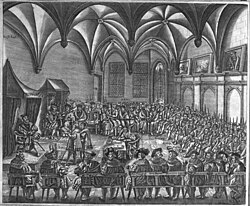
Beyond the Holy Roman Empire, the term has been applied to various other European assemblies. Following the Second Peace of Thorn in 1466, a German-language Prussian Landtag was held in Royal Prussia, a province of Poland. In Croatia, the legislative assembly is called the sabor (from sabrati se, meaning "to assemble"), which is often translated into English as "diet," such as the Diet of Dalmatia or the Croatian Diet.
Other notable historic diets include the Diet of Hungary (called Diéta in the Habsburg Empire before 1848), the Swedish Riksdag of the Estates (which operated from the 15th century until 1866), and the Diet of Finland (1809–1906). Additionally, the Swiss legislature was known as the Tagsatzung (or Diète in French) before being replaced by the Federal Assembly in the mid-19th century, and the Polish–Lithuanian Sejm was occasionally referred to as a diet.
Current Applications of the Term
While less common in general English than in the past, the term remains in active use in several specific contexts:
- National Governance: The National Diet of Japan is the country's primary legislative body. Similarly, the Swedish Riksdag is translated as the "Diet of the Realm," and the German Bundestag is the "Federal Diet."
- Academic Use: In some universities in India and the UK, the term "examination diet" refers to the formal period of exams and the conclusion of an academic term.
- Legal Use: In Scottish legal procedures, courts may order "diets" for specific purposes, such as diets of proof, debate, appeal, or meeting.
| Region/Country | Term Used | English Translation/Equivalent |
|---|---|---|
| Japan | National Diet | Legislative Body |
| Germany | Bundestag / Landtag | Federal Diet / Regional Assembly |
| Sweden | Riksdag | Diet of the Realm |
| Croatia | Sabor | Diet / Assembly |
| Switzerland (Historic) | Tagsatzung | Diet (Diète) |
Frequently Asked Questions
How is a political diet different from a nutritional diet?
While they share a linguistic root in the Latin dieta, a political diet is a formal deliberative assembly or legislature, whereas a nutritional diet refers to the food and drink regularly consumed by a person.
Why is the word "day" linked to the word "diet"?
Due to a false etymology in medieval Europe, the Latin diaeta was associated with dies (day). This led to the belief that the term referred to the specific day an assembly met, a concept preserved in German terms like Bundestag.
Which modern countries still use the term "Diet" for their parliament?
Japan uses the term for its National Diet. Additionally, the parliaments of Germany (Bundestag) and Sweden (Riksdag) are translated into English as "diets."
What were the Imperial Diets of the Holy Roman Empire?
They were general assemblies of the Imperial Estates of the Holy Roman Empire, meeting in cities such as Worms, Augsburg, and Regensburg to deliberate on imperial matters.
Does the term "diet" have any meaning in law or education?
Yes. In Scottish law, a "diet" is a court-ordered date for a meeting, proof, or appeal. In some UK and Indian universities, an "examination diet" refers to the formal exam period at the end of a term.