Alliance 90/The Greens: The Evolution of Germany's Environmentalist Party
Alliance 90/The Greens (German: Bündnis 90/Die Grünen) is a prominent centre-left political party in Germany that has evolved from a grassroots movement into a cornerstone of the nation's governing coalitions. By blending ecological wisdom with social liberalism, the party has become a significant force not only within the German Bundestag but also across the European Union.
The party is currently led by co-leaders Felix Banaszak and Franziska Brantner, with Katharina Dröge and Britta Haßelmann serving as parliamentary leaders. As of February 2025, the party maintains a membership of 166,000, ranking it as the third largest party in Germany by membership.
Key Facts
- Founded: Formed through a merger on May 14, 1993, between The Greens (est. 1980) and Alliance 90 (est. 1990).
- Ideology: Green politics and social liberalism.
- European Role: Founding member of the European Green Party and the largest party in the Greens/EFA group.
- Think Tank: Associated with the Heinrich Böll Foundation.
- Youth Wing: Green Youth.
- Current Status: Holds 85 seats in the Bundestag and 12 seats in the European Parliament.
Historical Foundations and Merger
The origins of the party are rooted in the distinct political landscapes of West and East Germany. The Greens were established in West Germany on January 13, 1980, built upon four primary pillars: ecological wisdom, social justice, grassroots democracy, and nonviolence.
Following German reunification in 1990, the West German Greens merged with the East German Green Party. Simultaneously, Alliance 90 was formed in East Germany on September 21, 1991. These two entities eventually merged on May 14, 1993, to create the unified Alliance 90/The Greens.
The Path to Power
The party's trajectory has been marked by periods of rapid growth and strategic shifts. After entering the Bundestag in 1983, the party spent years in opposition before entering its first term as a governing party from 1998 to 2002 in coalition with the Social Democratic Party (SPD). This was followed by a second term from 2002 to 2005.
Following a period in opposition between 2005 and 2021, the party returned to the federal government in 2021 as part of a "traffic light" coalition with the SPD and the FDP. However, as of 2025, the party has returned to the opposition.
Political Platform and Ideology
Alliance 90/The Greens advocate for a comprehensive overhaul of economic and environmental policies to combat climate change. Their platform emphasizes a transition to renewable energy and a strict stance against nuclear power.
The party's anti-nuclear identity has been a defining characteristic since its inception. This commitment culminated in the permanent shutdown of eight nuclear power reactors on August 6, 2011, following the Fukushima disaster in Japan.
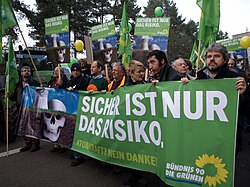
![Eight German nuclear power reactors (Biblis A and B, Brunsbuettel, Isar 1, Kruemmel, Neckarwestheim 1, Philippsburg 1 and Unterweser) were declared permanently shut down on 6 August 2011, following the Japanese Fukushima nuclear disaster.[145]](/images/dc/fa/dcfa84c9137b4dd4846312a5470f9835bc161ab99461a46faf6daeae9030bad7.webp)
Core Policy Areas
- Environment and Climate: Prioritizing carbon neutrality and biodiversity.
- Foreign Policy: A shift toward a "post-pacifist" approach, balancing traditional nonviolence with modern security needs.
- Social Rights: Strong advocacy for women's rights, LGBTQIA+ rights, and the legalization of cannabis.
- European Integration: Pro-European Union stance, working through the European Green Party to implement continent-wide ecological standards.
Electoral Performance
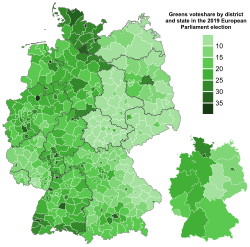
The party's electoral success has varied significantly across different levels of government. In the 2019 European Parliament election, they achieved a historic result, winning 20.5% of the vote and becoming the second largest party in Germany at that time.
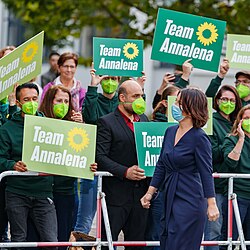
In federal elections, the party saw a significant peak in 2021, securing 118 seats in the Bundestag with 14.7% of the party list vote. By 2025, this number adjusted to 85 seats with 11.6% of the vote.
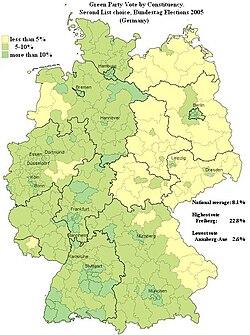
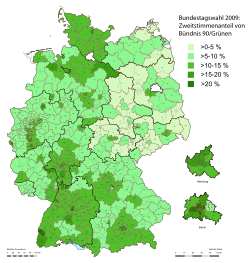
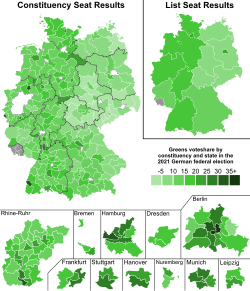
At the state level, the party has seen varying success, notably serving as the leading party in Baden-Württemberg since 2011.
Party Overview Summary
| Attribute | Details |
|---|---|
| Headquarters | Platz vor dem Neuen Tor 1, 10115 Berlin |
| Political Position | Centre-left |
| Bundestag Seats | 85 / 630 |
| European Parliament Seats | 12 / 96 |
| Membership | 166,000 (Feb 2025) |
| International Affiliation | Global Greens / European Green Party |
Frequently Asked Questions
How was Alliance 90/The Greens formed?
The party was created on May 14, 1993, through the merger of The Greens (originally from West Germany) and Alliance 90 (originally from East Germany).
What are the primary goals of the party?
The party focuses on green politics and social liberalism, emphasizing ecological sustainability, social justice, nonviolence, and grassroots democracy.
What is the party's stance on nuclear energy?
The party is strongly anti-nuclear. Their advocacy contributed to the permanent shutdown of several German nuclear reactors in 2011 following the Fukushima disaster.
Which think tank is associated with the party?
The Heinrich Böll Foundation serves as the party's associated think tank.
Who are the current leaders of the party?
As of 2024, the party is led by co-leaders Felix Banaszak and Franziska Brantner.