Claudia Roth: A Legacy of Culture, Human Rights, and Green Politics
Claudia Roth is a prominent figure in German politics, known for her lifelong commitment to human rights, cultural advocacy, and the advancement of Alliance 90/The Greens. From her early days in the artistic world to her high-ranking roles in the German government and the European Parliament, Roth has consistently blended her passion for the arts with a rigorous political agenda.
Throughout her career, she has served in several critical capacities, including as the Federal Government Commissioner for Culture and the Media and as a Vice President of the Bundestag. Her trajectory reflects the evolution of the Green movement in Germany, moving from grassroots activism to a central role in national governance.
Key Facts
- Current Role: Member of the Bundestag (since 2002).
- Government Service: Minister of State in the Chancellery and Federal Commissioner for Culture and the Media (2021–2025).
- Party Leadership: Served as co-leader of Alliance 90/The Greens from 2004 to 2013.
- European Experience: Member of the European Parliament from 1989 to 1998.
- Key Focus Areas: Human rights, anti-death penalty advocacy, and cultural diplomacy.
Early Life and Artistic Roots
Born on May 15, 1955, in Ulm, West Germany, Claudia Roth began her professional journey in the arts. In the 1970s, she worked as a trained artistic director at a theatre in Memmingen, later moving to the municipal theatre in Dortmund and the Hoffmanns-Comic-Teater. Roth viewed her artistic endeavors as inherently political.
Her transition into formal politics began in the mid-1980s. She managed the political rock band "Ton Steine Scherben" until 1985 and subsequently became the press spokesperson for the Green Party's parliamentary group in the Bundestag, marking her entry into the political sphere.
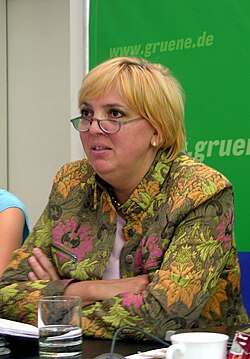
Rise Through European and National Politics
The European Parliament Years
Roth was first elected to the European Parliament in 1989. Her influence grew quickly, and by 1994, she served as the chairperson of the Green Group in the European Parliament. During her tenure, she focused heavily on civil liberties, justice, and home affairs, and served as the deputy chairperson of the EC-Turkey Joint Parliamentary Committee.
Leadership in the Bundestag
Following the 1998 federal election, Roth transitioned to the German Bundestag. She quickly became a leading voice on human rights, serving as the chairperson of the newly established Committee on Human Rights and Humanitarian Aid. Between 2003 and 2004, she held the role of Federal Government Commissioner for Human Rights Policy and Humanitarian Aid under Chancellor Gerhard Schröder.
Roth's leadership within Alliance 90/The Greens was marked by two distinct periods as federal chairperson: first from March 2001 to December 2002, and again from October 2004 to October 2013. Her second term was notably supported by a grassroots social media campaign known as "candystorm," which helped her secure re-election with 88.5 percent backing.
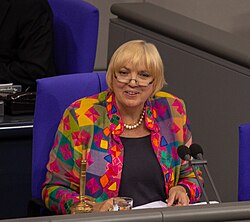
Executive Roles and Parliamentary Leadership
On October 22, 2013, Roth was elected Vice President of the Bundestag. In this role, she became a member of the Council of Elders, which manages the legislative agenda. Her expertise in culture and media was further utilized during the formation of the "traffic light coalition" (SPD, Greens, and FDP) in 2021, where she led her party's working group on cultural affairs.
From December 8, 2021, to May 6, 2025, Roth served as the Minister of State in the Chancellery and the Federal Commissioner for Culture and the Media under Chancellor Olaf Scholz.
| Period | Role | Organization/Body |
|---|---|---|
| 1989–1998 | Member of Parliament (MEP) | European Parliament |
| 1998–2001 | Member of Parliament | German Bundestag |
| 2001–2002; 2004–2013 | Federal Chairperson | Alliance 90/The Greens |
| 2003–2004 | Commissioner for Human Rights | Federal Foreign Office |
| 2013–2021 | Vice President | German Bundestag |
| 2021–2025 | Commissioner for Culture and the Media | Federal Chancellery |
Political Positions and Advocacy
Human Rights and the Death Penalty
Roth is a staunch opponent of capital punishment. In 2008, she urged then-President-elect Barack Obama to push for a global ban on the death penalty, describing it as the "biggest blow against human rights." She has consistently condemned executions in the United States, including those of Troy Davis and the LaGrand brothers.
International Relations and Conflict
Roth's approach to foreign policy is a blend of pacifism and pragmatic intervention. While she criticized the use of cluster bombs in Afghanistan in 2001, she eventually supported German participation in NATO-led security missions (ISAF) and various UN peacekeeping missions in Africa, including Somalia, Mali, and South Sudan.
Regarding Turkey, Roth has been a critical observer of the country's democratic health. She has criticized the erosion of the democratic system under Recep Tayyip Erdoğan and was personally affected by tear gas during the Gezi Park protests in 2013.
Arms Exports and Tibet
Roth has advocated for stricter controls on arms exports, specifically criticizing sales to Saudi Arabia. In 2014, she challenged the government's lack of transparency regarding arms deals before the Federal Constitutional Court. Additionally, she is a dedicated supporter of the Tibet movement and a signatory of the 2015 Paris Declaration regarding China's policies in Tibet.
Recognition and Criticism
For her contributions, Roth has been awarded the Chevalier de la Légion d'Honneur (2004) and the Bavarian Order of Merit (2014). However, her career has not been without controversy. She has faced criticism for her diplomatic engagements with the Islamic Republic of Iran, including a 2013 incident where she greeted the Iranian ambassador with a high five, a gesture criticized by Iranian Kurdish dissidents.
Frequently Asked Questions
What was Claudia Roth's role in the German government under Olaf Scholz?
From December 2021 to May 2025, she served as the Minister of State in the Chancellery and the Federal Commissioner for Culture and the Media.
How did Claudia Roth enter politics?
Roth began in the arts as a theatre director and manager for the band "Ton Steine Scherben." She entered politics in 1985 as the press spokesperson for the Green Party's parliamentary group in the Bundestag.
What is Roth's stance on the death penalty?
She is a fierce opponent of capital punishment, viewing it as a violation of the fundamental right to live and a major blow to human rights.
What was the "candystorm" campaign?
The "candystorm" was a social media support campaign started by fellow party member Volker Beck to encourage the re-election of Claudia Roth as party leader in 2012.
Has Claudia Roth held positions in the European Union?
Yes, she was a Member of the European Parliament from 1989 to 1998 and served as the chairperson of the Green Group from 1994 to 1998.