Social Democratic Party of Germany (SPD)
The Social Democratic Party of Germany (Sozialdemokratische Partei Deutschlands, or SPD) is one of Germany's oldest and most influential political organizations. Positioned as a centre-left party, the SPD has played a pivotal role in shaping the modern German state, evolving from a Marxist-rooted workers' movement into a broad-based Volkspartei (people's party) that appeals to a wide cross-section of the electorate.
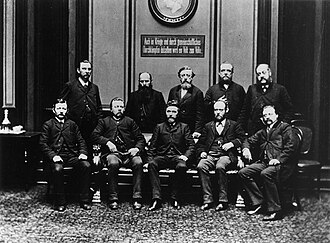
Founded on May 27, 1875, through the merger of the General German Workers' Association (ADAV) and the Social Democratic Workers' Party (SDAP), the SPD has navigated the turbulent waters of Imperial Germany, the Weimar Republic, and the post-war era to remain a cornerstone of European social democracy.
Key Facts
- Founded: May 27, 1875.
- Ideology: Social democracy.
- Political Position: Centre-left.
- Current Leadership: Co-led by Bärbel Bas and Lars Klingbeil.
- European Affiliation: Party of European Socialists (PES).
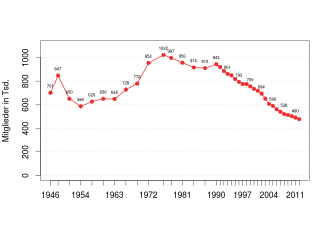
- Membership (2025): 348,451 members.
- Headquarters: Willy-Brandt-Haus, Berlin.
Historical Evolution
From Imperial Germany to the Weimar Republic
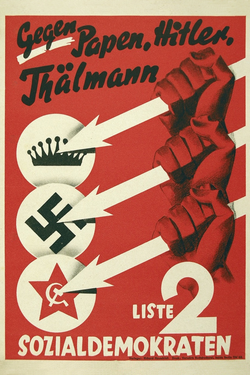
During the Imperial era, the SPD established itself as the primary voice for the working class, becoming the largest party in the Reichstag by 1912. Following World War I, the party was central to the formation of the Weimar Republic, leading various coalition governments. However, the rise of totalitarianism in the 1930s posed an existential threat. The party formed the Iron Front (1931–1933), a paramilitary wing designed to resist the threats of Nazism, Communism, and reactionary conservatism.
Post-War Reconstruction and the Godesberg Program
After 1945, the SPD was re-established in the Western occupation zones. In contrast, in the Soviet zone, the party was forcibly merged with the Communist Party (KPD) to form the Socialist Unity Party of Germany (SED), which ruled East Germany until 1989. In West Germany, the SPD emerged as a major power, though it initially struggled to overcome the dominance of the Christian Democratic Union (CDU).
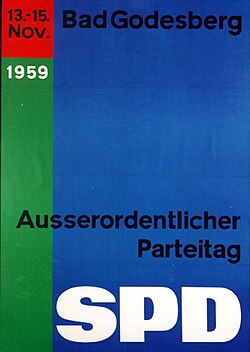
A turning point occurred in 1959 with the Godesberg Program. In this landmark policy shift, the party officially dropped its commitment to Marxism, transitioning from a class-based party to a "big tent" party of the centre-left to attract middle-class voters.
Political Influence and Governance
Federal Leadership
The SPD has provided Germany with several key leaders, including Federal Chancellors such as Willy Brandt, Helmut Schmidt, Gerhard Schröder, and Olaf Scholz. The party's influence extends beyond the Chancellery to the Vice Chancellery and various federal ministries.
Regional and European Presence
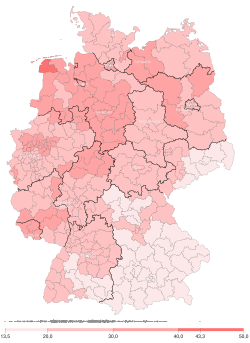
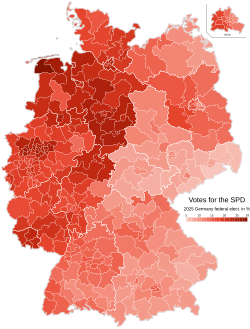
The SPD maintains a strong presence in state parliaments (Länder), though its support varies geographically. While it remains powerful in northern and western Germany, it has seen a decline in the south, particularly in Bavaria and Baden-Württemberg, where it has occasionally struggled to meet the five percent parliamentary hurdle.
International Relations
Internationally, the SPD is a member of the Progressive Alliance (since 2013) and was previously a prominent member of the Socialist International. In the European Parliament, it sits with the Progressive Alliance of Socialists and Democrats.
Election Performance and Statistics
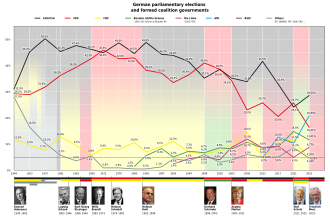
The SPD's electoral journey has been marked by periods of dominance and significant decline. While it was the largest party in the 1960s and 70s, recent decades have seen a more fragmented political landscape.
| Election Year | Candidate | Vote % (Constituency) | Seats (Bundestag) | Status |
|---|---|---|---|---|
| 1949 | Kurt Schumacher | 29.2% | 131 | Opposition |
| 1969 | Willy Brandt | 44.0% | 237 | Coalition (with FDP) |
| 1998 | Gerhard Schröder | 43.8% | 298 | Coalition (with Greens) |
| 2021 | Olaf Scholz | 26.4% | 206 | Coalition (Greens/FDP) |
| 2025 | N/A | 20.1% | 120 | Coalition (with CDU/CSU) |
Frequently Asked Questions
What was the significance of the Godesberg Program?
The 1959 Godesberg Program was a fundamental ideological shift where the SPD moved away from Marxist doctrine to become a broader centre-left party, allowing it to appeal to middle-class voters and increase its electoral viability in West Germany.
Who are the current leaders of the SPD?
As of 2025, the party is co-led by Bärbel Bas and Lars Klingbeil.
What is the "Iron Front"?
The Iron Front was a paramilitary organization active between 1931 and 1933, created by the SPD and other democratic forces to resist the rise of Nazism, Communism, and reactionary conservatism during the final years of the Weimar Republic.
How does the SPD perform in southern Germany?
The SPD typically sees lower support in southern Germany compared to the north and west. In recent years, it has dropped to single-digit percentages in some southern regions, such as in the 2026 Baden-Württemberg elections where it received 5.5% of the vote.
Which international organizations is the SPD affiliated with?
The SPD is currently affiliated with the Progressive Alliance and the Party of European Socialists (PES).