Diana: The Roman Goddess of the Wild, Hunt, and Home
In the spiritual landscape of the classical period, few deities were as versatile or widely revered as Diana. Originally a goddess common to all Latin tribes, her influence stretched from the deepest woodland groves of Italy to the furthest reaches of the Roman Empire. While often remembered today as the huntress, Diana served a multifaceted role as a protector of the lower classes, a patroness of the family, and a bridge between the Roman and Greek worlds.
Key Facts
- Primary Sanctuary: Lake Nemi, where she was known as Diana Nemorensis ("Diana of the Wood").
- Roman Presence: Her main city temple was located on the Aventine Hill, outside the original city boundary (pomerium).
- Greek Conflation: She was merged with the Greek goddess Artemis, adopting her iconography and attributes.
- Social Role: She provided asylum to slaves and was a patroness of the plebeians (lower-class citizens).
- Household Worship: Beyond the wild, she was worshiped as a family protector similar to Vesta.
The Sacred Groves and Sanctuaries
Diana's worship was deeply rooted in nature. Her most significant sanctuary was a woodland grove overlooking Lake Nemi, often called "Diana's Mirror." Here, she was worshiped as Diana Nemorensis. Legend suggests the site was founded by Orestes and Iphigenia, who brought a cult statue from the Tauri, modeling the sanctuary after the Temple of Artemis Tauropolos.
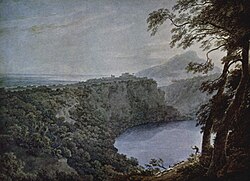
Historical evidence shows that the Nemi sanctuary flourished from the 6th century BCE to the 2nd century CE. It was not merely a religious site but a political one, held in common by the Latin League. The sanctuary's most famous festival, the Nemoralia, occurred annually around August 13–15. Worshippers carried torches and garlands to the lake, leaving prayers and threads on fences. During this time, hunting was forbidden, and the goddess was seen as a protector of wild animals.
The Legend of the Rex Nemorensis
One of the most enduring and controversial legends of Lake Nemi concerns the Rex Nemorensis, or "King of the Wood." According to accounts cited by Sir James George Frazer, the high priest was always a runaway slave who gained the position by killing his predecessor in a fight to the death after breaking a bough from a sacred central tree. However, modern scholars like Joseph Fontenrose have questioned the historical reality of this violent rite, noting a lack of contemporary records.
Diana in the City of Rome
As Rome sought to unify the Latin tribes, Diana's cult was imported into the city as a gesture of political solidarity. Her primary temple was established on the Aventine Hill. Notably, this location sat outside the pomerium—the sacred original boundary of the city—signifying that Diana remained a goddess for all Latins, not just the Romans.
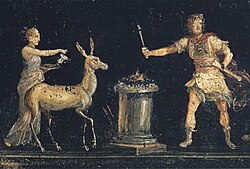
While tradition attributes the temple to King Servius Tullius in the 6th century BCE, archaeological evidence suggests it may have been built later, around the 3rd century BCE. Unlike most of Diana's shrines, which were decorated with stag antlers, the Aventine temple featured bull horns, commemorating a legendary sacrifice made by Servius Tullius.
Hellenization and the Merge with Artemis
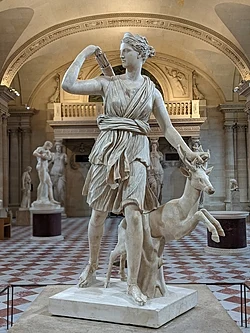
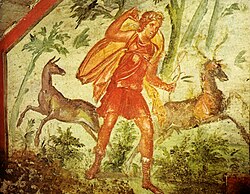
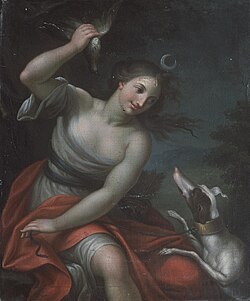
Over time, Diana became Hellenized, a process where she was identified with the Greek goddess Artemis. This conflation was driven by artists who noticed the similarities between the two deities and by trade with Massilia. By 399 BCE, Diana appeared alongside Apollo in Rome's first lectisternium (a banquet for the gods). This shift brought Greek iconography into Roman worship, such as the depiction of Diana with a deer, symbolizing her role as the patroness of the hunt.
Regional and Provincial Worship
Diana's influence extended far beyond the capital. In Campania, she was worshiped as Diana Tifatina at a major temple on Mount Tifata. This rural sanctuary was so prosperous that its renovations were often funded by the spoils of Roman military campaigns. Today, the church of Sant'Angelo in Formis stands upon these ruins.
In the Roman provinces—particularly Gaul, Upper Germania, and Britannia—Diana was frequently paired with Silvanus, another forest deity. She was often conflated with local goddesses, such as Abnoba, and honored with titles like Augusta or regina (queen).
Household Devotion and Social Status
Despite her association with the wild, Diana was a cornerstone of domestic life. She functioned similarly to Vesta, the hearth goddess, and was sometimes included among the Penates (household deities). Families often gave her a specific name based on their tribe, such as Diana Mattiaca. The poet Horace highlighted this contrast in his work, distinguishing between the grand state hymns of the Aventine temple and the intimate, personal devotion practiced at home altars.
Furthermore, Diana was a sanctuary for the marginalized. Her temples offered asylum to slaves and were championed by the plebeians, possibly because the earliest Roman slaves were members of the Latin tribes who already revered her.
Summary of Diana's Cult Sites
| Location | Epithet/Name | Key Characteristic |
|---|---|---|
| Lake Nemi | Diana Nemorensis | Woodland grove; site of the Nemoralia festival. |
| Aventine Hill | Diana Aventina | Located outside the pomerium; featured bull horns. |
| Mount Tifata | Diana Tifatina | Ancient Campanian rural sanctuary. |
| Colle di Corne | Deva Cornisca | Archaic Latin name; featured a collegium of worshippers. |
| Provinces | Augusta / Regina | Often paired with Silvanus; merged with local deities. |
Frequently Asked Questions
Why was Diana's temple on the Aventine Hill located outside the city boundary?
The temple was placed outside the pomerium to reflect Diana's status as a goddess common to all Latin tribes, rather than a deity exclusive to the city of Rome.
What was the Nemoralia?
The Nemoralia was an annual festival held at Lake Nemi during the Ides of August. It involved processions with torches and garlands, and was characterized by a ban on hunting.
How did Diana differ from Artemis?
Originally, Diana was a Latin deity of the woods and hunt. Through Hellenization, she was conflated with the Greek Artemis, eventually adopting her myths, iconography, and familial relationship with Apollo.
Who was the Rex Nemorensis?
The Rex Nemorensis was the legendary high priest of Diana at Lake Nemi. According to myth, he was always a runaway slave who won the priesthood by killing the previous priest in combat.
Did Diana have a role in the home?
Yes, Diana was worshiped as a patroness of families and a protector of the household, similar to the role of Vesta, and was often invoked in personal rituals for family prosperity.