Ancient Greek: The Evolution, Dialects, and Modern Legacy of a Classical Language
Ancient Greek (Ἑλληνική, Hellēnikḗ) is a foundational branch of the Indo-European language family that shaped the intellectual and cultural landscape of the Eastern Mediterranean and the Greco-Roman world. Spanning from approximately 1500 BC to 300 BC, the language evolved through several distinct stages, providing the medium for some of history's most influential philosophy, literature, and scientific inquiry.
The development of the language is typically categorized into four primary eras: the Mycenaean Greek period (c. 1400 – 1200 BC), the Dark Ages (c. 1200 – 800 BC), the Archaic or Homeric period (c. 800 – 500 BC), and the Classical period (c. 500 – 300 BC).
Key Facts
- Language Family: Indo-European > Hellenic > Ancient Greek.
- Writing System: The Greek alphabet.
- Timeframe: Roughly 1500 BC to 300 BC.
- Major Dialects: Including Attic, Ionic, Doric, and Aeolic.
- Modern Status: Taught globally in classical studies and used in niche modern publications.
The Diversity of Ancient Greek Dialects
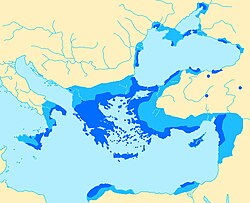
Ancient Greek was not a monolithic tongue but a collection of regional dialects. These varieties are generally grouped into four main categories based on linguistic characteristics:
- West Group: Comprising Northwest Greek and Doric.
- Aeolic Group: Including Thessalian, Boeotian, and Aegean/Asiatic Aeolic.
- Ionic-Attic Group: Featuring Attic (the dialect of Athens), Ionic (including Asiatic Ionic and Cycladic), and Euboean.
- Arcadocypriot Greek: Including Arcadian and Cypriot.
The interplay between these dialects eventually led to the rise of Koine Greek, a common dialect that served as the lingua franca of the ancient world.
Linguistic Structure and Phonology
The phonology of Ancient Greek is characterized by a sophisticated system of consonants and vowels. The consonant inventory includes labial, alveolar, velar, and glottal sounds, distinguished by whether they are voiced, voiceless, or aspirated (such as the aspirated plosives φ, θ, and χ).
The vowel system was equally complex, utilizing front and back vowels with distinctions between short and long durations. This precision in sound allowed for the nuanced expression found in classical poetry and rhetoric.
Morphological Features
One notable feature of Ancient Greek morphology is the augment, a prefix added to verbs to indicate past tense. Additionally, the language employed reduplication, where the initial consonant and vowel of a verb root are repeated to form certain tenses.
The Writing System and Literary Examples
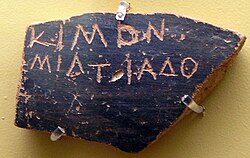
The transition from early scripts to the Greek alphabet allowed for the recording of epic poetry and historical records. A prime example of the Archaic period is found in the works of Homer. The opening of the Iliad showcases the rhythmic and structural complexity of the language during this era.

Ancient Greek in the Modern World
While no longer a spoken vernacular, Ancient Greek remains a vital subject in global education. It is often taught alongside Latin as part of Classics. In Europe, it remains a compulsory or optional subject in various traditional schools, including the liceo classico in Italy and the gymnasium in the Netherlands and Germany.
Beyond the classroom, the language sees surprising real-world applications. Modern authors have translated popular works like Harry Potter and the Philosopher's Stone and Asterix into Ancient Greek. There are even niche publications, such as Onomata Kechiasmena (a crossword magazine) and Akropolis World News, which provides weekly news summaries in the classical tongue.
| Period | Approximate Dates | Key Characteristics |
|---|---|---|
| Mycenaean | 1400 – 1200 BC | Earliest attested form of the language. |
| Dark Ages | 1200 – 800 BC | Transitional period of linguistic shift. |
| Archaic (Homeric) | 800 – 500 BC | Rise of epic poetry and the Greek alphabet. |
| Classical | 500 – 300 BC | Peak of Athenian drama, philosophy, and rhetoric. |
Frequently Asked Questions
What is the difference between Ancient Greek and Modern Greek?
Ancient Greek refers to the forms of the language used from roughly 1500 BC to 300 BC, including various dialects like Attic and Doric. Modern Greek is the evolved descendant of these forms, having undergone significant phonetic and grammatical changes over two millennia.
Which dialect of Ancient Greek was the most influential?
Attic Greek, spoken in Athens, became highly influential due to the city's cultural and political dominance during the Classical period. It eventually merged with Ionic to form Koine Greek, the common language of the Hellenistic world.
Is Ancient Greek still taught in schools today?
Yes, it is still taught in many European countries, such as Italy, Greece, and Germany, often in specialized humanities tracks or as part of a classical studies curriculum at universities worldwide.
Can you find modern books written in Ancient Greek?
While rare, some modern works have been translated into Ancient Greek for academic or artistic reasons, including the first Harry Potter novel and certain volumes of the Asterix comic series.