Greek Language: A Comprehensive History and Evolution
The Greek language (ελληνικά, elliniká) stands as one of the world's oldest recorded living languages. A prominent member of the Indo-European language family, it has evolved over millennia from early prehistoric forms to the modern tongue spoken today by approximately 13.5 million people. Its influence extends far beyond its native borders, shaping the foundations of Western philosophy, science, and literature.
Primarily native to Greece and Cyprus, Greek is also spoken in parts of Albania, Italy, and various regions across the Balkans, Caucasus, and the Eastern Mediterranean. It serves as an official language in Greece, Cyprus, and the European Union, while maintaining recognized minority status in numerous countries including Turkey, Russia, and the United States.
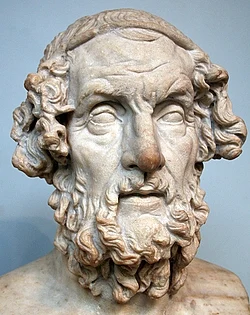
Key Facts
- Language Family: Indo-European, specifically the Hellenic branch.
- Native Speakers: Approximately 13.5 million (as of 2015).
- Official Status: Official in Greece, Cyprus, and the European Union.
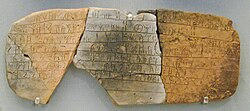
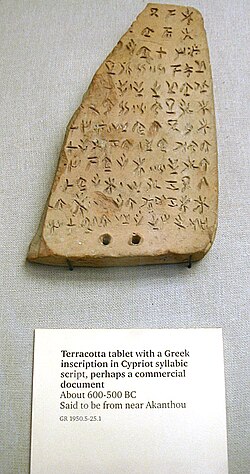
- Writing Systems: Historically used Linear B and the Cypriot syllabary; currently uses the Greek alphabet.
- Closest Relative: Phrygian is widely considered the closest linguistic relative to Greek.
The Historical Evolution of Greek
Linguists divide the history of the Greek language into several distinct periods, reflecting the cultural and political shifts of the Mediterranean world.
Early and Ancient Periods
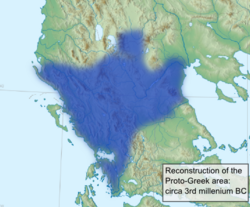
The journey began with Proto-Greek, the reconstructed ancestor of all Greek dialects. This evolved into Mycenaean Greek, the earliest attested form of the language, recorded in the Linear B script. Following this was the era of Ancient Greek, characterized by various regional dialects, including those spoken in Macedonia, which recent scholarship identifies as part of the North-West Greek group.
Koine and Medieval Greek
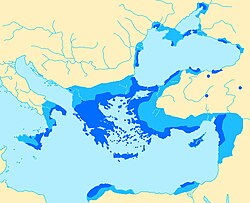
With the conquests of Alexander the Great, Koine Greek (Hellenistic Greek) emerged as a lingua franca, simplifying earlier dialects to facilitate communication across a vast empire. This transitioned into Medieval Greek, also known as Byzantine Greek, which served as the administrative and liturgical language of the Byzantine Empire.
Modern Greek
The final stage is Modern Greek (Neo-Hellenic), the contemporary standard used today. While it maintains a strong connection to its ancestors, it has undergone significant phonetic and grammatical simplification.
![Distribution of varieties of Greek in Anatolia, 1910. Demotic in yellow. Pontic in orange. Cappadocian Greek in green, with green dots indicating individual Cappadocian Greek villages.[28]](/images/0e/3f/0e3fe5ca3e1a71109d196c71a70e1bcf845b85a717556aa7057a4a6927b973b1.png)
Linguistic Characteristics
The transition from Ancient to Modern Greek involved substantial changes in how the language handles time, mood, and structure.
| Feature | Ancient Greek | Modern Greek |
|---|---|---|
| Person | 1st, 2nd, 3rd | 1st, 2nd, 3rd (includes 2nd person formal) |
| Number | Singular, Dual, Plural | Singular, Plural |
| Tense | Present, Past, Future | Past, Non-past (Future is periphrastic) |
| Mood | Indicative, Subjunctive, Imperative, Optative | Indicative, Subjunctive, Imperative |
| Voice | Active, Medio-passive, Passive | Active, Medio-passive |
A periphrastic construction is a grammatical structure where a single concept (like the future tense) is expressed using multiple words (such as an auxiliary verb) rather than a single inflected word form.
Writing Systems and Scripts
Greek has been recorded using several different writing systems throughout its history. The earliest known was Linear B, a syllabary used for Mycenaean administration.
Another early system was the Cypriot syllabary, used primarily on the island of Cyprus. However, the most enduring contribution is the Greek alphabet, introduced around the 10th or 9th century BC. This alphabet consists of uppercase and lowercase letters and has served the language for nearly 2,800 years.
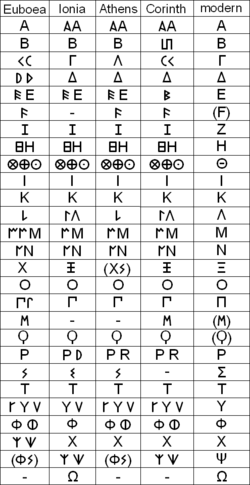
Over time, various epichoric (regional) variants of the alphabet existed in areas like Euboea, Ionia, Athens, and Corinth before the alphabet was standardized.
Geographic Distribution
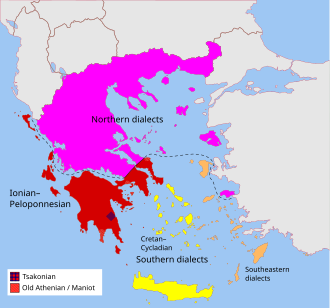
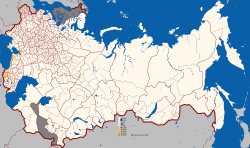
While centered in Greece and Cyprus, the Greek language has a wide historical and modern footprint. In the late 19th century, the Russian Empire's census recorded significant Greek-speaking populations within its borders. Today, Greek continues to be spoken in diaspora communities and recognized minority regions across the globe.
Frequently Asked Questions
What is the oldest recorded form of Greek?
The oldest recorded form is Mycenaean Greek, which was written using the Linear B syllabary on clay tablets.
How does Modern Greek differ from Ancient Greek?
Modern Greek has simplified its grammar, losing the dual number and the optative mood, and now uses periphrastic constructions to express the future tense and certain modal functions.
What is Koine Greek?
Koine Greek, or Hellenistic Greek, was a common dialect that emerged after the conquests of Alexander the Great, serving as a universal language across the Mediterranean and Near East.
Which language is most closely related to Greek?
Linguistic evidence suggests that Phrygian is the closest relative to Greek, with both likely emerging from a single language spoken in the Balkans at the end of the third millennium BCE.
Is the Greek alphabet the same as it was in ancient times?
While the core structure remains, the alphabet evolved from various regional (epichoric) variants into the standardized form used today, and it later added lowercase letters.