DAP and the Rise of the NSDAP: The Origins of the Nazi Party
The political landscape of post-World War I Germany was a volatile mix of nationalism and social unrest. In this environment, a small gathering of individuals in Munich laid the groundwork for one of the most infamous political organizations in history. What began as a modest debating circle known as the German Workers' Party (DAP) eventually evolved into the National Socialist German Workers' Party (NSDAP), driven by the strategic ambitions and oratory power of Adolf Hitler.
The Founding of the DAP
On January 5, 1919, the DAP was established at the hotel Fürstenfelder Hof in Munich. The party was founded by Anton Drexler, alongside Dietrich Eckart, Gottfried Feder, and Karl Harrer. The organization grew out of the Freien Arbeiterausschuss für einen guten Frieden (Free Workers' Committee for a Good Peace), a league Drexler had started in 1918.
The ideological seeds were sown earlier when Harrer, a journalist and member of the Thule Society (a völkisch occultist and political group), convinced Drexler to form the Politischer Arbeiterzirkel (Political Workers' Circle). This group met periodically to discuss themes of nationalism and antisemitism. Drexler was further encouraged to formalize the party by his mentor, Paul Tafel, a leader of the Alldeutscher Verband (Pan-Germanist Union) and a director of the Maschinenfabrik Augsburg-Nürnberg.
Initially, the DAP was a tiny organization. In May 1919, only ten members attended a meeting, and by August, attendance had only risen to 38. Most of these early members were Drexler's colleagues from the Munich railway yards. While Drexler served as chairman, Harrer held the honorary title of Reich Chairman.
Adolf Hitler's Entry into the Party
Following the end of World War I, Adolf Hitler returned to Munich without a formal career path. In July 1919, he was appointed as a Verbindungsmann (intelligence agent) by a reconnaissance commando of the Reichswehr (the German army) to investigate the DAP and influence other soldiers.
Although Hitler initially found the DAP meetings disorganized, he was drawn to Anton Drexler's nationalist, antisemitic, anti-capitalist, and anti-Marxist views. His turning point occurred on September 12, 1919, at the Sterneckerbräu beer hall. During a heated argument with Professor Adalbert Baumann over Bavarian separatism and capitalism, Hitler's aggressive oratory skills impressed the party members. Drexler subsequently encouraged him to join.
Hitler applied for membership with the permission of his superior, Captain Karl Mayr. This arrangement allowed Hitler to remain in the army and receive a weekly pay of 20 gold marks, providing him with the financial stability to dedicate himself fully to the party's growth.
The Truth About Membership Numbers
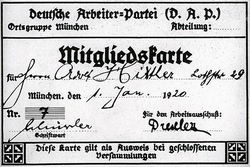
There is a historical discrepancy regarding Hitler's membership number. In his book Mein Kampf, Hitler claimed to be the seventh member of the party. In reality, he was the seventh executive member of the central committee. When the party first issued membership numbers in January 1920, they started the count at 501 to make the organization appear larger than it was; consequently, Hitler was assigned number 555, though he was actually the 55th member.
Ideology and the Power of Propaganda
The DAP's early program was explicitly nationalistic, antisemitic, and anti-Marxist. Unlike other nationalist groups, the DAP targeted the working class. Hitler rejected the Marxist concept of the dictatorship of the proletariat, proposing instead a Volksgemeinschaft (people's community)—a society where German national identity superseded class, religion, or other divisions.
Hitler's first speech for the party took place on October 16 at the Hofbräukeller. His ability to attract crowds grew rapidly between 1919 and 1920, to the point where the party began charging entry fees for visitors to hear him speak. By early 1920, with Drexler's support, Hitler became the chief of propaganda, viewing the role as a "drummer" for the national cause.
Evolution into the NSDAP
By February 1920, Hitler had shifted the DAP from a debating society into an active political party. On February 24, 1920, during a massive meeting of 2,000 people at the Staatliches Hofbräuhaus in Munich, the party was renamed the National Socialist German Workers' Party (NSDAP).
The name was suggested by Rudolf Jung and borrowed from an existing Austrian party. The terminology was a strategic choice: "National" and "German" appealed to the right wing, while "Socialist" and "Workers'" were intended to attract the left. This shift in direction led to the resignation of Karl Harrer.
Following the renaming, the party adopted the swastika as its official symbol in August 1920. While the Deutschvölkische Partei (German Folkish Party) had used the symbol in its publications since 1917, it became the central emblem of the NSDAP during this period of expansion.
Key Facts
- Founded: January 5, 1919, in Munich by Anton Drexler and others.
- Original Name: German Workers' Party (DAP).
- Renamed: National Socialist German Workers' Party (NSDAP) on February 24, 1920.
- Hitler's Role: Joined as an army intelligence agent; became chief of propaganda in early 1920.
- Membership Number: Officially 555 (actually the 55th member), though he later claimed to be the 7th.
- Core Goal: Creation of a Volksgemeinschaft to replace class-based identity with national identity.
- Symbol: The swastika was adopted in August 1920.
| Feature | German Workers' Party (DAP) | National Socialist German Workers' Party (NSDAP) |
|---|---|---|
| Primary Nature | Small debating society | Active political party |
| Key Leadership | Anton Drexler | Adolf Hitler |
| Membership Size | Dozens (initially) | Thousands (by Feb 1920) |
| Primary Strategy | Small group discussions | Mass propaganda and oratory |
Frequently Asked Questions
Who actually founded the DAP?
The DAP was founded by Anton Drexler, Dietrich Eckart, Gottfried Feder, and Karl Harrer in January 1919.
Why did the party start membership numbers at 501?
The party began numbering at 501 to create the illusion that the organization was larger and more established than it actually was.
What is a Volksgemeinschaft?
A Volksgemeinschaft is a "people's community" where German national identity takes precedence over class, religion, or other social divisions.
How did Adolf Hitler join the party?
Hitler was originally sent by the Reichswehr as an intelligence agent to investigate the DAP. After being impressed by the ideology and encouraged by Anton Drexler, he applied for membership with his captain's permission.
Why was the party renamed the NSDAP?
The name was changed to make the party more broadly appealing. "National" and "German" targeted right-wing supporters, while "Socialist" and "Workers'" were meant to attract the left-wing working class.