Cyrrhus: The Ancient Strategic Hub of Northern Syria
Nestled in the landscapes of northern Syria, near the Turkish border, lie the ruins of Cyrrhus. Once a thriving center of commerce, military power, and religious devotion, this ancient city served as a vital link between the Mediterranean coast and the Euphrates River. From its foundation by a general of Alexander the Great to its role as a Byzantine stronghold, Cyrrhus embodies the complex layering of Hellenistic, Roman, and Islamic history.
The city is located approximately 70 km northwest of Aleppo and 24 km west of Killis, Turkey. It served as the capital of Cyrrhestica, a vast district situated between Commagene and the plain of Antioch. Today, the site is known as Khoros, positioned near the Afrin Marsyas River, a tributary of the Orontes.
Key Facts
- Founded: Around 300 BC by Seleucus I Nicator.
- Strategic Role: A major Roman administrative and military center on the trade route to Zeugma.
- Military Significance: Served as the base for the Roman legion Legio X Fretensis.
- Religious Importance: A prominent early Christian bishopric and a center for the worship of Zeus and Athena.
- Fate: Captured by Arabs in 637 AD and largely abandoned by the 13th century AD.
The Rise and Fall of a Frontier City
Hellenistic and Roman Eras
Cyrrhus was established shortly after 300 BC by Seleucus Nicator, named after a Macedonian city. While it initially flourished as a civilian center, the Treaty of Apamea in 188 BC shifted its role. As Asia Minor separated from the Seleucid state, Cyrrhus became a frontier city, evolving into a primary assembly point for the armies of the kings of Antioch.
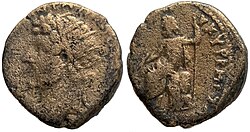
After a brief period under the control of Tigran the Great of Armenia, the Romans recaptured the city in 69 BC. Under Roman rule, it became a commercial powerhouse and minted its own coinage to facilitate trade.
Byzantine Fortifications and Arab Conquest
During the 3rd century, the Sassanid Persian Empire launched several attacks on the city, prompting the Romans to rapidly fortify its defenses. This strategic importance continued into the 6th century when the Byzantine Emperor Justinian further embellished and strengthened the city's formidable walls.
The Byzantine era ended in 637 AD when the city was captured by Arab forces, after which it became known as Qorosh. By the Middle Ages, the region saw shifting control between the Armenian Bagrat and the county of Edessa, before falling to Nur ad-Din Zangi in 1150. By the 13th and 14th centuries, travelers described the once-great city as being largely in ruins.
Archaeological Discoveries
Excavations by the Lebanese Syrian Archaeological Mission have revealed that Cyrrhus followed a Hippodamian grid—a square urban layout characterized by a central main road lined with colonnades, a hallmark of Hellenistic eastern cities.
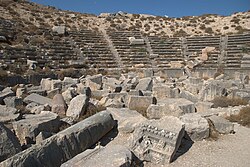
Among the most significant remains are two functional Roman bridges and a large theatre located outside the town walls. On the hill overlooking the theatre, archaeologists found a 6th-century Byzantine citadel featuring Greek and Egyptian design influences. The city also housed a Temple of Zeus on the nearby mountain and a magnificent basilica that held the relics of Saints Cosmas and Damian, earning the city the name Hagioupolis.
Ecclesiastical History and the Legacy of Theodoret
Cyrrhus was an early and influential center of Christianity. It began as a suffragan of Hierapolis Bambyce before becoming an autocephalous metropolis under Emperor Justinian, reporting directly to the Patriarch of Antioch.
The most renowned figure associated with the city was Theodoret of Cyrrhus (423-458 AD), a prolific writer and theologian. Theodoret described a remarkably dense Christian population, claiming his small diocese contained roughly 800 churches. The region was also a haven for hermits and holy figures, including Saint Maron, the patron of the Maronite Church.
| Period | Key Event/Status | Primary Influence |
|---|---|---|
| c. 300 BC | City founded by Seleucus I Nicator | Seleucid (Macedonian) |
| 64 BC | Annexation by Pompey | Roman Empire |
| 6th Century AD | Fortifications expanded by Justinian | Byzantine Empire |
| 637 AD | Capture by Arab forces | Islamic Caliphate |
| 1117-1150 AD | Control by County of Edessa then Nur ad-Din | Crusader/Zangid |
| 13th Century AD | City largely abandoned | N/A |
Frequently Asked Questions
Who founded the city of Cyrrhus?
Cyrrhus was founded around 300 BC by Seleucus I Nicator, one of the prominent generals of Alexander the Great.
Why was Cyrrhus strategically important to the Romans?
It served as a critical administrative, military, and commercial hub on the trade route between Antioch and the Euphrates River crossing at Zeugma, and it housed the Legio X Fretensis.
What is the significance of the name Hagioupolis?
The city was called Hagioupolis because it housed a magnificent basilica containing the relics of Saints Cosmas and Damian, who were martyred in the vicinity around 283 AD.
What architectural style was used in the city's layout?
The city utilized a Hippodamian grid, which is a square road plan featuring a central main road with colonnades typical of the Hellenistic east.
Who was Theodoret of Cyrrhus?
Theodoret was the bishop of Cyrrhus from 423 to 458 AD and is remembered as a prolific writer and a key figure in the theological disputes regarding Nestorianism, Eutychianism, and Marcionism.