Crown of Aragon: The Rise and Fall of a Mediterranean Empire
The Crown of Aragon was a powerful composite monarchy—a political entity where multiple states share a single monarch while maintaining their own distinct laws and institutions. Emerging from a dynastic union in the 12th century, it evolved into a dominant thalassocracy (a state with primary control over the sea), projecting power across the western Mediterranean for centuries.
At its zenith during the 14th and 15th centuries, the Crown controlled vast territories including the eastern Iberian Peninsula, parts of southern France, the Balearic Islands, Sicily, Sardinia, Corsica, Malta, Southern Italy, and portions of Greece. Its legacy remains etched in the cultural and political landscapes of Spain, Italy, and France.
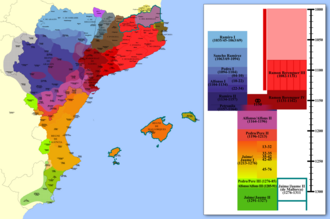
Key Facts
- Duration: 1162–1715.
- Origin: Dynastic union between the Kingdom of Aragon and the County of Barcelona.
- Peak Power: A Mediterranean empire controlling Sicily, Sardinia, Naples, and the Balearic Islands.
- Governance: A feudal monarchy subject to fueros (local laws and privileges).
- Dissolution: Abolished by the Nueva Planta decrees following the War of the Spanish Succession.
The Origins of the Union
The foundation of the Crown began in 1137 through the marriage of Petronilla of Aragon and Raymond Berenguer IV of Barcelona. This union was born of necessity; the Aragonese nobility, fearing the influence of Castile after the death of Alfonso I, pressured the monk-king Ramiro II to leave his monastery and secure a successor.
The titles of the two territories were formally combined in their son, Alfonso II, who ascended the throne in 1162. Crucially, this union was not a merger of states but a personal union that respected the existing parliaments and institutions of both Aragon and Catalonia.
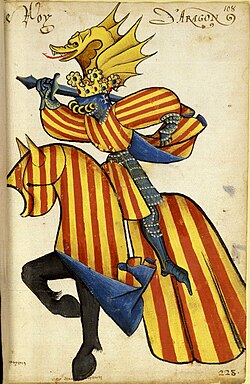
Territorial Expansion and Mediterranean Dominance
The Crown's trajectory was marked by a shift from continental ambitions to maritime expansion. An early attempt to maintain influence in southern France ended in disaster at the Battle of Muret in 1213, where King Peter II was killed. This defeat eventually led to the Treaty of Meaux-Paris (1229), through which the Crown renounced rights over southern Occitania.
Under King James I, the Crown pivoted south and east. He successfully conquered Mallorca, Ibiza, and the Kingdom of Valencia. By the 14th and 15th centuries, the Crown expanded further into the Mediterranean, incorporating Sardinia and Sicily. The conquest of the Kingdom of Naples by Alfonso V in 1442 marked the height of its Italian influence.
![Ferdinand II of Aragon on his throne flanked by two shields with the emblem of the Royal Seal of Aragon. Frontispiece of a 1495 edition of Catalan constitutions.[18]](/images/35/b2/35b2e6b4e7d3be9cf029890903d3245f1770abd7eea36ea58c8e9836b46e4c4d.jpg)
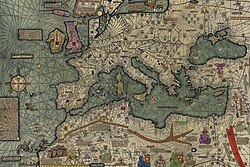
The Catalan Atlas and Maritime Reach
The Crown's maritime prowess was not only military but also intellectual and commercial, as evidenced by the detailed cartography of the era, which mapped the known world from Europe to the Mediterranean coastlines.
Union with Castile and the Spanish Monarchy
A pivotal turning point occurred on October 19, 1469, with the marriage of Ferdinand II of Aragon and Isabella I of Castile. Known as the Catholic Monarchs, their union joined "the Spains," creating a massive composite monarchy. While they ruled together, the Crown of Aragon and the Crown of Castile remained separate polities with their own laws and traditional institutions.
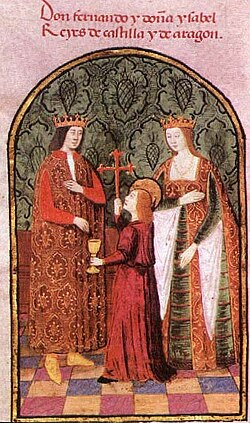
This decentralized structure continued under the Habsburgs, specifically under Emperor Charles V (Charles I of Spain), who ruled nearly the entire Iberian Peninsula by 1516.
Decline and Dissolution
The decline of the Crown of Aragon was gradual. Wealth and authority shifted toward the Castilian center of power. Demographic losses, including the expulsion of Jews (1492), Muslims (1502), and Moriscos (1609), weakened the social fabric. Territorial losses followed, including the loss of Roussillon in 1659 and the eventual loss of Italian domains.
The final blow came after the War of the Spanish Succession (1701–1714). King Philip V issued the Nueva Planta decrees between 1707 and 1716, which abolished the separate institutions and public laws of the Crown of Aragon. The territories were formally united with Castile under a centralized, absolutist Bourbon government, creating the modern legal framework of the Kingdom of Spain.
Summary of Territories
| Entity | Type | Earliest Annexation | Notes |
|---|---|---|---|
| Aragon | Kingdom | 1162 | Founding member of the union. |
| Catalonia | Principality | 1162/73 | Originally the County of Barcelona. |
| Valencia | Kingdom | 1238 | Conquered by James I. |
| Majorca | Kingdom | 1231 | Included Balearic Islands. |
| Sicily | Kingdom | 1282 | Key Mediterranean stronghold. |
| Sardinia and Corsica | Kingdom | 1324 | Expanded maritime reach. |
| Naples | Kingdom | 1442 | Conquered by Alfonso V. |
| Andorra | Co-lordship | 1278 | Formed by the Pareatge charter. |
Frequently Asked Questions
What was a composite monarchy?
A composite monarchy is a political system where multiple distinct states or territories are ruled by a single sovereign, but each state retains its own laws, parliaments, and administrative institutions.
How did the Crown of Aragon differ from the Kingdom of Aragon?
The Kingdom of Aragon was one of the constituent states. The Crown of Aragon was the overarching entity that included the Kingdom of Aragon, the Principality of Catalonia, the Kingdom of Valencia, and various other Mediterranean territories.
What were the Nueva Planta decrees?
These were a series of decrees issued by Philip V of Spain between 1707 and 1716. They abolished the autonomous laws and institutions of the Crown of Aragon, integrating them into a centralized Castilian administrative system.
Who were the Catholic Monarchs?
The Catholic Monarchs were Ferdinand II of Aragon and Isabella I of Castile, whose marriage in 1469 united the two most powerful crowns in the Iberian Peninsula, laying the foundation for the modern Spanish state.
What role did the sea play in the Crown's power?
The Crown of Aragon functioned as a thalassocracy, meaning its power was based on maritime trade and naval dominance. This allowed it to build an empire across the Mediterranean, encompassing islands and coastal kingdoms in Italy and Greece.