Senyera: The History and Symbolism of the Catalan Flag
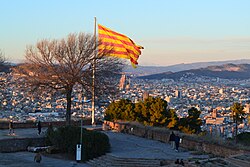
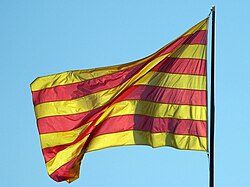
The Senyera is one of Europe's oldest surviving flags, characterized by its striking design of four red stripes on a golden-yellow background. More than just a piece of fabric, it is a powerful vexillological symbol—the study of flags—rooted in the medieval coat of arms of the Crown of Aragon. Today, it serves as the official flag of Catalonia and continues to influence the heraldry of several regions across the Mediterranean.
Historically known as the "four bars," this design originally represented the King of the Crown of Aragon. Over centuries, it evolved from a dynastic emblem of the House of Barcelona into a broader symbol of identity for various territories that once fell under Aragonese rule.
Key Facts
- Design: Four red horizontal stripes on a yellow field.
- Official Adoption: Adopted as the official flag of Catalonia on May 25, 1933.
- Proportions: The standard ratio is 2:3.
- Widespread Use: Found in the flags of Catalonia, Aragon, the Balearic Islands, and the Valencian Community.
- International Presence: Appears in the coat of arms of Andorra and various regions in France, such as Provence and Roussillon.
Origins and Historical Debates
The exact origin of the Senyera is a subject of historical debate, with theories often split between Aragonese and Catalan roots. Because the symbol was used by the Crown of Aragon—a composite monarchy—the distinction is often blurred.
The Catalan Perspective
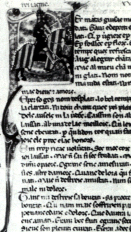
The Gran Enciclopèdia Catalana suggests the symbol first appeared on the tomb of Ramon Berenguer II, Count of Barcelona, who died in 1082. Further evidence is cited in the seals of Ramon Berenguer IV from the mid-12th century. Additionally, a genealogical roll from the late 14th century depicts the four red bars on the images of early Counts of Barcelona, suggesting the emblem belonged to the dynasty that eventually ruled the Crown of Aragon.
The Aragonese Perspective
Conversely, the Gran Enciclopedia Aragonesa argues that the first undisputed material evidence is a royal seal of Alfonso II of Aragon dating to 1159. This perspective posits that the symbol is fundamentally Aragonese, and that references to a "Catalan" origin are actually references to the House of Barcelona rather than the geographical region of Catalonia.
Alternative Theories and the Papal Connection
One theory suggests the Kings of Aragon adopted the colors of the Papal States as a sign of submission to the Pope. In the 12th century, the colors of Rome—controlled by the Pope—were red and yellow. However, some historians reject this, citing 16th-century chronicles that suggest the Church's banner actually adopted the colors of the Aragonese crown after Pope Innocent III appointed King Peter II as Gonfalonier of the Church.
![Papal States flag prior to 1808[4]](/images/d3/5b/d35b366e2f3e01484b9819a7921c2c8d0bc0f0ea80577248d31c97f1444707d1.webp)
Legends of the Four Bars
Beyond academic history, several romantic legends attempt to explain the flag's creation. The most famous 14th-century legend claims that during the 9th century, King Charles the Bald dipped his fingers in the blood of the wounded Count Wilfred the Hairy and drew four stripes across the Count's golden shield as a gesture of gratitude. While popular during the 19th-century Renaixença (Catalan rebirth), historians note that Charles the Bald died decades before the events described.
Modern Usage and Variations
The Senyera remains a central element of identity in the Western Mediterranean. While the plain version is the official flag of Catalonia, other regions have adapted the design to reflect their own specific identities.
Regional Variations
- Aragon: Includes an additional coat of arms.
- Balearic Islands: Features a castle in the canton (the upper-left corner).
- Valencia: Includes a blue crowned fringe on the hoist side.
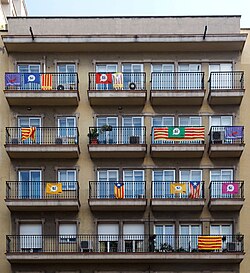
In modern political contexts, the Senyera serves as the foundation for the Estelada, an unofficial flag used by Catalan independence movements, which adds a triangle and a star to the original design.
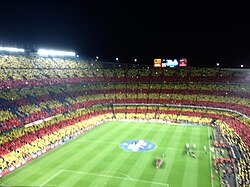

Summary of Senyera Influence
| Category | Entity/Region | Usage Type |
|---|---|---|
| Spanish Autonomous Communities | Catalonia, Aragon, Balearic Islands, Valencia | Official Flag/Pattern |
| Sovereign States | Andorra | Coat of Arms |
| French Regions/Departments | Provence, Roussillon, Pyrénées-Orientales | Flag/Coat of Arms |
| Cities | Alghero (Sardinia, Italy) | Official Flag |
Frequently Asked Questions
What does the word "Senyera" mean?
In Catalan, Senyera (or Senyal Reial) literally means "pennon," "standard," or "banner," and is used more generally to refer to a flag.
Is the Senyera the same as the Estelada?
No. The Senyera is the official flag of Catalonia consisting of four red stripes on a yellow background. The Estelada is a variation used by independence supporters that adds a star and a triangle to the Senyera design.
Which is the oldest extant flag related to this design?
The Pennon of the Conquest of Valencia, dating from 1238, is documented as the world's oldest extant flag. Although its yellow section was originally white, it featured the same red stripes design.
Why is the Senyera found in France and Italy?
The symbol is present in these areas because they were once part of the Crown of Aragon or had strong historic ties to the Counts of Barcelona, such as Provence in France and the city of Alghero in Sardinia.