Spanish March: The Carolingian Buffer Zone of the Pyrenees
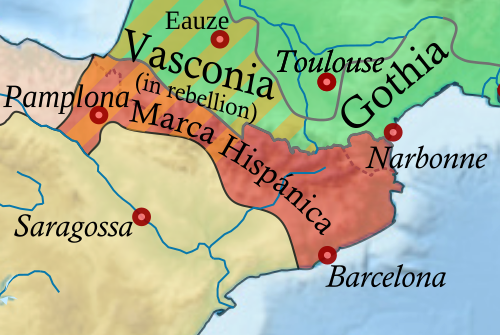
The Spanish March (also known as the Hispanic March or Marca Hispanica) was a strategic military buffer zone established in approximately 795. Created by Charlemagne in the eastern Pyrenees and surrounding regions, this territory served as a defensive shield for the Christian Carolingian Empire. Its primary purpose was to protect the Duchy of Gascony, the Duchy of Aquitaine, and Septimania from the expansionist efforts of the Muslim Umayyad Emirate of Córdoba based in al-Andalus.
Beyond its military function, the Spanish March represented a complex collection of early Iberian and trans-Pyrenean lordships. Over time, these territories evolved from imperial outposts into autonomous counties, eventually laying the groundwork for modern political entities in Southern Europe.
Key Facts
- Established: c. 795 by Charlemagne.
- Purpose: A military buffer zone to protect Carolingian territories from the Umayyad Emirate of Córdoba.
- Geography: Located between the Pyrenees mountains and the Ebro river.
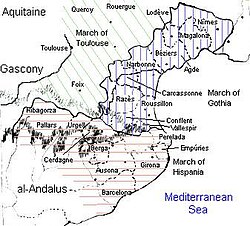
- Key Territories: Included the counties of Barcelona, Girona, Urgell, and Cerdanya.
- Legacy: The County of Barcelona eventually evolved into the Principality of Catalonia.
- Unique Survivor: Andorra is the only part of the March that remained independent of both France and Spain.
Geographical and Demographic Context
The Spanish March spanned the eastern regions between the Pyrenees and the Ebro river. The population was highly diverse, consisting of Basques in the northwestern valleys, Jews of Occitania, and a large Occitano-Romance-speaking population. Many of these inhabitants were governed by the Visigothic Code (the legal system of the fallen Visigothic Kingdom).
Initially, these populations had vowed allegiance to the Umayyad rulers in 719. However, loyalties began to shift toward the Franks after King Pepin the Short conquered Septimania in 759, and further shifts occurred in the Pyrenean valleys around 785.
Evolution of the Counties
The boundaries of the March were fluid, shifting based on imperial fortunes and the ambitions of local administrators. While the counts owed loyalty to the Carolingian monarch, they often operated with significant autonomy. Many smaller counties were eventually absorbed by more powerful neighbors, most notably the County of Barcelona.
While Navarre and Aragon were under Carolingian overlordship between 794 and 806 as part of the Duchy of Vasconia (Gascony), they were not formally part of the Spanish March.
Historical Development
The Umayyad Advance and Frankish Response
By 718, the Umayyad Caliphate had conquered most of the Visigothic Kingdom of Hispania, leaving only Septimania (modern Languedoc-Roussillon) and parts of the northern mountains. In 719, Umayyad forces established a base at Narbonne, securing the region through treaties and intermarriage. However, their northward expansion was halted at the Battle of Toulouse in 721.
The Frankish response began in earnest with Charles Martel in 732. Following decades of conflict, Pepin the Short successfully subdued Septimania in 759 and crushed Aquitanian resistance, opening the path for his son, Charlemagne, to push the defensive boundaries further south.
The Expansion under Charlemagne
Charlemagne systematically established counties to create a barrier against the Caliphate. The timeline of acquisition included:
- c. 760: Roussillon and Vallespir.
- 785: Girona and Besalú.
- c. 790: Ribagorza and Pallars.
- 798: Urgell and Cerdanya.
- 801: Barcelona and Ausona.
Following Charlemagne's death in 814, the region faced instability. The Battle of Pancorbo in 816 led to Pamplona breaking away under Iñigo Arista, followed by the County of Aragon in 820. The remaining southern counties became an extension of the March of Gothia.
Administrative Structure and Governance
Titles and Hierarchy
The region was governed by counts. Those overseeing multiple counties might be titled duke (Dux Gothiae). Because the region served as a border, the title marquis (Marquis de Gothie) or margrave (Marcgravi) was used to denote a governor of a march. Some ambitious lords even sought the title "Prince of Gothia."
The Aprisio System
In the early 9th century, Charlemagne introduced the aprisio, a land grant system that reallocated abandoned imperial lands to settlers. This provided settlers with special rights and immunities, encouraging them to populate the dangerous border regions. In exchange, these self-sufficient landholders provided armed men to defend the frontier, creating a direct link of loyalty between the settlers and the king, bypassing the local counts.
The Path to Independence
Due to poor communications and the distance from the central Frankish power, the counties became increasingly self-sufficient. Countships eventually became hereditary, such as with Wifred the Hairy in 897. The County of Barcelona achieved de facto independence under Borrell II after the Frankish kings failed to provide military aid against the Muslim leader al-Mansur.
| Category | Included Territories / Counties |
|---|---|
| Spanish March Counties | Barcelona, Girona, Urgell, Cerdanya, Ribagorza, Pallars, Empúries, Peralada, Besalú, Osona |
| Gothic March | Conflent, Roussillon, Vallespir, Fenouillet |
| Associated (but not formal) | Navarre, Aragon (via Duchy of Vasconia) |
| Independent Legacy | Andorra |
Frequently Asked Questions
What was the primary purpose of the Spanish March?
It was established as a military buffer zone to protect the Carolingian Empire's territories in southern Gaul from the Umayyad Emirate of Córdoba.
Who founded the Spanish March?
The march was established around 795 by the Frankish King Charlemagne.
What is the aprisio system?
The aprisio was a system of land grants given by the Carolingian kings to settlers in depopulated border areas, granting them independence and immunities in exchange for military defense of the frontier.
Which modern region evolved from the County of Barcelona?
The County of Barcelona, along with its vassal counties, eventually became the Principality of Catalonia.
Why is Andorra significant in the context of the Spanish March?
Andorra is the only territory from the original Spanish March that managed to retain its independence and was never fully incorporated into either France or Spain.