Cosmic Rays: High-Energy Particles from the Deep Universe
The universe is constantly bombarded by cosmic rays, also known as astroparticles. These are high-energy particles or clusters of particles—primarily protons or atomic nuclei—that travel through the vacuum of space at nearly the speed of light. Originating from the Sun, the Milky Way, and distant galaxies, these particles carry immense energy and provide a window into the most violent processes in the cosmos.
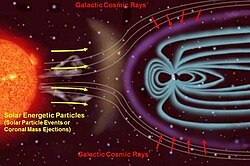
When these particles encounter Earth, most are deflected by the magnetosphere (Earth's magnetic field) or the heliosphere. However, those that penetrate the atmosphere collide with gas molecules, triggering a cascade of secondary particles known as air showers. While the bulk of this radiation is filtered by the atmosphere, some secondary particles reach the surface, influencing everything from atmospheric chemistry to electronic stability.
Key Facts
- Composition: Primarily protons and atomic nuclei.
- Origins: Supernova explosions, active galactic nuclei (such as blazar TXS 0506+056), and the Sun.
- Discovery: Identified by Victor Hess in 1912 via balloon experiments.
- Interaction: Primary rays create "air showers" of secondary particles upon hitting the atmosphere.
- Protection: Earth's magnetic field and the heliosphere deflect a significant portion of incoming flux.
The History and Discovery of Astroparticles
The existence of cosmic rays was first proven by Victor Hess in 1912. Through a series of daring balloon flights, Hess observed that ionization levels increased with altitude, suggesting that radiation was arriving from space rather than originating from the Earth's crust.

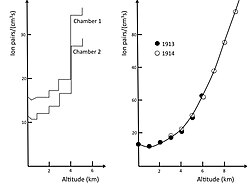

Hess's groundbreaking work earned him the Nobel Prize in Physics in 1936. Following his discovery, researchers like Bruno Rossi and others began identifying the nature of these particles. By the late 1950s, the advent of satellites allowed for the direct measurement of cosmic rays, particularly those at lower energy levels, using detectors similar to those found in high-energy physics laboratories.
Types and Sources of Cosmic Radiation
Cosmic rays are categorized into two primary types based on their origin and interaction with the environment.
Primary Cosmic Rays
Primary cosmic rays are the original particles that travel through interplanetary space. These include protons, alpha particles, and heavier atomic nuclei. Data from the Fermi Space Telescope suggests that a significant portion of these originate from supernova explosions. Additionally, observations of gamma rays and neutrinos from blazars indicate that active galactic nuclei are also major contributors.

Secondary Cosmic Rays
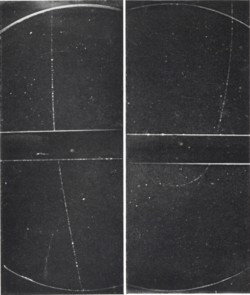
Secondary cosmic rays are produced when a primary particle collides with a molecule in Earth's atmosphere. This collision creates an "air shower," a cascade of particles including muons, pions, and neutrons. Some of these, such as muons, are capable of penetrating deep into the Earth's crust.

Energy and Flux Distribution
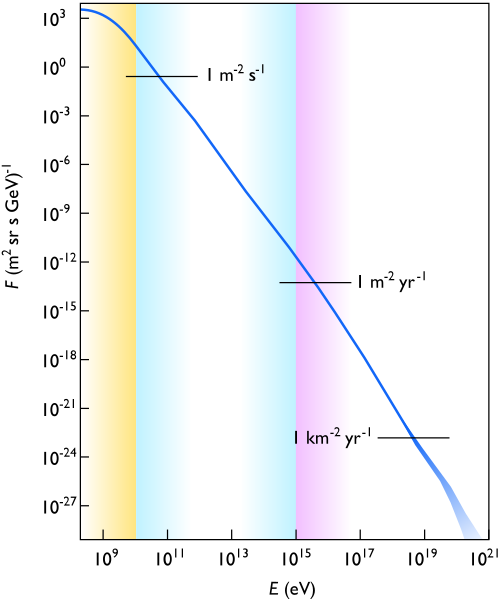
The energy of cosmic rays varies wildly, from relatively low-energy solar particles to ultra-high-energy cosmic rays (UHECR) with kinetic energies exceeding 1 EeV (exaelectronvolt). The flux—or the rate at which these particles arrive—decreases as the energy increases.
| Particle Energy (eV) | Particle Rate (ms) |
|---|---|
| 1 × 10¹⁰ (10 GeV) | 1 × 10⁴ |
| 1 × 10¹² (1 TeV) | 1 |
| 1 × 10¹⁵ (10 PeV) | 1 × 10⁻³ |
| 1 × 10²⁰ (100 EeV) | 1 × 10⁻¹⁰ |
The intensity of these rays is also subject to solar modulation, where the Sun's activity influences the amount of galactic cosmic radiation reaching the inner solar system.
![An overview of the space environment shows the relationship between the solar activity and galactic cosmic rays.[73]](/images/65/fe/65fe3829be702f5545d7710acd0da852efd48376bdb18e8b937a555a3cd7b8f2.jpg)
Detection and Scientific Research
Scientists use three primary methods to detect and study cosmic rays:
- Direct Detection: Using satellites (e.g., Alpha Magnetic Spectrometer, PAMELA) and space probes (Voyager 1 and 2) to measure particles before they hit the atmosphere.
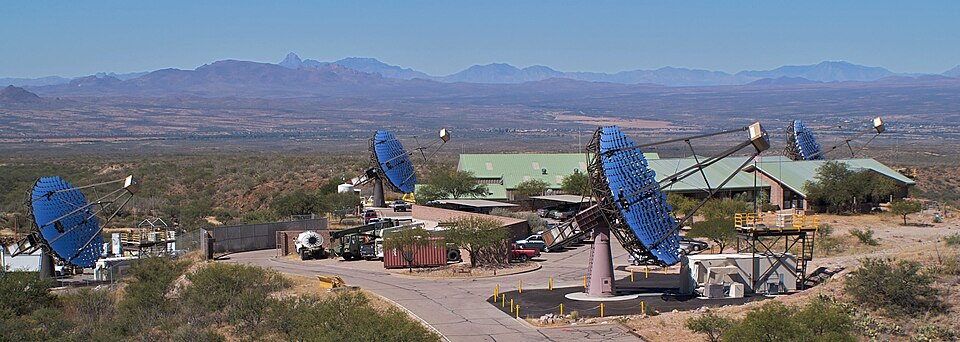
- Indirect Detection: Using ground-based arrays (e.g., Pierre Auger Observatory, VERITAS) to detect the air showers and Cherenkov radiation produced by primary particles.
- Balloon-borne Experiments: Using high-altitude balloons (e.g., BESS, CREAM) to sample rays above the bulk of the atmosphere.
Environmental and Biological Effects
Cosmic rays play a subtle but significant role in Earth's environment. They contribute to the production of radioisotopes in the atmosphere through spallation (the fragmentation of a nucleus after being hit by a high-energy particle). Examples include Carbon-14, used in radiocarbon dating, and Beryllium-10.
Beyond chemistry, cosmic rays pose challenges for modern technology and exploration. They can cause "soft errors" in computer electronics by flipping bits in memory. For aerospace travel, they represent a significant radiation hazard for astronauts traveling to Mars or beyond.
![Comparison of radiation doses, including the amount detected on the trip from Earth to Mars by the RAD on the MSL (2011–2013).[105][106][107]](/images/96/62/96624007e6648b714197b0cd283616c536b32c51929cf11af3f1642602f02218.png)
Frequently Asked Questions
What exactly are cosmic rays?
Cosmic rays are high-energy protons and atomic nuclei moving through space at nearly the speed of light, originating from the Sun, our galaxy, and other distant galaxies.
How does Earth protect us from cosmic radiation?
Earth is protected by its magnetosphere (magnetic field) and the heliosphere, which deflect many particles, as well as a thick atmosphere that absorbs and scatters the remaining radiation into secondary particle showers.
Where do the most energetic cosmic rays come from?
While the Sun produces lower-energy rays, the most powerful cosmic rays are believed to originate from supernova explosions and active galactic nuclei, such as blazars.
Do cosmic rays affect electronics?
Yes, cosmic rays can cause soft fails in computer electronics, where a particle strike changes the state of a memory bit, potentially leading to system crashes or data errors.
What is an "air shower"?
An air shower is a cascade of secondary particles created when a high-energy primary cosmic ray collides with a molecule in Earth's upper atmosphere.