Pierre Auger Observatory: Tracking Ultra-High-Energy Cosmic Rays
Deep in the western Mendoza Province of Argentina, near the towering Andes, lies one of the most ambitious scientific endeavors in astrophysics: the Pierre Auger Observatory. This international facility is dedicated to the study of ultra-high-energy cosmic rays—sub-atomic particles, such as protons or atomic nuclei, that travel through space at nearly the speed of light with energies exceeding 1018 eV.
Because these high-energy particles are incredibly rare—with an estimated arrival rate of only one particle per square kilometer per century—the observatory requires a massive footprint to capture enough data. Spanning 3,000 square kilometers (roughly the size of Luxembourg or Rhode Island), the facility provides the scale necessary to record these elusive cosmic events.
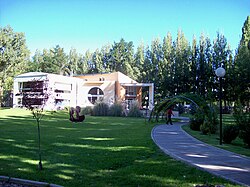
Key Facts
- Location: Malargüe, Mendoza Province, Argentina.
- Detection Area: 3,000 km².
- Hybrid Technology: Combines Surface Detectors (SD) and Fluorescence Detectors (FD).
- Primary Target: Cosmic rays with energies beyond 1018 eV.
- Collaboration: Over 500 physicists from nearly 100 institutions across 15 countries.
- Construction: Built between 2004 and 2008, with data collection beginning in 2005.
The Science of Air Showers
When an ultra-high-energy cosmic ray enters Earth's atmosphere, it collides with air nuclei, triggering a cascade of billions of secondary particles, including electrons, photons, and muons. This phenomenon is known as an air shower. These particles move in a forward-moving plane, spreading longitudinally as they descend toward the surface.
As this plane of particles passes through the atmosphere, it produces a faint ultraviolet (UV) light through a process called the fluorescing effect. This light, though invisible to the human eye, creates straight traces in the sky that can be captured by specialized telescopes.
When the shower finally reaches the ground, the particles enter water tanks where they trigger the Cherenkov effect—the emission of visible blue light that occurs when particles travel faster than the speed of light in that specific medium (water). This light is then captured by sensitive photoelectric tubes.
Hybrid Detection Systems
The Pierre Auger Observatory is unique because it employs a hybrid detection strategy, using two different methods to observe the same events. This allows for cross-calibration and reduces the systematic errors associated with using a single method.
Surface Detector (SD)
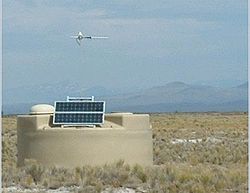
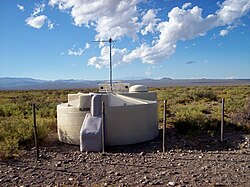
The surface array consists of 1,600 water-Cherenkov detectors, often referred to as "tanks." These stations are distributed across the Pampa Amarilla plain. By measuring the time difference between the arrival of particles at different tanks, scientists can use basic geometry to calculate the original direction and energy of the cosmic ray.
Fluorescence Detector (FD)
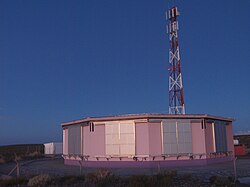
The FD system consists of 24 optical telescopes divided among four sites: Los Leones, Morados, Loma Amarilla, and Coihueco. These telescopes monitor the sky on cloudless, moonless nights to photograph the UV glow of air showers as they descend. This provides a direct observation of the shower's longitudinal development.
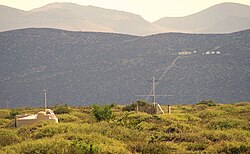
Observatory Infrastructure and Components
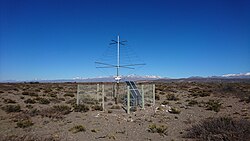
To ensure the accuracy of the FD measurements, the observatory utilizes several supporting facilities to monitor atmospheric conditions. These include the Central Laser Facility (CLF), the eXtreme Laser Facility (XLF), and various tools such as Lidars, infrared cloud cameras, and weather stations. Until 2010, a Balloon Launch Station (BLS) was used to record atmospheric data up to 23 km in height.
| Feature | Details |
|---|---|
| Altitude | 1,330 m – 1,620 m (Average ~1,400 m) |
| Wavelengths | 330–380 nm UV (FD); 10–1018 eV (SD) |
| SD Stations | 1,600 water-Cherenkov tanks |
| FD Telescopes | 24 telescopes across 4 locations |
| Budget | $50 million (shared by 15 countries) |
Scientific Results and Future Upgrades
Since 2005, the observatory has provided critical insights into the nature of the universe. While early results in 2007 suggested a correlation between the highest-energy events and active galactic nuclei (AGNs), further analysis indicated this was likely a statistical fluctuation. However, in 2017, 12 years of data revealed a significant anisotropy (non-uniformity) in the arrival directions of cosmic rays above 8 × 10¹⁸ eV, strongly supporting the theory that these particles originate from extragalactic sources.
The AugerPrime Upgrade
To further refine these measurements, the AugerPrime upgrade began in 2019. This project enhances the surface detectors with scintillation detectors and radio antennas and extends the FD duty cycle to include nights with moonlight. Additionally, the AMIGA (Auger Muons and Infill for the Ground Array) project is being completed to include underground muon detectors in a 20 km densely spaced area, aiming to better determine the mass of primary cosmic-ray particles.
Frequently Asked Questions
Who was Pierre Auger?
Pierre Victor Auger was a French physicist who, in 1937, concluded that cosmic rays interact with air nuclei to create showers of electrons and photons.
What is a water-Cherenkov detector?
It is a tank filled with ultra-pure water that detects the blue light (Cherenkov radiation) emitted when high-energy particles pass through the water at speeds exceeding the phase velocity of light in that medium.
Why is the observatory located in Argentina?
The location provides the vast, flat plains of the Pampa Amarilla and the clear skies necessary for both the massive surface array and the UV-sensitive fluorescence telescopes.
What is the difference between SD and FD?
The Surface Detector (SD) measures the particles that actually hit the ground, while the Fluorescence Detector (FD) observes the light emitted by the shower as it travels through the air.
Are the cosmic rays coming from our galaxy?
Data from 2017 suggests that ultra-high-energy cosmic rays above 8 × 10¹⁸ eV originate from extragalactic sources, meaning they come from outside the Milky Way.