Georges Lemaître: The Priest Who Proposed the Big Bang
Georges Lemaître was a rare polymath of the 20th century: a Belgian Catholic priest, a theoretical physicist, and a mathematician. While many know the Big Bang theory as the cornerstone of modern cosmology, it was Lemaître who first formulated the idea that our universe began from a single, incredibly dense point. His work bridged the gap between the complex mathematics of Albert Einstein's general relativity and the observable reality of a universe in motion.
Lemaître's journey was one of dual devotion. He balanced his ecclesiastical duties with a rigorous scientific career, eventually becoming a professor of physics at the Catholic University of Louvain. His ability to synthesize theoretical physics with astronomical observation changed our understanding of time, space, and the origin of existence.
Key Facts
- First Formulation: Proposed the "hypothesis of the primeval atom," now recognized as the first version of the Big Bang theory.
- Cosmic Expansion: First argued that the recession of galaxies proved the universe is expanding.
- Hubble–Lemaître Law: Connected the observational speed-distance relationship of galaxies with Einstein's field equations.
- Dual Career: Served as a priest of the Archdiocese of Mechelen and as President of the Pontifical Academy of Sciences.
- Scientific Legacy: His theories were later supported by the discovery of cosmic microwave background radiation.
Early Life and Academic Foundation
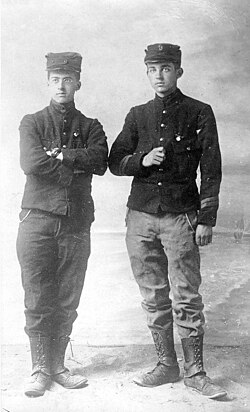
Born in Charleroi, Belgium, in 1894, Georges Lemaître pursued a diverse education in engineering, mathematics, physics, and philosophy at the Catholic University of Louvain. His path was not linear; he served in the Belgian Army during World War I before dedicating himself to both the church and science.
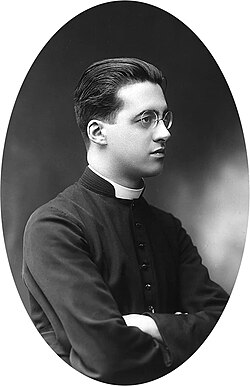
Lemaître entered the seminary for "late vocations" at Maison Saint-Rombaut between 1920 and 1923. It was during his spare time as a seminarian that he mastered the general theory of relativity—the geometric theory of gravitation published by Albert Einstein. He was ordained as a priest on September 22, 1923, by Cardinal Désiré-Joseph Mercier, who became a vital mentor, supporting Lemaître's desire to study abroad.
International Research and Mentorship
With the support of Cardinal Mercier, Lemaître traveled to the world's leading scientific hubs. In 1923–1924, he worked with astrophysicist Arthur Eddington at the University of Cambridge. He then moved to the United States (1924–1925), collaborating with Harlow Shapley at the Harvard College Observatory and studying at the Massachusetts Institute of Technology (MIT).
The Birth of the Big Bang Theory
In 1927, Lemaître published a report arguing that the universe was expanding. He linked the observed recession of galaxies to the solutions of the Einstein field equations for a universe that is homogenous (uniform in composition) and isotropic (looking the same in all directions). This relationship is now known as the Hubble–Lemaître law.
The Primeval Atom
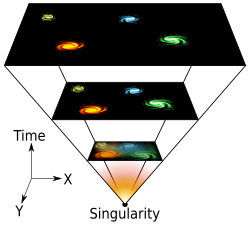
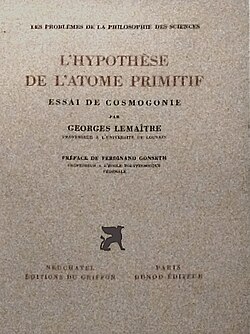
By March 1931, Lemaître took his theory a step further. He proposed that if the universe is expanding, it must have originated from a single initial quantum, which he termed the primeval atom. This concept suggested that the entire universe emerged from an extremely hot and dense state.
While the term "Big Bang" was actually coined in 1949 by astronomer Fred Hoyle—who ironically used it to mock the theory in favor of a steady-state model—Lemaître's "primeval atom" provided the scientific foundation for the concept.
Interactions with Albert Einstein
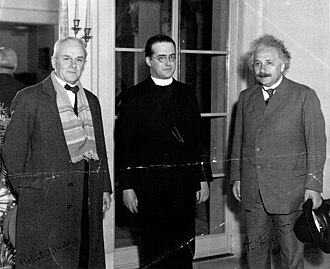
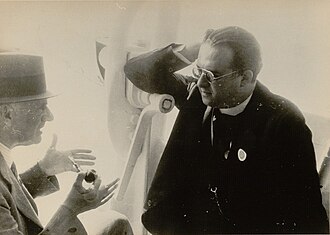
Lemaître and Albert Einstein met four times between 1927 and 1935. Initially, Einstein was skeptical of an expanding universe. However, after a lecture at the California Institute of Technology in 1933, Einstein reportedly applauded Lemaître, calling his explanation of creation "the most beautiful and satisfactory" he had ever heard, though some historians suggest Einstein was specifically praising Lemaître's ideas on cosmic rays.
Further Scientific Contributions
Beyond the origin of the universe, Lemaître was a pioneer in several other areas of physics:
- Cosmic Rays: Working with Manuel Sandoval Vallarta, he demonstrated that cosmic rays are deflected by Earth's magnetic field, proving they carry an electric charge. He hypothesized these rays might be "fossil radiation" from the decay of the primeval atom.
- Cosmological Constant: He advocated for a positive cosmological constant in Einstein's equations to reconcile the age of the universe with the age of the oldest known stars.
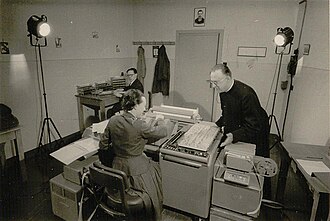
- Computational Physics: In the late 1950s, Lemaître was an early adopter of computers in physics research, utilizing machines like the Burroughs E101.
Later Years and Legacy
Lemaître remained a secular priest throughout his life. In 1960, Pope John XXIII appointed him as a Domestic Prelate (Monsignor) and President of the Pontifical Academy of Sciences. Despite his high standing in the church, Lemaître maintained a strict boundary between science and faith, believing it was dangerous for a mathematician to venture outside their expertise when discussing theology.
Lemaître passed away on June 20, 1966. Poetically, his death occurred shortly after the discovery of cosmic microwave background radiation, the experimental evidence that finally proved the universe had indeed begun with a hot, dense explosion.
| Category | Details |
|---|---|
| Born/Died | 1894 (Charleroi, Belgium) – 1966 (Leuven, Belgium) |
| Primary Theory | Hypothesis of the Primeval Atom (Big Bang) |
| Key Law | Hubble–Lemaître Law (Expansion of the Universe) |
| Major Awards | Eddington Medal (1953), Prix Jules Janssen (1936), Francqui Prize (1934) |
| Church Role | President of the Pontifical Academy of Sciences |
Frequently Asked Questions
Did Georges Lemaître invent the term "Big Bang"?
No. Lemaître proposed the "hypothesis of the primeval atom." The term "Big Bang" was coined in 1949 by Fred Hoyle, who actually opposed the theory.
How did Lemaître's work relate to Edwin Hubble?
While Edwin Hubble provided the observational data showing galaxies move away from us, Lemaître derived the mathematical relationship between distance and velocity two years earlier. This is why the law is now officially called the Hubble–Lemaître law.
Did Lemaître's faith conflict with his scientific theories?
Lemaître did not see a conflict. However, he was careful to keep his scientific work distinct from religious dogma, arguing that the two should be treated as separate areas of expertise.
What was the "primeval atom"?
The primeval atom was Lemaître's term for the single initial quantum of energy and matter from which the entire universe expanded.
What evidence eventually proved Lemaître correct?
The discovery of cosmic microwave background radiation shortly before his death provided the solid experimental support needed to confirm the Big Bang theory.