Corner Kicks: Rules, History, and the Rare Olimpico Goal
In the fast-paced world of association football, the corner kick (or simply a "corner") serves as a critical method of restarting play. It occurs when the ball crosses the goal line—without a goal being scored—having last been touched by a member of the defending team. While not as high-probability as a penalty, corners provide the attacking side with a significant opportunity to score through precise crossing and tactical positioning.
The kick is taken from the corner of the field nearest to where the ball exited the pitch, specifically within a designated quarter-circle area.

Key Facts
- Awarded when: The ball crosses the goal line after being last touched by the defending team.
- Olimpico Goal: A rare occurrence where a goal is scored directly from a corner kick without touching another player.
- Distance Rule: Opponents must remain at least ten yards away from the corner area.
- Offside: Players cannot be offside directly from a corner kick.
- Own Goals: Since 1997, it is impossible to score an own goal directly from a corner kick.
The Procedure and Rules
Executing a corner kick requires adherence to specific regulations to ensure fair play. The ball is placed within the corner area, and the kicker must ensure the ball clearly moves to be considered in play. Historically, the ball had to travel its own circumference, but this requirement was removed in 1997.

Positioning and Infringements
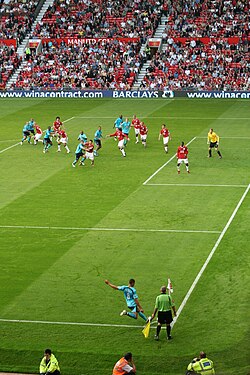
To prevent overcrowding and interference, the Laws of the Game dictate that all opposing players must maintain a minimum distance of ten yards from the corner area. If a player infringes upon this distance or if the kicker touches the ball a second time before another player does (known as a double touch), the referee may award a retake or a free kick to the opposing side.
Tactical Approaches
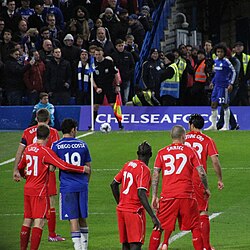
Teams employ various strategies when defending or attacking corners. Defending teams often choose between man marking (assigning a defender to a specific attacker) or zonal marking (defending specific areas of the penalty box). Attacking teams may opt for a traditional cross into the box or a short corner, where the ball is played to a nearby teammate to change the angle of attack.

The Olimpico Goal
An Olimpico goal occurs when the ball is kicked directly into the opposing goal from the corner arc. This rare feat was formally legalized by the International Football Association Board (IFAB) on June 14, 1924. The first recorded instance of such a goal took place on October 2, 1924, when Argentina's Cesáreo Onzari scored against Uruguay.
Modern examples continue to appear in professional play. For instance, Douglas Luiz scored two direct corners within a single week in August 2022, scoring against both Bolton Wanderers in the EFL Cup and Arsenal in the Premier League.

Evolution of the Corner Kick
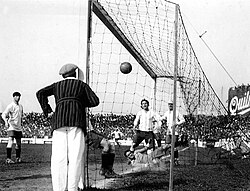
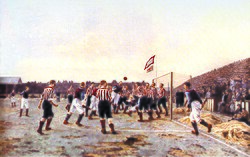
The corner kick has undergone numerous changes since its inception. Initially introduced in 1872, the kick had to be taken from the corner-flag itself. By 1874, the rule allowed the ball to be placed up to one yard from the flag, which briefly introduced the possibility of offside positions. However, by 1883, it was agreed that players could not be offside directly from a corner.
Other historical curiosities include the use of corner counts as tie-breakers in early 20th-century charity matches and certain cups in Dublin and Belfast, a practice that was never officially approved by IFAB. The board eventually endorsed the penalty shoot-out in 1970 as the standard tie-breaking method.
Summary of Rule Evolution
| Date | Awarded When | Location | Opponent Distance | Direct Goal Allowed? | Offside Possible? |
|---|---|---|---|---|---|
| 1872 | Last touched by defender | Corner-flag | 6 yards | Yes | Yes (from 1874) |
| 1883 | Last touched by defender | Within 1 yard of flag | 6 yards | No (from 1875) | No |
| 1924 | Last touched by defender | Corner area | 10 yards (by 1914) | Yes (Olimpico) | No |
| Modern | Last touched by defender | Corner area | 10 yards | Yes (Attacking only) | No |
Frequently Asked Questions
Can a player be offside directly from a corner kick?
No. According to the Laws of the Game established in 1883, a player cannot be in an offside position when receiving the ball directly from a corner kick.
What happens if the kicker touches the ball twice?
If the kicker plays the ball a second time before it has been touched by another player, it is an infringement. This is typically penalized by awarding an indirect free kick to the opposing team.
Is it possible to score an own goal directly from a corner?
No. Since a law amendment in 1997, a goal cannot be scored directly against one's own team from a corner kick. If the ball enters the kicker's own goal without touching another player, a corner kick is awarded to the opposing team.
What is the minimum distance opponents must keep?
Opposing players must remain at least ten yards away from the corner area until the ball is put into play.
What is the difference between man and zonal marking during a corner?
Man marking involves a defender following a specific attacking player wherever they move. Zonal marking involves defenders guarding a specific area of the penalty box, regardless of which attacker enters that space.