Football Captaincy: Roles, Responsibilities, and Traditions
In association football, the captain—often referred to as the skipper—serves as the designated on-pitch leader of a team. Typically chosen for their experience, age, or ability to influence the game through strong leadership qualities, the captain acts as the primary bridge between the players and the officiating crew.
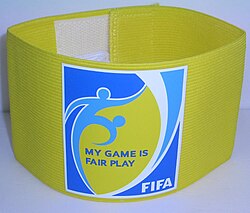
Traditionally, the captain is identified by a captain's armband. While this was once a custom, the 2024/25 edition of the Laws of the Game (the official rules governing football) has made it mandatory for every team to have a captain and for that individual to be clearly identified by an armband.
Key Facts
- Mandatory Role: Every team must have a captain according to the 2024/25 Laws of the Game.
- Identification: The captain must wear a captain's armband.
- Official Duty: The only rule-mandated responsibility is participating in the coin toss.
- Hierarchy: Vice-captains and additional captains (3rd, 4th, etc.) step in when the primary captain is unavailable.
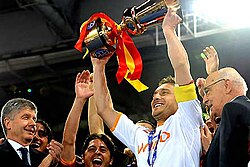
- Trophy Protocol: The match captain is typically the first to lift a trophy.
Responsibilities of the Captain
Official Duties under the Laws of the Game
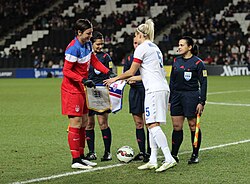
Contrary to popular belief, the Laws of the Game grant the captain very few official powers. Their primary mandatory responsibility is to participate in the coin toss before kickoff—to decide which end of the pitch to defend or who kicks off—and before a penalty shoot-out. Importantly, captains have no special legal authority to challenge a referee's decision, although referees may choose to speak with the captain regarding the general behavior of the team.
Ceremonial and Leadership Roles
Beyond the rulebook, the captain handles several traditional duties:
- Match Day: Leading the team out of the dressing room and leading the squad to collect medals during award ceremonies.
- Trophies: Receiving and hoisting the trophy first upon winning a competition.
- Team Management: Running the dressing room and serving as a rallying point to boost morale when spirits are low.
- Tactical Input: In some cases, captains may assist the manager in selecting the starting eleven. In youth or recreational football, they often handle administrative duties usually reserved for a manager.
Club vs. Match Captaincy
In professional club football, a distinction is often made between the club captain and the match captain. A club captain is usually appointed for the entire season and may serve as a public relations representative for the players.
However, if the club captain is injured, suspended, or not in the starting lineup, a match captain is designated. The match captain assumes all on-pitch duties and is the first to lift a trophy. For example, in the 1999 UEFA Champions League Final, Peter Schmeichel lifted the trophy as match captain because club captain Roy Keane was suspended. In the 2012 final, vice-captain Frank Lampard jointly lifted the trophy with suspended club captain John Terry after UEFA granted special permission.
Some clubs separate these roles entirely. Manchester United, for instance, had Gary Neville as club captain from 2005 to 2010, but because of injuries, players like Rio Ferdinand or Ryan Giggs served as captains on the field during major finals.
The Captaincy Hierarchy
Vice-Captains and Beyond
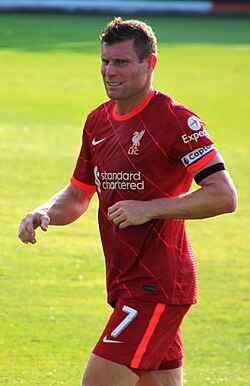
A vice-captain (or assistant captain) is the immediate successor who takes over if the captain is substituted, sent off, or not selected. Modern examples include players like Frenkie De Jong (Barcelona), Joshua Kimmich (Bayern Munich), and Federico Valverde (Real Madrid).
Some organizations implement a deeper hierarchy, naming 3rd, 4th, or even 5th captains. Barcelona has utilized this system with Raphinha (3rd) and Pedri (4th), while Barcelona Femení named six captains during their 2015–16 season.
International Captaincy
International leadership can be fluid due to tournament dynamics. During the 1986 FIFA World Cup, England saw Peter Shilton take over the captaincy after Bryan Robson was injured and vice-captain Ray Wilkins was suspended.
A complex situation occurred during Germany's 2010 FIFA World Cup campaign. Michael Ballack was the national captain but missed the tournament due to injury. Philipp Lahm was appointed as the World Cup captain, and Bastian Schweinsteiger captained the team for the third-place match when Lahm was ill. This led to a public clarification by manager Oliver Bierhoff to distinguish between the "World Cup captain" (Lahm) and the overall "captain" (Ballack).
| Role | Primary Function | Key Responsibility |
|---|---|---|
| Club Captain | Seasonal leader and PR representative | Overall squad leadership and representation |
| Match Captain | On-pitch leader for a specific game | Coin toss and trophy lifting |
| Vice-Captain | Backup leader | Assume duties if captain is absent or removed |
| International Captain | National team representative | Leading the country in tournaments/matches |
Frequently Asked Questions
Is the captain's armband mandatory?
Yes, according to the 2024/25 Laws of the Game, every team must have a captain, and that captain must be identified by an armband.
Can a captain argue with the referee to change a decision?
No. Under the Laws of the Game, captains have no special authority to challenge or change a referee's decision, although referees may communicate with them regarding team behavior.
What happens if the club captain is suspended for a final?
A match captain (usually the vice-captain) takes over the on-pitch duties and typically lifts the trophy, though special permissions from governing bodies (like UEFA) can sometimes allow the club captain to participate in the celebration.
How many captains can a team have?
While there is only one on-pitch captain per game, clubs can appoint multiple captains in a hierarchy (1st, 2nd, 3rd, etc.). Some teams, such as Barcelona Femení in 2015–16, have named as many as six captains.
What is the only official duty of a captain in the rulebook?
The only official responsibility specified by the Laws of the Game is participating in the coin toss before the start of the match and before a penalty shoot-out.