Penalty Kicks: History, Rules, and Tactics of Football's Most Dramatic Moment
In the world of association football, few moments carry as much tension as the penalty kick (also known as a pen or spot kick). This method of restarting play provides a striker with a single, direct shot at the goal, defended only by the opposing goalkeeper. Awarded when a player commits a direct free-kick offence within their own penalty area, the penalty kick is a high-stakes duel that can decide the outcome of a match in a matter of seconds.
The shot is taken from the penalty spot, located exactly 12 yards (11 metres) from the goal line and centered between the touch lines.
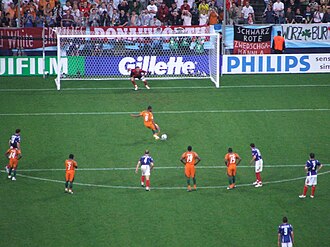
Key Facts
- Distance: The penalty spot is 12 yards (11 metres) from the goal line.
- Origin: Invented by William McCrum in 1890 and officially introduced in 1891.
- Success Rate: Conversion rates vary, with some European leagues seeing between 76.5% and 79.8% success.
- Key Rule: The ball must clearly move forward to be considered in play.
- Infringements: Awarded for offences like handball, tripping, pushing, or holding within the penalty area.
The Evolution of the Penalty Kick
The concept of the penalty was born out of a need for fairness. In the early days of football, the 1863 laws had no defined punishments for rule infringements. By 1872, indirect free kicks were used for illegal handling, but these were often seen as inadequate when a handball prevented a certain goal.
William McCrum, a goalkeeper and businessman from County Armagh, proposed the penalty kick in 1890. Following a few high-profile goal-line handball incidents in the 1890–91 season, the International Football Association Board (IFAB) approved the rule in 1891.
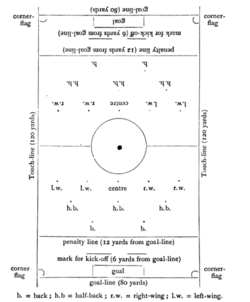
Major Rule Changes Over Time
The penalty we see today has evolved significantly since its inception:
- 1902: The modern penalty area (18 yards from goal-posts) and the specific penalty spot were introduced.
- 1923: To prevent defenders from crowding the kicker, all other players were required to be at least 10 yards (9.15 m) from the spot.
- 1997: The rule requiring the ball to travel its own circumference before being in play was removed; the ball became in play as soon as it moved forward.
- 2010: Rules were clarified regarding feinting (the "paradinha" or little stop). While feinting during the run-up is permitted, feinting to kick the ball after the run-up is complete is an infringement.
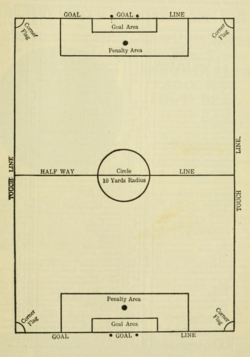
Procedure and Infringements
The outcome of a penalty kick depends on the conduct of both the attacking and defending teams. If the kick is taken correctly and enters the goal, a goal is awarded. However, various violations can change the result.
Common Violations
- Attacking Team Violation: If the kicker feints at the end of the run-up or a teammate kicks the ball instead, the kicker is cautioned.
- Defending Team Violation: If the defense infringes, the kick is typically retaken.
- Ball Movement: If the kick does not go forward, it is considered a violation.
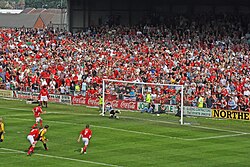
The "Tap Penalty"
A rare variation is the tap penalty, where two players touch the ball in succession. The first recorded instance occurred on May 1, 1957, involving Jimmy McIlroy and Danny Blanchflower of Northern Ireland. Other notable attempts include a 1982 play by Johan Cruyff and Jesper Olsen of Ajax.
Goalkeeper Tactics and Psychology
Because the pressure is primarily on the kicker, goalkeepers often employ psychological tactics to induce mistakes. These include:
- Visual Distractions: Pointing or gesturing to mislead the kicker. For example, Edwin van der Sar pointed to his left in the 2008 Champions League Final to trick Nicolas Anelka.
- Verbal Provocation: Using words to irritate or annoy the opponent.
- Physical Presence: Confronting the kicker or delaying the start of the kick to build tension.
- Movement: Using erratic movements, such as Bruce Grobbelaar's "spaghetti legs" in 1984 or Jerzy Dudek's similar tactics in 2005.
Penalty Statistics
While penalties are generally successful, they are far from guaranteed. In the 2005–06 English Premier League season, nearly 30% of penalties were unsuccessful. Research in the German Bundesliga over 16 years showed a 76% success rate, with a striking 99% of shots in the upper half of the goal resulting in scores, despite being a harder target.
World Cup shootouts tend to be more difficult, with a lower scoring rate of 69.4%.
| Feature | 1891 Rules | Modern Rules (Post-2010) |
|---|---|---|
| Offence Location | Within 12 yards of goal-line | Within the penalty area |
| Kick Location | Any point 12 yards from goal-line | The penalty spot |
| Other Players | At least 6 yards behind the ball | Outside area & 10 yards from spot |
| Feinting | Permitted unless "ungentlemanly" | Permitted in run-up; forbidden after run-up |
| GK Movement | Within 6 yards of goal-line | Must stay on the goal line |
Frequently Asked Questions
What offences result in a penalty kick?
A penalty is awarded for direct free-kick offences committed by a player in their own penalty area. This includes handballs (except by the goalkeeper), tripping, pushing, holding, jumping at an opponent, or striking/head-butting.
Can a player feint during a penalty kick?
Yes, feinting during the run-up to confuse the goalkeeper is permitted. However, if a player feints to kick the ball after the run-up is already complete, it is an infringement and the player must be cautioned.
What happens if the goalkeeper moves off the line too early?
If the goalkeeper violates the rule of staying on the goal line and the kick is missed or saved, the penalty is typically retaken. However, historical data shows that goalkeepers frequently move from the line in practice.
What is a tap penalty?
A tap penalty is a trick play where the designated kicker passes the ball to a teammate, who then allows the original kicker (or another teammate) to score. While recorded in history, such as by Northern Ireland in 1957, they are rare.