Constructivism: The Industrial Art of the Soviet Avant-Garde
Emerging from the turbulence of early twentieth-century Russia, Constructivism was more than an art movement; it was a radical attempt to align creative expression with the needs of a modern industrial society. Founded in 1915 by Vladimir Tatlin and Alexander Rodchenko, the movement rejected the idea of "art for art's sake," opting instead for an austere, abstract aesthetic that mirrored the urban space and machinery of the era.
By replacing decorative stylization with the industrial assemblage of materials, Constructivists sought to put art in the service of propaganda and social utility. Deeply entwined with the Bolsheviks and Soviet socialism, the movement aimed to transform the artist from a solitary dreamer into a "constructor" who contributed directly to the building of a new socialist state.
Key Facts
- Active Period: 1915–1934.
- Origins: Founded in Russia (later the Soviet Union) by Vladimir Tatlin and Alexander Rodchenko.
- Core Philosophy: Rejection of decorative art in favor of industrial materials and social utility.
- Key Concepts: Faktura (material properties) and tektonika (spatial presence).
- Major Influence: Directly led to Productivism and indirectly influenced the Bauhaus and De Stijl movements.
- Defining Work: Tatlin's Tower (Monument to the Third International).
The Evolution of Constructivist Theory
Constructivism developed as a post-World War I evolution of Russian Futurism. While it drew geometric inspiration from Kazimir Malevich's Suprematism, it diverged by focusing on the physical and the functional. The term was coined by sculptors Antoine Pevsner and Naum Gabo, appearing formally in Gabo's 1920 Realistic Manifesto and later in Aleksei Gan's 1922 book, Constructivism.
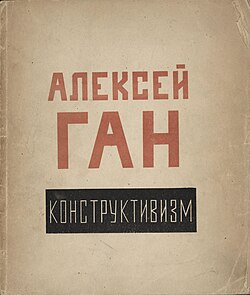
Much of the movement's theoretical framework was forged during debates at the Institute of Artistic Culture (INKhUK) in Moscow between 1920 and 1922. After removing Wassily Kandinsky for his perceived "mysticism," a core group of artists—including Liubov Popova, Varvara Stepanova, and Rodchenko—defined the movement through two primary lenses: faktura, the specific material properties of an object, and tektonika, its spatial presence. This shift moved the movement from three-dimensional compositions toward two-dimensional works like posters and books, utilizing montage and factography.
Tatlin's Tower and the Great Schism
The quintessential symbol of the movement was Vladimir Tatlin's 1919–20 proposal for the Monument to the Third International, commonly known as Tatlin's Tower. This design merged a machine aesthetic with dynamic elements, including projection screens and searchlights, to celebrate technology.
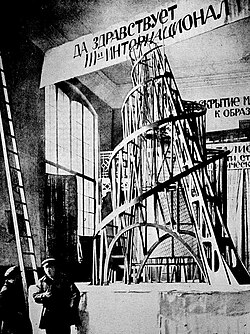
The tower sparked a significant ideological divide. Naum Gabo and Antoine Pevsner argued for a distinction between pure art and functional engineering, asserting a spiritual core for the movement. In contrast, Tatlin and Rodchenko championed a utilitarian version of Constructivism. Although the tower was never built due to post-revolutionary financial shortages, it became a sensation in Germany, where artists like George Grosz hailed it as the birth of "Machine Art."
Art in the Service of Revolution
Constructivists viewed the city as their canvas. Following the October Revolution, they designed public festivals and street decorations for the Bolshevik government. In Vitebsk, the UNOVIS Group produced propaganda plaques, most notably El Lissitzky's Beat the Whites with the Red Wedge (1919).
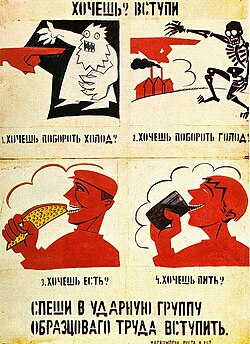
This era saw a strong overlap with Proletkult, a movement dedicated to creating a completely new proletarian culture. Artists also contributed to the "ROSTA Windows," a public information campaign featuring the work of poet-painter Vladimir Mayakovsky and Vladimir Lebedev.
Productivism and the Mass Market
By the early 1920s, the movement evolved into Productivism, a theory propounded by Osip Brik and others that demanded the end of easel painting in favor of direct industrial participation. Tatlin designed economical stoves and workers' overalls, while others turned to the New Economic Policy (NEP) of 1921, which introduced market opportunities into the Soviet economy.
Rodchenko and Mayakovsky branded themselves as "advertising constructors," creating bold, geometric advertisements for the state-owned department store Mosselprom. This period also saw experiments in fashion; Varvara Stepanova and Lyubov Popova designed geometric dresses and overalls intended for mass production.
Cinema, Photography, and Graphic Design
The "Left Front of the Arts" (LEF) promoted cinema as a superior medium to traditional painting. Constructivist influence is evident in the fast-cut montage styles of Dziga Vertov and Sergei Eisenstein. Rodchenko provided designs for Vertov's Kino Eye (1924), while Aleksandra Ekster designed sets for the sci-fi film Aelita (1924).
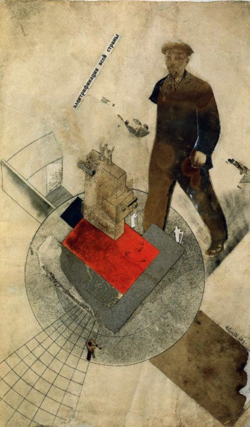
In photography, the movement pioneered photomontage—the process of collaging photographs and painted sections to create striking, multi-layered compositions. Gustav Klutsis and El Lissitzky used this technique to convey rapid social change, creating works that were less destructive than the Dadaist montages of the time.
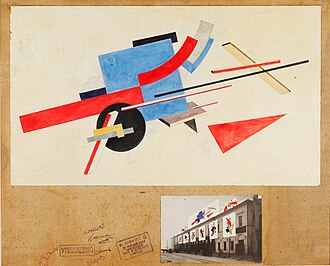
Constructivist Architecture and Global Legacy
Constructivist architecture focused on the social demands of the new regime. While Gabo and Pevsner focused on space and rhythm, the dominant thread—led by the O.S.A. group under Alexander Vesnin and Moisei Ginzburg—emphasized social utility.
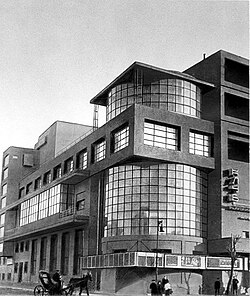
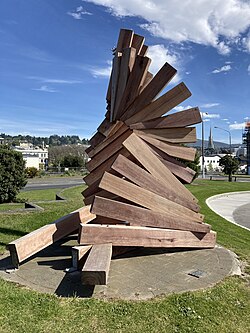
The movement's influence spread globally. Many Constructivists taught at the Bauhaus in Germany, and the style reached Latin America through figures like Joaquín Torres García, influencing masters such as Oscar Niemeyer. Even in the late 20th century, the aesthetic resurfaced in the work of graphic designer Neville Brody and the company The Designers Republic.
| Category | Key Characteristics / Figures |
|---|---|
| Primary Goal | Integration of art into industrial production and social utility. |
| Key Figures | Vladimir Tatlin, Alexander Rodchenko, El Lissitzky, Varvara Stepanova. |
| Visual Style | Geometric abstraction, industrial materials, bold lettering, photomontage. |
| Influences | Cubism, Futurism, Suprematism, Russian folk art. |
| Legacy | Bauhaus, De Stijl, Modernist architecture in Latin America. |
Frequently Asked Questions
What is the difference between Constructivism and Productivism?
Constructivism was the broader art movement focusing on the "construction" of art using industrial materials. Productivism was a more radical offshoot that demanded the total abandonment of fine art (like easel painting) in favor of direct participation in industrial manufacturing.
Why was Tatlin's Tower never built?
Despite its immense influence on the international art community, the tower remained a proposal because the Soviet government lacked the necessary funds following the Russian Revolution.
How did Constructivism influence modern graphic design?
Constructivism introduced the use of bold typography, asymmetrical layouts, and photomontage. These elements were later adopted by the Bauhaus and continue to influence contemporary graphic design and advertising.
What happened to the movement in the 1930s?
By 1934, the Soviet government officially instituted Socialist Realism as the state-approved artistic style, effectively replacing the avant-garde experimentation of Constructivism with a more traditional, realist approach.
What are faktura and tektonika?
Faktura refers to the inherent material properties of the objects used in a work, while tektonika refers to the spatial presence and structural logic of the composition.