Compton Scattering: The Quantum Nature of Photon Interaction
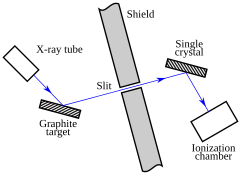
Compton scattering, also known as the Compton effect, is a fundamental quantum phenomenon where a high-frequency photon interacts with a charged particle—typically an electron. When a photon strikes a loosely bound electron in the outer valence shell of an atom or molecule, it releases the electron and scatters in a new direction with reduced energy.
Discovered in 1923 by Arthur Holly Compton, this effect provided critical evidence for the particle-like behavior of light. By combining special relativity and quantum mechanics, Compton explained why X-rays scattering off light elements shifted in wavelength, a discovery that earned him the Nobel Prize in Physics in 1927.
Key Facts
- Discovery: Identified by Arthur Holly Compton in 1923; Nobel Prize awarded in 1927.
- Core Mechanism: A photon transfers part of its energy to a recoil electron, resulting in an increase in the photon's wavelength.
- Energy Range: It is the dominant interaction for photons with energies higher than the photoelectric effect but lower than the pair-production threshold.
- Inverse Effect: In inverse Compton scattering, a high-energy electron transfers energy to a photon, increasing the photon's energy.
- Conservation: The process strictly obeys the laws of conservation of energy and momentum.
The Mechanics of the Compton Effect
At the atomic level, photons can interact with matter in several ways. While the photoelectric effect involves total absorption and pair production creates an electron-positron pair from high-energy photons (1.022 MeV and above), Compton scattering occurs specifically at the electron level.
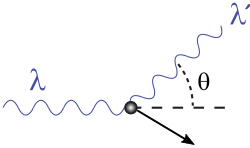
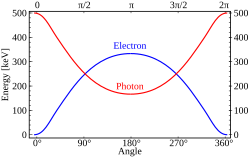
When a high-frequency photon collides with an electron, it behaves like a billiard ball. The photon's energy is reduced, which means its wavelength increases. This change is known as the Compton shift. The energy lost by the photon is transferred to the electron, which is then called a Compton recoil electron.
Elastic vs. Inelastic Scattering
Compton scattering is often described as inelastic scattering because the scattered photon has less energy than the incident photon. However, the classification depends on the perspective: if viewed as a collision between a photon and a free electron, it is elastic because the internal state of the electron does not change. If viewed as an interaction with an atom, it is inelastic because the atom's state is altered (ionization).
The Mathematical Foundation
Classical electromagnetism predicted that scattered X-rays should maintain their original wavelength. Compton disproved this by attributing particle-like momentum to light quanta. He derived a relationship showing that the wavelength shift depends on the scattering angle (θ).
The shift is defined by the Compton wavelength of the electron, which is approximately 2.43 × 10⁻¹² m. The wavelength shift is zero at 0° and reaches its maximum (twice the Compton wavelength) at 180°. In cases where no shift occurs despite a large angle, the photon has scattered off the entire atom rather than a single electron, a process called coherent scattering.
![Plot of photon energies calculated for a given element (atomic number Z) at which the cross section value for the process on the right becomes larger than the cross section for the process on the left. For calcium (Z = 20), Compton scattering starts to dominate at hυ = 0.08 MeV and ceases at 12 MeV.[2]](/images/65/1e/651e2d4e1f11c591f9d12406ab77479349295ded0035a7ece8aa63c7ea3c21e5.webp)
Comparison of Photon Interactions
| Process | Energy Range | Primary Interaction Target | Result |
|---|---|---|---|
| Photoelectric Effect | eV to few keV | Atomic Electron | Complete absorption; electron ejection |
| Compton Scattering | Intermediate | Loosely bound electron | Partial energy transfer; wavelength shift |
| Pair Production | ≥ 1.022 MeV | Nucleus | Creation of electron and positron |
| Photodisintegration | ≥ 1.670 MeV | Nucleus | Ejection of nucleon or alpha particle |
Advanced Variations and Applications
Inverse Compton Scattering
In inverse Compton scattering, the roles are reversed: a relativistic electron transfers energy to a low-energy photon. This is vital in astrophysics, particularly in X-ray astronomy. For example, in the accretion disks of black holes, lower energy photons are scattered to higher energies by electrons in the surrounding corona, a process known as relativistic reflection.
This effect also causes the Sunyaev–Zel'dovich effect, where cosmic microwave background (CMB) photons are boosted to higher energies by hot gas in galaxy clusters, allowing astronomers to detect these clusters regardless of their redshift.
Non-linear Inverse Compton Scattering (NICS)
NICS occurs when an intense electromagnetic field (such as a high-power laser) allows a charged particle to absorb multiple low-energy photons and emit a single high-energy X-ray or gamma ray. This is used to probe non-linear quantum electrodynamics (QED) and trigger nuclear reactions.
Practical Applications
- Radiobiology: It is the most probable interaction for gamma rays in living tissue, making it central to radiation therapy.
- Gamma Spectroscopy: It creates the Compton edge in detectors; scientists use Compton suppression to filter out these stray scattered rays.
- Nuclear Physics: Compton backscattering in synchrotron facilities produces MeV to GeV photons for experimental use.
Frequently Asked Questions
What is the difference between Compton scattering and Thomson scattering?
Thomson scattering is the low-energy limit of photon scattering where the photon's energy is not significantly changed. Compton scattering is the quantum version where the photon loses energy and its wavelength increases.
Why is the Compton effect important for quantum mechanics?
It provided the first direct experimental evidence that photons possess momentum and behave as particles, not just as waves, validating the quantum theory of light.
What is a Compton recoil electron?
A Compton recoil electron is the electron that has been knocked out of its atomic shell after absorbing a portion of the incident photon's energy during the scattering process.
How does inverse Compton scattering differ from standard Compton scattering?
In standard Compton scattering, a high-energy photon loses energy to an electron. In inverse Compton scattering, a high-energy electron gives energy to a low-energy photon, increasing the photon's frequency.
What is the Sunyaev–Zel'dovich effect?
It is a specific instance of inverse Compton scattering where photons from the cosmic microwave background are energized by hot electrons in galaxy clusters, serving as a tool for detecting those clusters.