Photon: The Quantum Particle of Light
In the realm of physics, a photon is the elementary particle or quantum of light. It serves as the fundamental unit of electromagnetic radiation, bridging the gap between the classical understanding of light as a wave and the modern understanding of light as a stream of discrete energy packets. Whether it is the light from a distant star or the signal in a fiber-optic cable, every interaction involves these massless particles.
The concept of the photon revolutionized our understanding of the universe, moving science away from the purely wave-based models of the 19th century toward the complex world of quantum mechanics.
![Thomas Young's sketch of interference based on observations of water waves.[35] Young reasoned that the similar effects observed with light supported a wave model and not Newton's particle theory of light.[20]: 964](/images/92/05/920596923a843023f5835f3b1b8f1b5767cb93464c238eda697dca866e4c5e35.png)
Key Facts
- Symbol: Denoted by the Greek letter gamma (γ) in physics, or hν in chemistry and optical engineering.
- Mass: Theoretically zero, with an experimental upper limit of less than 1 × 10-18 eV/c2.
- Charge: Electrically neutral (experimental limit < 1 × 10-18 e).
- Spin: 1 ħ, making it a gauge boson.
- Stability: Considered a stable particle with no known mean lifetime.
- Theorized by: Albert Einstein in 1905; the term "photon" was coined by Gilbert N. Lewis in 1926.
Physical Properties and Behavior
Energy and Momentum
A photon's energy is directly proportional to its frequency, defined by the equation E = hν, where h is the Planck constant and ν (nu) is the frequency. Unlike matter, photons have no rest mass, yet they possess momentum. This momentum is determined by the wave vector k, and its magnitude is expressed as p = ħk.
Polarization and Spin
Photons are characterized by a spin of 1 ħ, which classifies them as gauge bosons—particles that carry forces between other particles. In the case of the photon, it mediates the electromagnetic force. They exhibit two possible spin states (+1 ħ and −1 ħ), which correspond to the left and right circular polarizations of light.
Wave-Particle Duality
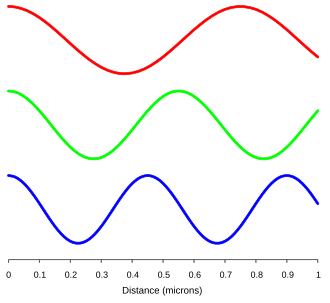
One of the most profound aspects of the photon is wave-particle duality. While light exhibits wave-like properties such as interference and diffraction, it also interacts with matter as discrete particles. This duality is central to quantum field theory, where electromagnetic modes are treated as independent simple harmonic oscillators, and a photon represents a single unit of energy within that mode.
Historical Development
From Waves to Quanta
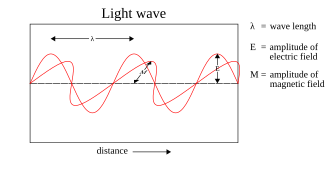
By 1900, James Clerk Maxwell's model of light as oscillating electric and magnetic fields was the gold standard. However, certain observations could not be explained by wave theory alone. This led to the realization that light energy is packaged into quanta.
The Photoelectric Effect
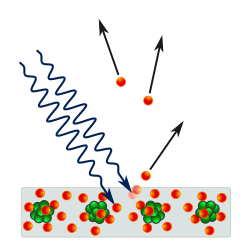
Albert Einstein's 1905 proposal that light consists of quanta was supported by the photoelectric effect—the phenomenon where electrons are emitted from a metal plate when struck by light of a sufficient frequency. This proved that light behaves as a particle (the photon) rather than just a continuous wave.
The Path to Quantum Mechanics
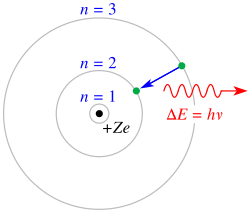
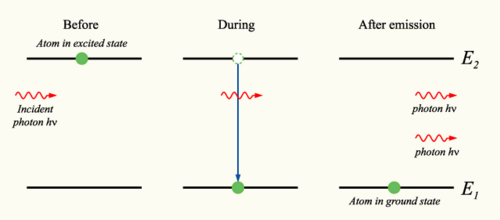
Early physicists were initially hesitant to accept that light itself was quantized. Some attempted to explain these behaviors by quantizing only matter, as seen in the Bohr model of the hydrogen atom. However, subsequent experiments and the prediction of stimulated emission—where photons "clone" themselves—paved the way for the development of the laser and the statistical interpretation of quantum mechanics.
The Photon in Modern Physics
Quantum Field Theory and Gauge Bosons
In the Standard Model of particle physics, the photon is the gauge boson for electromagnetism. It is the mediator of the electromagnetic interaction, meaning that when two charged particles (like electrons) interact, they do so by exchanging virtual photons.

Summary of Photon Characteristics
| Property | Value / Description |
|---|---|
| Mass | 0 (Theoretical) |
| Electric Charge | 0 |
| Spin | 1 ħ |
| Statistics | Bose–Einstein |
| Interactions | Electromagnetic, Gravity |
| Parity | −1 |
Frequently Asked Questions
Does a photon have mass?
Theoretically, the photon is massless. Experimental limits have placed an extremely low upper bound on its possible rest mass (less than 1 × 10-18 eV/c2), but for all practical purposes in physics, it is treated as having zero mass.
What is the difference between a photon and a gamma ray?
A gamma ray is simply a high-energy photon. The term "gamma ray" refers to the specific part of the electromagnetic spectrum with the highest frequency and shortest wavelength, but the underlying particle is still a photon.
How does a photon carry momentum if it has no mass?
In quantum mechanics, momentum is related to wavelength (or wave vector) rather than just mass and velocity. Because photons have energy and a specific wavelength, they possess momentum defined by p = h/λ.
What is a virtual photon?
A virtual photon is a transient fluctuation that mediates the electromagnetic force between charged particles. Unlike real photons, which can be detected as light, virtual photons are mathematical tools in quantum field theory used to describe the exchange of force.
Who named the photon?
While Albert Einstein theorized the existence of light quanta in 1905, the specific term "photon" is generally attributed to the chemist Gilbert N. Lewis in 1926.