Cockades: The History and Symbolism of the Ribbon Knot
A cockade is a knot of ribbons or a circular, oval-shaped symbol of distinctive colors typically worn on a hat or cap. Derived from the French cocarde (and the Old French coquarde, meaning vain or arrogant), the term first appeared in documented use in 1709. While they may seem like simple accessories today, cockades have served as powerful tools for national identification and political expression for centuries.
The practice began in 15th-century Europe, where armies used them to signal nationality and distinguish allies from enemies on the battlefield. This tradition was inspired by the colored bands and ribbons worn by knights during the Late Middle Ages for both warfare and tournaments.
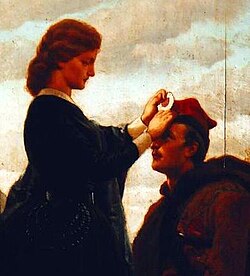
Key Facts
- Origin: First introduced in Europe during the 15th century to distinguish friend from foe.
- Function: Served as an economical way to identify nationality when regimental uniforms varied.
- Political Use: Became a primary symbol of political allegiance during the Age of Revolutions.
- Evolution: Transitioned from fabric ribbons on hats to metal insignia and aircraft roundels.
- Modern Legacy: Still used in some national uniforms and as commemorative symbols in countries like Hungary.
The Cockade as a Revolutionary Symbol
During the 18th and 19th centuries, the cockade evolved into a symbol par excellence for revolutionary movements. Its high visibility allowed wearers to unequivocally signal their political ideas, yet it remained easier to hide than a full-sized flag if the wearer needed to avoid detection.
In London during the 1780 Gordon Riots, the blue cockade became a prominent symbol of anti-government sentiment. Similarly, in Italy, the tricolor cockade (green, white, and red) became a central symbol of the Risorgimento (Italian unification). First appearing in Genoa on August 21, 1789, the tricolor cockade preceded the official national flag of the Cispadane Republic in 1797.
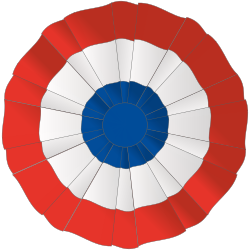
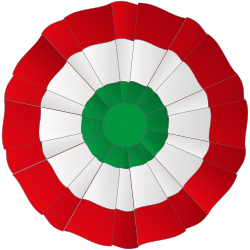
Military Application and Evolution
For European monarchies, cockades provided a standardized field sign. Because individual regiments often had different uniform coats, a consistent cockade on headgear ensured that soldiers could be identified by their nationality.
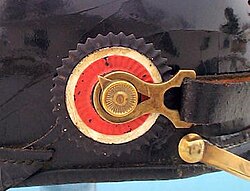
These symbols were worn on a variety of headgear, including tricornes, bicornes, shakoes, and cocked hats. Over time, materials evolved: ribbon-style cockades were common on brimmed hats, while metal versions were often attached to the side of helmets. Small button-type cockades were later used on the front of peaked caps and kepis.
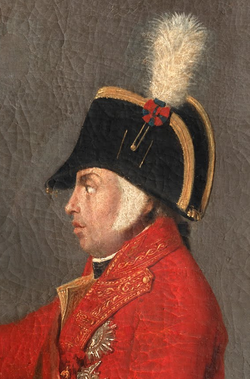
The German Empire and the Third Reich
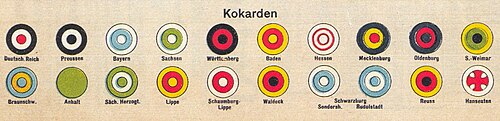
The Second German Empire (1870–1918) utilized a dual-cockade system. One cockade (black-white-red) represented the empire, while a second represented the wearer's specific monarchy. Exceptions included Bavaria (white-blue-white) and Württemberg (black-red-black), which maintained their own independent armed forces.
The Weimar Republic later removed these symbols to prevent regional separatism. However, the Nazi regime rejected the democratic black-red-gold colors of the Weimar era and reintroduced the imperial black-white-red colors, representing the union of Prussia and the Hanseatic League city-states.
From Hats to Aircraft: The Roundel
In 1909, France established its first Air Service and adopted the traditional French cockade as a national emblem for aircraft. This evolved into what is now known as a roundel. During World War I, other nations followed suit, using colored circular emblems to identify military aircraft, sometimes adding central devices—such as the French navy's black anchor—for further specification.


Global Variations
Beyond Europe, cockades played a role in American history. During the lead-up to the American Civil War (1861–1865), blue ribbons worn on clothing or hats were widespread tokens of Southern support for secession, echoing the symbols used during the American rebellion against Britain.
In Hungary, the cockade remains a potent symbol of national identity. Revolutionaries wore them during the uprisings of 1848 and 1956, leading to the modern tradition of wearing cockades on March 15.
| Country | Colors (Center $\rightarrow$ Edge) |
|---|---|
| France | Blue-White-Red |
| Italy | Green-White-Red |
| Germany (Modern) | Black-Red-Gold |
| Hungary | Green-White-Red |
| United States | White-Blue-Red |
| Poland | Red-White |
| Brazil | Blue-Yellow-Green |
Frequently Asked Questions
What is the difference between a cockade and a roundel?
A cockade is traditionally a ribbon or fabric knot worn on headgear. A roundel is a circular national emblem painted on the fuselage or wings of military aircraft, a design that evolved directly from the French cockade.
Why were cockades used instead of just uniforms?
Cockades were an economical and efficient way to provide a common field sign. Because different regiments within a single national army often wore different colored coats, the cockade served as the primary indicator of nationality.
What did the colors of the Nazi cockade represent?
The black-white-red colors represented the largest and smallest entities of the Reich: the black and white of Prussia and the white and red of the Hanseatic League city-states (Hamburg, Bremen, and Lübeck).
How did cockades function as political symbols?
Due to their high visibility, cockades allowed individuals to publicly declare their allegiance to a political faction or revolutionary cause. Because they were small, they could be easily hidden if the wearer was in danger.