China Urban Planning: The Evolution of a National Strategy
The development of urban planning in the People's Republic of China (PRC) represents a unique trajectory defined by "Chinese characteristics." Since the communist takeover in the early 1950s, the nation has transitioned from a rigid, centralized industrial model to a complex, modern system of rapid urbanization. This evolution reflects the shifting political and economic priorities of the state, moving from heavy industrialization to comprehensive urban renewal.
Key Facts
- Early Influence: Initial planning was heavily based on Soviet principles, focusing on grand designs and industrial bases.
- Industrial Focus: The First Five-year Plan (1953–58) prioritized 156 national key projects and 8 key industrial cities.
- Rapid Growth: China's urbanization rate reached nearly 50% by 2010.
- Current System: Modern planning is governed by the Chinese Urban and Rural Planning Act, utilizing a two-tier system of master and detailed plans.
- Urban Phenomena: The term "nail houses" (dingzi hu) refers to residents who refuse to relocate during large-scale redevelopment.
Phase 1: Centralized Industrialization (1949–1960)
Following the establishment of the PRC, urban planning was inextricably linked to centralized economic planning. In September 1952, two pivotal policies were introduced: the construction of key cities coordinated with national economic development and the establishment of a formal urban planning structure. These mandates ensured that city growth served the state's goal of rapid industrialization, particularly in heavy industry.
During the First Five-year Plan (1953–58), China developed 8 key industrial cities and 156 national projects. This era relied heavily on Soviet Union experts, adopting Soviet planning principles. This model emphasized formalistic street patterns, massive public squares, grand monuments, and the dominance of the master plan. Planners focused on the functional division of land, the placement of factories, and the creation of worker housing.
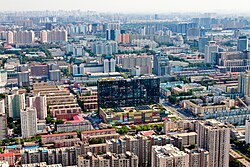
Historic preservation was largely ignored during this phase. A notable example was the demolition of Beijing's city walls under Mao Zedong; the resulting bricks were repurposed for new homes and the city's subway system. By 1959, this approach had produced plans for 180 cities, 1,400 towns, and over 2,000 suburban settlements.
Phase 2: Political Turbulence and Social Imbalance (1961–1976)
Between 1960 and 1976, the political climate shifted dramatically, leading to a period of instability for urban planning. Many planning institutions ceased operations, documents were destroyed, and professional planners were reassigned to rural areas. During the Great Leap Forward, a utopian socialist approach to planning was championed over Western styles, emphasizing large-scale development.
However, severe shortages of labor and fiscal resources meant that utopian principles often took precedence over the basic livelihoods of the people. This led to significant physical and social imbalances. In Beijing's historic hutongs (traditional narrow alleys), courtyards were frequently replaced by new residential structures to increase density; by the end of this period, roughly 30% of these courtyards had been built over.
This era also saw anti-urban movements, such as the People's Commune Movement. These communes acted as sub-communities within cities, designed to export industrial values to rural areas to eliminate the gap between urban and rural life.
Phase 3: Reform and Restoration (1977–1984)
A new era of economic and political reform began in December 1978, shifting the focus toward the actual function of cities. The government launched a nationwide effort to restore urban master plans to ensure organized construction. While these plans did not always meet every technical need, they provided essential guidelines for growth.
By the end of 1984, 241 cities and 1,071 counties had completed their master plans. This period also saw the emergence of early concepts regarding mega-metropolitan areas, setting the stage for the massive urban expansion that would follow.
Phase 4: Contemporary Urbanization and Renewal (1985–Present)
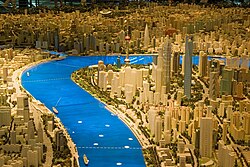
Modern China is characterized by unprecedented urbanization and industrialization. By 2010, the urbanization rate had climbed to nearly 50%. Today, the planning system is governed by the Chinese Urban and Rural Planning Act, which employs a two-tier structure consisting of a master plan (broad strategic vision) and a detailed plan (specific implementation).
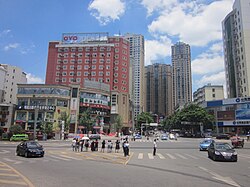
Contemporary planning is a hybrid, neither strictly following Soviet models nor exclusively adopting Western viewpoints. Urban renewal is a dominant theme, often involving the demolition of large city sections to make way for new developments. This process has given rise to "nail houses" (dingzi hu)—homes where residents refuse to move, forcing developers to adjust their architectural plans around the remaining structure.
| Phase | Period | Primary Focus | Key Influence/Characteristic |
|---|---|---|---|
| Phase 1 | 1949–1960 | Heavy Industry & Key Cities | Soviet Planning Principles |
| Phase 2 | 1961–1976 | Utopian Socialism & Rural Integration | Political instability; People's Communes |
| Phase 3 | 1977–1984 | Restoration of Master Plans | Economic and political reform |
| Phase 4 | 1985–Present | Rapid Urbanization & Renewal | Two-tier planning system (Master/Detailed) |
Frequently Asked Questions
What were the main characteristics of Soviet-style planning in China?
Soviet-style planning focused on grand designs for public buildings and monuments, huge public squares, formalistic street patterns, and the use of comprehensive master plans to organize urban space.
What are "nail houses" in the context of Chinese urban renewal?
Known as "dingzi hu," nail houses are residential properties where the owners refuse to move out or sell their land during large-scale redevelopment projects, often resulting in the house remaining as a lone structure amidst new developments.
How did the First Five-year Plan affect urban development?
The First Five-year Plan (1953–58) directed the creation of 8 key industrial-based cities and 156 national key projects, focusing on industrial bases, worker housing, and community facilities.
What is the current legal framework for urban planning in China?
Contemporary planning is based on the Chinese Urban and Rural Planning Act, which utilizes a two-tier system consisting of a master plan and a detailed plan.
How did the People's Commune Movement impact cities?
The movement established communes as sub-communities within cities to spread industrial values from urban centers to rural areas, with the ultimate goal of eliminating the urban-rural divide.