Chickasaw Wars: The Struggle for the Mississippi River
During the first half of the 18th century, the American Southeast became a critical battleground for colonial dominance. The Chickasaw Wars (1721–1763) were a series of conflicts fought between the Chickasaw people, who were allied with Great Britain, and the French Empire, supported by their allies: the Choctaw, Quapaw, and the Illinois Confederation.
At the heart of the conflict was geography. The French Province of Louisiana stretched from the Illinois region down to New Orleans. To maintain control, the French needed secure communication and transport lines along the Mississippi River. However, the Chickasaw, residing in northern Mississippi and western Tennessee, occupied the very land the French needed to traverse. By successfully holding their ground, the Chickasaw created a strategic barrier that benefited the British and, eventually, the United States.
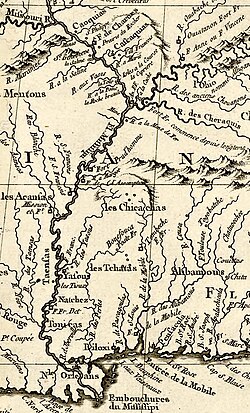
Key Facts
- Duration: 1721 to 1763.
- Primary Belligerents: Chickasaw and Great Britain vs. France, Choctaw, Quapaw, and the Illinois Confederation.
- Strategic Goal: French control of the Mississippi River communications.
- Outcome: Chickasaw victory; the conflict ended with the Treaty of Paris in 1763.
- Key Locations: Northern Mississippi, western Tennessee, and the Mississippi Delta.
The Strategy of Attrition and Choctaw Attacks
The conflict began in earnest in 1721 when Jean-Baptiste Le Moyne de Bienville, the founder of New Orleans and governor of Louisiana, sought to sever the trade links between the Chickasaw and the British. Bienville incited the Choctaw to launch raids on Chickasaw villages and ambush pack trains traveling the Trader's Path toward Charleston, South Carolina.
The Chickasaw responded by consolidating their villages for better defense and strengthening their ties with the British to ensure a steady supply of firearms. In 1723, they established a settlement at Savannah Town, South Carolina. They further disrupted French interests by occupying Chickasaw Bluff (near modern-day Memphis), effectively blocking French traffic on the Mississippi River.
For decades, the French continued to fuel indigenous conflicts. The Choctaw employed hit-and-run tactics, destroying croplands, killing livestock, and ambushing hunting parties. Occasional support from the Illini and Iroquois from the north added to the pressure. This war of attrition pushed the Chickasaw to a crisis point in the late 1730s and early 1740s, forcing them into an even tighter alliance with the British.
Major French Military Campaigns
The Campaign of 1736
Upon returning to Louisiana in 1734, Bienville attempted to shift from proxy warfare to European-style grand campaigns. In 1736, he coordinated a pincer movement: a southern force moving up the Tombigbee River and a northern force led by Pierre D'Artaguiette sweeping down from Fort de Chartres.
The plan failed catastrophically. On March 25, 1736, the northern force—comprising French troops and Illini allies under Chief Chicagou—was crushed at the village of Ogoula Tchetoka (near present-day northwest Tupelo, Mississippi), and d'Artaguiette was killed. Unaware of this defeat, Bienville attacked the fortified village of Ackia on May 26, 1736, with 1,200 French and Choctaw soldiers. He was repulsed and returned to New Orleans in disgrace.
The Campaign of 1739
Bienville was ordered to try again in 1739, this time equipped with heavy siege machinery. He assembled his forces at the Fourth Chickasaw Bluff. This expedition included troops from Canada under Charles Le Moyne de Longueuil and Pierre-Joseph Céloron de Blainville. However, the campaign was crippled by disease and the inability to transport heavy artillery through the dense wilderness. After months of delays, Bienville was forced to negotiate peace without engaging in armed conflict.
The Disputed Campaign of 1752
Following Bienville's replacement by the Marquis de Vaudreuil in 1742, some historical accounts suggest a grand expedition took place in 1752. However, modern historians, including Dawson A. Phelps, argue that this grand effort never actually occurred, though the French did continue to support strong Choctaw attacks during this period.
Conflict Summary
| Feature | Details |
|---|---|
| Primary Goal | French security of the Mississippi River corridor |
| British Role | Supplying firearms and trade to the Chickasaw |
| French Tactics | Proxy warfare via Choctaw; failed European-style sieges |
| Chickasaw Tactics | Fortified villages and strategic occupation of river bluffs |
| Final Resolution | French cession of New France via the Treaty of Paris (1763) |
Aftermath
Despite suffering significant losses in population and disruptions to their traditional way of life, the Chickasaw were never defeated by the French. Their ability to maintain heavily fortified villages and secure British weaponry allowed them to survive the onslaught. The legacy of the conflict persisted long after the official end of the wars, particularly in the enduring enmity between the Illini and the Chickasaw.
Frequently Asked Questions
Why were the Chickasaw Wars fought?
The wars were primarily fought because the Chickasaw occupied land that blocked French communication and transport lines along the Mississippi River, which was vital for the Province of Louisiana.
Who were the primary allies of the French?
The French were supported by the Choctaw, Quapaw, and the Illinois Confederation, as well as occasional assistance from the Iroquois.
What was the significance of Chickasaw Bluff?
By occupying Chickasaw Bluff (near present-day Memphis), the Chickasaw were able to block French traffic on the Mississippi River, creating a strategic bottleneck for the French Empire.
How did the wars finally end?
The wars ended not with a military victory on the ground, but through diplomacy. The conflict concluded in 1763 when France ceded New France to Great Britain under the terms of the Treaty of Paris.
Did the French ever successfully conquer the Chickasaw?
No. Despite multiple grand campaigns and decades of attrition warfare supported by the Choctaw, the French never managed to defeat the Chickasaw in their fortified villages.