Jean-Baptiste Le Moyne de Bienville: The Father of Louisiana
Jean-Baptiste Le Moyne, Sieur de Bienville, was a pivotal French-Canadian colonial administrator whose vision and persistence shaped the early landscape of North America. Born in the frontier village of Fort Ville-Marie (modern-day Montreal) in 1680, Bienville rose from a young naval midshipman to become the governor of French Louisiana on four separate occasions between 1701 and 1743.
Known primarily as the founder of New Orleans, Bienville's career was defined by his ability to navigate the complex geography of the Mississippi River Delta and the political intricacies of the French monarchy. Alongside his brother, the explorer Pierre Le Moyne d'Iberville, he laid the groundwork for French sovereignty in the Gulf Coast region.
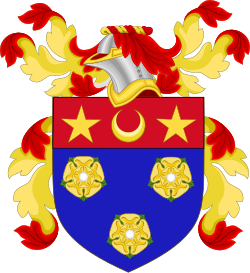
Key Facts
- Role: Served as the 2nd, 4th, 6th, and 9th Colonial Governor of French Louisiana.
- Major Achievement: Founded the city of New Orleans in 1718.
- Military Rank: Lieutenant in the French Navy.
- Lifespan: February 23, 1680 – March 7, 1767.
- Legacy: Often referred to as the "Father of Louisiana."
Early Life and Naval Career
Born into a prosperous fur-trading family, Bienville was the twelfth of fourteen children. He received his education at the Sulpician Seminary in Montreal before entering the French Navy at the age of twelve. Serving under his brother Pierre, Bienville gained critical experience during King William's War, participating in campaigns to remove English fishermen from Hudson Bay and Newfoundland.
His early military career was marked by bravery and hardship; he was injured in 1698 during an attempt to capture Port Hudson. These experiences prepared him for the exploratory missions that would eventually lead him to the mouth of the Mississippi River.
Exploration and the Founding of Mobile
In 1699, Bienville joined his brother on an expedition to establish the Louisiana colony. During this journey, he charted the coast near Mobile, Alabama, and discovered several key landmarks, including the Chandeleur Islands, Cat Island, and Ship Island. The expedition's first settlement, Fort Maurepas (Old Biloxi), was established in April 1699, where Bienville served as lieutenant.
Bienville later moved the settlers to the west side of the Mobile River to establish Fort Louis de la Mobile. To support the colony's growth and stability, he arranged for the arrival of twenty-four young women in 1704, known as the casquette girls (named for the small trunks, or cassettes, they carried). These women, cared for by Madame Langlois, are credited with helping initiate Creole cuisine by blending French traditions with local native cooking techniques.
The Birth of New Orleans
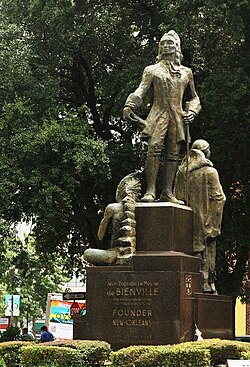
In 1717, Bienville identified a crescent bend in the Mississippi River that he believed was naturally protected from hurricanes and tidal surges. With permission from the Company of the Indies, he founded New Orleans in the spring of 1718, naming the city after Philippe II, Duke of Orléans, the Prince Regent of France.
The city's layout was formalized in 1720 by assistant engineer Adrien de Pauger, who designed the eleven-by-seven block rectangle known today as the Vieux Carré (French Quarter). Despite early struggles with flooding, New Orleans became the capital of French Louisiana in 1723, replacing Biloxi due to its superior deepwater port and proximity to fertile agricultural lands.
Conflict and Later Years
Bienville's final term as governor (1733–1743) was marred by conflict with the Chickasaw people. Two separate military campaigns ended in failure; the first in 1736 and a second in 1739. Although a peace treaty was eventually signed in April 1740, the setbacks led Bienville to request relief from his duties.
Before returning to France in 1743, he contributed to the colony's social infrastructure by helping establish a Charity Hospital and leading relief efforts following two devastating hurricanes in 1740. He spent his final years in Paris, unsuccessfully lobbying to prevent the transfer of Louisiana from France to Spain. He died in 1767 at the age of 87.
Summary of Gubernatorial Terms
| Term | Years | Monarch | Preceded By | Succeeded By |
|---|---|---|---|---|
| 2nd | 1701–1713 | Louis XIV | Sauvolle de la Villantry | Sieur de Cadillac |
| 4th | 1717–1718 | Louis XV | Sieur de Cadillac | Jean-Michel de Lepinay |
| 6th | 1724–1728 | Louis XV | Jean-Michel de Lepinay | Pierre Dugué de Boisbriant |
| 9th | 1733–1743 | Louis XV | Étienne Perier | Marquis de Vaudreuil-Cavagnal |
Frequently Asked Questions
Who were the casquette girls?
The casquette girls were twenty-four young French women brought to the Louisiana colony in 1704 to marry French soldiers and encourage permanent settlement. They are named after the small trunks (cassettes) they brought with them.
Why did Bienville choose the site for New Orleans?
Bienville selected a crescent bend in the Mississippi River because he believed it was safe from tidal surges and hurricanes, and it provided a deepwater port closer to agricultural lands than other sites.
What is the significance of the Vieux Carré?
The Vieux Carré, or French Quarter, is the original heart of New Orleans. It was designed as an eleven-by-seven block rectangle by engineer Adrien de Pauger in 1721.
How did Bienville's relationship with the Chickasaw end?
After two failed military campaigns in 1736 and 1739, the Chickasaws sued for peace, and a treaty was signed in April 1740.
What honors does Bienville have in the United States today?
His legacy is preserved through various namesakes, including Bienville Parish and the town of Bienville in Louisiana, Bienville National Forest in Mississippi, and Bienville Square in Mobile, Alabama.