Antoine-Simon Le Page du Pratz and the History of Louisiana
Antoine-Simon Le Page du Pratz (1695?–1775) was a French naturalist, historian, and ethnographer whose detailed observations of the American wilderness provided some of the most significant early records of the Louisiana colony. He is best remembered for his seminal work, Histoire de la Louisiane, a comprehensive memoir that blended scientific curiosity with deep cultural immersion.
Unlike many colonial authors of his time who wrote from a detached perspective, Le Page du Pratz sought to understand the indigenous peoples he encountered. By learning native languages and befriending local leaders, he captured a nuanced portrait of a world in transition during the early 18th century.
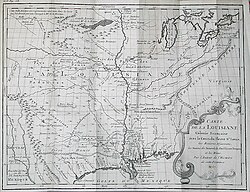
Key Facts
- Primary Work: Histoire de la Louisiane, first published in installments (1751–1753) and later as a three-volume set (1758).
- Residency: Lived in Louisiana from 1718 to 1734, spending significant time near Fort Rosalie and Natchez.
- Ethnographic Focus: Provided detailed accounts of the Natchez people, including their language and funeral rituals.
- Historical Impact: His writings served as a vital guide for the Lewis and Clark Expedition in 1804.
- Notable Account: Documented the travels of Moncacht-Apé, a Yazoo explorer who reached the Pacific Coast.
Early Life and Arrival in Louisiana
Born around 1695 in either France or the Netherlands and raised in France, Le Page du Pratz was educated in a cours de mathematiques (a course of mathematics), qualifying him as a professional architect and engineer. His early career included service in the French Army as part of King Louis XIV's dragoons, where he saw action in Germany during the War of the Spanish Succession in 1713.
On May 25, 1718, he departed La Rochelle, France, arriving in Louisiana on August 25 of the same year. For the next sixteen years, he navigated the complexities of colonial life. Between 1720 and 1728, he resided near the Mississippi River at Natchez and Fort Rosalie, where he cultivated tobacco. During his time in New Orleans, he owned two slaves and lived with a Chitimacha woman, who likely bore his children.
Ethnography and the Natchez People
Le Page du Pratz's most enduring contribution is his study of the Natchez people. Because he learned their language and built genuine relationships with their leaders, he was able to record their culture with rare accuracy. He famously documented the funeral rituals of the Tattooed Serpent, the second-highest ranking chief of the Natchez, including descriptions of the funeral procession and ritual sacrifices.
His writings are particularly noted for using the verbatim words of his Native informants, providing a primary-source perspective on indigenous society that was uncommon for the era.
The Travels of Moncacht-Apé
One of the most fascinating sections of his work details the account of Moncacht-Apé, a Yazoo explorer. Moncacht-Apé claimed to have traveled to the Pacific Coast and back in the late 17th or early 18th century. Through this explorer, Le Page du Pratz recorded oral traditions from West Coast indigenous peoples suggesting that the first Native Americans arrived in North America via a land bridge from Asia.
Colonial Conflict and the Natchez Rebellion
Le Page du Pratz lived under the colonization scheme of the Company of the Indies, managed by John Law. In 1728, he moved back to New Orleans to manage a company plantation, overseeing 200 enslaved people in tobacco cultivation. This move proved fortuitous, as it placed him away from Fort Rosalie during the Natchez Rebellion of 1729.
The rebellion, involving the Natchez, Yazoo, and Chickasaw, resulted in the destruction of Fort Rosalie and the deaths of nearly all male French colonists there. The Native forces spared French women, children, and enslaved Africans, taking them as captives. The French Army eventually suppressed the rebellion by 1731, subsequently selling hundreds of captured Indians into slavery in Saint-Domingue (modern-day Haiti).
The Publication and Legacy of Histoire de la Louisiane
After returning to France, Le Page du Pratz waited over fifteen years to publish his memoirs. The work first appeared in the Journal Economique (Economic Journal) between 1751 and 1753 before being released as a complete three-volume set in 1758. The text covered everything from the early Spanish and French explorations of the 16th and 17th centuries to the detailed ethnography of the Natchez.
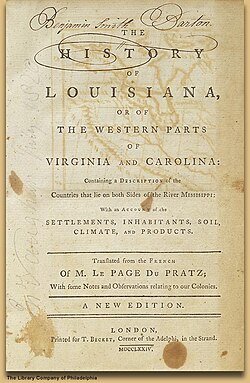
Following the British victory in the Seven Years' War, a partial English translation was published in London in 1763 under the title The History of Louisiana, or of the Western Parts of Virginia and Carolina. This translation reframed the region as a British asset. Decades later, the work's accuracy and detail made it an essential resource for the Lewis and Clark Expedition as they explored the Louisiana Purchase starting in 1804.
| Category | Details |
|---|---|
| Lifespan | c. 1695 – 1775 |
| Louisiana Residency | 1718 – 1734 |
| Major Publication | Histoire de la Louisiane (1758) |
| Key Indigenous Group | The Natchez |
| Notable Influence | Guide for the Lewis and Clark Expedition (1804) |
Frequently Asked Questions
What is the significance of the Histoire de la Louisiane?
It is one of the most detailed early ethnographic and historical accounts of the Louisiana colony, providing rare, first-hand insights into the Natchez culture and the geography of the region before widespread European settlement.
Who was Moncacht-Apé?
Moncacht-Apé was a Yazoo explorer who told Le Page du Pratz about his journey to the Pacific Coast and back, sharing oral histories regarding the Asian land bridge theory of human migration to North America.
How did Le Page du Pratz survive the Natchez Rebellion?
He survived because he had moved from the Natchez area back to New Orleans in 1728 to manage a plantation, placing him safely away from the attack on Fort Rosalie in 1729.
Did the Lewis and Clark Expedition use his work?
Yes, the expedition carried a copy of Le Page du Pratz's work as a guide during their journey through the Louisiana Purchase starting in 1804.
Was the Histoire de la Louisiane ever fully translated into English?
No, while a partial translation was published by the British in 1763, the work has never been fully translated into English.