Charnia: The Fossil That Rewrote Precambrian History
For decades, scientists believed that the Precambrian era—the vast stretch of time before the Cambrian explosion—was a biological wasteland, devoid of complex, macroscopic life. This scientific consensus was shattered by the discovery of Charnia, an extinct genus of frond-like organisms that lived between 570 and 550 million years ago. As the first recognized Precambrian fossil, Charnia fundamentally changed our understanding of the timeline of life on Earth.
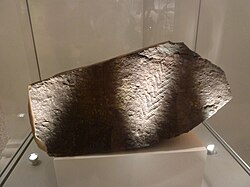
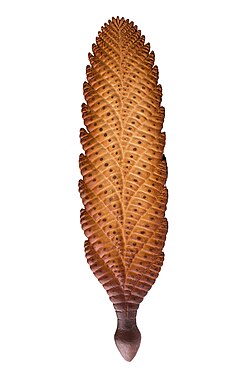
Physically, Charnia resembled a leaf or a fern, featuring segmented ridges that branched alternately to the left and right from a central zig-zag suture. This specific growth pattern is known as glide reflection (or opposite isometry). Despite its plant-like appearance, evidence suggests it was an animal-like organism that lived anchored to the deep sea floor.
Key Facts
- Temporal Range: Late Ediacaran period (570–550 million years ago).
- Significance: The first fossil officially recognized as originating from the Precambrian era.
- Habitat: Benthic (sea floor) and sessile (stationary), living in deep waters below the photic zone.
- Size: Ranged from as small as 1 cm to as large as 66 cm in length.
- Classification: Belongs to the clade Rangeomorpha within the phylum Petalonamae.
The Story of Discovery
The discovery of Charnia masoni is a remarkable tale of curiosity and persistence. In 1957, a schoolboy named Roger Mason was rock-climbing in Charnwood Forest, Leicestershire, England, when he and his friends noticed an unusual fossil. Mason took a rubbing of the rock and shared it with his father, who introduced him to local geologist Trevor Ford. Ford subsequently published the find in the Journal of the Yorkshire Geological Society, bringing the specimen to global attention.
Interestingly, the discovery was not entirely unique to Mason. A 15-year-old schoolgirl named Tina Negus had spotted the fossil a year earlier, but her geography teacher dismissed the possibility of Precambrian fossils existing. Negus was later recognized for her early observation during the 50th anniversary of the official discovery.
Scientific Classification and Diversity
Charnia is categorized under the kingdom Animalia and the clade Rangeomorpha. While several species have been proposed over the years, only five are currently considered valid: C. masoni, C. brasieri, C. ewinoni, C. gracilis, and C. grandis. Some specimens previously classified under the genera Rangea or Glaessnerina have since been reclassified as Charnia.
The distribution of these organisms was widespread. While first found in England, Charnia masoni fossils have also been discovered in the Ediacara Hills of Australia, Siberia, the White Sea area of Russia, and Newfoundland, Canada.
| Category | Details |
|---|---|
| Kingdom | Animalia |
| Phylum | † Petalonamae |
| Clade | † Rangeomorpha |
| Feeding Method | Likely filter feeding or nutrient absorption |
| Growth Pattern | Apical insertion of new buds |
Evolutionary Significance and Ecology
The interpretation of Charnia has evolved alongside our understanding of paleontology. Initially thought to be an alga, it was later reinterpreted as a sea pen (a relative of modern soft corals). However, this theory was discredited when researchers discovered that Charnia grew via apical insertion (adding new growth at the tip), whereas sea pens grow through basal insertion.
In the 1980s, paleontologist Adolf Seilacher proposed that Charnia belonged to a completely extinct group called the Vendobionta, which may have had no close relationship to any living animal group. More recent analysis from 2021 suggests that rangeomorphs like Charnia were early diverging eumetazoans (complex multicellular animals) that branched off before the emergence of modern animal groups.
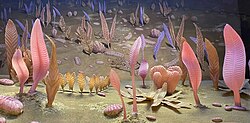
Ecologically, Charnia was benthic (living on the bottom) and sessile (fixed in one place). Because it lived in deep water well below the photic zone—the depth to which sunlight penetrates—it could not perform photosynthesis. Lacking a mouth or gut, scientists believe it survived by absorbing nutrients directly from the seawater or through filter feeding.
Frequently Asked Questions
Was Charnia a plant?
No. Although it looks like a fern, Charnia lived in deep-sea environments where there was no light for photosynthesis, meaning it could not be a plant or alga.
Why is Charnia so important to science?
It was the first fossil ever recognized as coming from the Precambrian era, proving that complex, macroscopic life existed long before the Cambrian period.
How did Charnia eat?
Charnia had no visible mouth or digestive system. Researchers believe it likely absorbed nutrients directly from the water or used a form of filter feeding.
Where can the original fossil be seen?
The holotype specimen of Charnia masoni is housed at the Leicester Museum & Art Gallery in England.
What is a rangeomorph?
A rangeomorph is a member of an extinct group of Ediacaran organisms characterized by a fractal-like growth pattern and a lack of obvious internal organs.