Auroralumina attenboroughii: The Earliest Known Crown Group Cnidarian
In the depths of the late Ediacaran period, long before the Cambrian explosion of life, a unique organism roamed the ancient seas. Auroralumina attenboroughii represents a pivotal discovery in evolutionary biology, serving as the earliest known crown group cnidarian—the group that includes modern jellyfish, corals, and sea anemones. Not only does it provide a window into the dawn of these animals, but it may also represent one of the earliest animal predators in Earth's history.
Key Facts
- Temporal Range: Late Ediacaran, approximately 562–557 million years ago (Ma).
- Classification: A monotypic genus within the phylum Cnidaria and subphylum Medusozoa.
- Discovery Site: Bradgate Formation, Charnwood Forest, Leicestershire, United Kingdom.
- Significance: Earliest known crown group cnidarian and potentially the first animal predator.
- Physical Size: Reached a total length of 20 cm.
Discovery and Etymology
The holotype fossil of Auroralumina was discovered in 2007 within the Maplewell Group's Bradgate Formation in the Charnwood Forest of Leicestershire, UK. Although found years earlier, it was formally described and named in 2022.
The naming of the organism is deeply symbolic. The genus name Auroralumina combines the Latin words Aurora (dawn), referring to the organism's ancient age, and lumina (light), describing its torch-like physical appearance. The species name, attenboroughii, honors Sir David Attenborough for his efforts in promoting awareness of the Ediacaran fossils found in the Charnwood Forest.
Physical Description
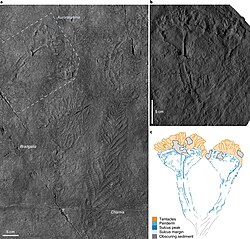
Auroralumina attenboroughii featured a distinct morphology consisting of two goblet-shaped theca (protective outer shells or casings) that branched off from a central stalk. The entire organism reached a length of 20 cm, with each goblet measuring 12 cm in length.
Each goblet was topped with a cup measuring 6 cm in both length and width. A prominent ridge ran the full length of these structures, which researchers believe functioned as a sulcus (a groove or furrow), a common feature in fossil cnidarians. This structure suggests the organism was tetra-radial, meaning it had four-fold symmetry.
The most striking feature was the crown of short, flexible projections extending from the top of the cups. These projections, which could reach 2.75 cm in length, were blunt-topped and faintly wrinkled. In one specimen, up to 30 of these projections were counted on a single cup.
Taphonomy and Composition
Taphonomy—the study of how organisms decay and become fossilized—reveals a fascinating contrast in the composition of Auroralumina. The organism is preserved against a mat-ground matrix, which is irregular in texture.
The theca is preserved as negative epi-relief, meaning the goblets appear as impressions pressed into the rock while the ridges protrude. The smooth surface of the theca and the lack of deformation suggest it was made of a sturdy, though non-biomineralized, organic material. This makes it one of the earliest known skeletons in the fossil record, alongside Palaeopascichnus.
Conversely, the crowns are preserved as positive epi-relief, with the projections protruding from the rock surface. This difference in preservation indicates that the tentacles were composed of much softer material than the supporting theca.
Palaeoecology and Phylogeny
With a crown wider than any other known solitary cnidarian, Auroralumina likely used its dense array of tentacles to feed on microorganisms, such as protists and phytoplankton, mirroring the behavior of modern cnidarians.
Some research suggests that Auroralumina may have possessed cnidocytes—specialized stinging cells. While modern cnidarians use these to capture prey, in Ediacaran species, they may have served a dual purpose: anchoring the animal to the seafloor and providing a defense mechanism against other organisms.
Phylogenetic analyses place Auroralumina as a stem-group medusozoan. It shares several morphological similarities with the Conulariida, another group of extinct stem-group medusozoans.
| Feature | Detail |
|---|---|
| Age | Late Ediacaran (~562–557 Ma) |
| Location | Leicestershire, UK |
| Total Length | 20 cm |
| Symmetry | Tetra-radial |
| Feeding Method | Tentacular capture of microorganisms |
| Phylogeny | Stem-group Medusozoa |
Frequently Asked Questions
What makes Auroralumina significant to science?
It is the earliest known crown group cnidarian and is potentially the first animal predator in the fossil record, providing critical data on the early evolution of animals.
How did Auroralumina feed?
It is inferred that Auroralumina used a wide, dense crown of tentacles to capture phytoplankton, protists, and other microorganisms from the water.
Was Auroralumina's body hard or soft?
It had a mixed composition. The theca (goblet structure) was made of a sturdy organic material that acted as an early skeleton, while the crown projections were made of much softer tissue.
Who was the species named after?
The species name attenboroughii honors Sir David Attenborough for his work in raising awareness about the Ediacaran fossils of the Charnwood Forest.
What is a crown group cnidarian?
A crown group consists of the last common ancestor of all living members of a clade and all its descendants. In this case, Auroralumina is the oldest known relative of modern cnidarians like jellyfish and corals.