Bilateria: The Evolution and Phylogeny of Bilaterally Symmetrical Animals
The Bilateria represent one of the most successful and diverse lineages in the history of life on Earth. Comprising over 98% of all known animal species, this clade includes everything from simple worms to complex mammals. Defined by bilateral symmetry—having a distinct left and right side—these animals diversified rapidly during the late Ediacaran and Cambrian periods, fundamentally reshaping the planet's ecosystems.
While they share a common body plan, the internal relationships between bilaterians have been a subject of intense scientific debate. Traditionally, they were split into two primary groups based on embryonic development, but modern genomic research continues to refine our understanding of how these animals evolved from a single common ancestor.
Key Facts
- Dominance: Bilaterians make up more than 98% of all known animal species.
- Temporal Range: They first appeared in the fossil record during the Ediacaran period (approximately 567 million years ago) and persist to the present.
- Defining Feature: Bilateral symmetry and typically a triploblastic (three-layered) body plan.
- Primary Division: Traditionally divided into Protostomes (mouth develops first) and Deuterostomes (anus develops first).
- Oldest Fossil: Kimberella (555 million years ago) is recognized as a bona fide bilaterian fossil.
The Urbilaterian and the Origin of Body Plans
Scientists use the term urbilaterian to describe the hypothetical most recent common ancestor of all bilaterians. The exact nature of this creature is a central point of contention in evolutionary biology, primarily focusing on the presence of a coelom (a fluid-filled body cavity lined with mesoderm).
The Planuloid–Aceloid Hypothesis
One school of thought suggests that the urbilaterian was an acoelomate—an animal without a body cavity—similar to modern simple worms. In this view, the solid-bodied form was the original state, and more complex body cavities evolved independently in different lineages later on.
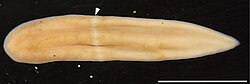
The Archicoelomata Hypothesis
Conversely, the Archicoelomata hypothesis proposes that the urbilaterian already possessed a coelom. According to this theory, simpler animals like flatworms and gastrotrichs are not primitive, but rather evolved from complex ancestors by secondarily losing their body cavities.
The Fossil Record
Tracing the origins of Bilateria requires analyzing ancient sediments from the Ediacaran period. While trace fossils (such as burrows) provide early hints, identifying actual body fossils is more challenging.
The fossil Kimberella, dating to 555 million years ago, is widely accepted as a true bilaterian. Other candidates, such as Vernanimalcula, remain controversial, with some researchers suggesting they may be geological artifacts rather than biological organisms. Similarly, burrows once thought to be 585 million years old in Uruguay have been re-evaluated as late Paleozoic, pushing the confirmed timeline of bilaterian activity slightly forward.
![Ikaria wariootia, living 571–539 million years ago, is one of the oldest bilaterians identified.[22]](/images/ae/5f/ae5ffacae9dc2e3e8dd87afa68bbfaf69207c818febf436b4b9494401dadcf9f.jpg)
Phylogeny and Classification
The classification of Bilateria has evolved from simple morphological observations to complex phylogenomic analyses. The traditional divide is based on the blastopore—the first opening of the embryo.
- Protostomes: The blastopore becomes the mouth. This group includes arthropods, molluscs, and annelids, and is further divided into Ecdysozoa (molting animals) and Spiralia.
- Deuterostomes: The blastopore becomes the anus. This group includes chordates (vertebrates) and ambulacrarians (echinoderms and hemichordates).
The Xenacoelomorpha Challenge
The discovery and reclassification of the phylum Xenacoelomorpha (including acoelomorphs and xenoturbellids) have challenged the traditional dichotomy. Some evidence suggests these simple worms are the sister group to all other bilaterians, a clade known as Nephrozoa. This would imply that the original bilaterian was a simple worm and that complex organs like kidneys and nerve cords evolved later within the Nephrozoa.
Other recent hypotheses suggest a "Xenambulacraria" grouping, where Xenacoelomorpha is more closely related to ambulacrarians. However, as of 2024, the scientific community remains divided, and the traditional protostome-deuterostome split is still widely utilized.
| Group | Defining Embryonic Feature | Example Taxa |
|---|---|---|
| Protostomia | Blastopore becomes mouth | Insects, Snails, Earthworms |
| Deuterostomia | Blastopore becomes anus | Humans, Starfish, Sea Squirts |
| Xenacoelomorpha | Acoelomate/Simple body plan | Xenoturbella, Acoela |
Frequently Asked Questions
What is the difference between a protostome and a deuterostome?
The primary difference lies in early embryonic development: in protostomes, the first opening (blastopore) becomes the mouth, whereas in deuterostomes, it becomes the anus.
Who is the 'urbilaterian'?
The urbilaterian is the hypothetical most recent common ancestor of all animals with bilateral symmetry.
Why is Xenacoelomorpha important to taxonomy?
Xenacoelomorpha consists of simple worms that may represent the most primitive bilaterian body plan, potentially sitting outside the traditional protostome/deuterostome split.
What is the oldest confirmed bilaterian fossil?
Kimberella, dating back to approximately 555 million years ago, is considered one of the first bona fide bilaterian fossils.
What percentage of animal species are bilaterians?
Bilaterians are the most successful animal lineage, accounting for over 98% of all known animal species.