Protostomes: The Diverse Clade of First-Mouth Animals
In the vast tree of animal life, Protostomes represent one of the most successful and diverse groups of organisms on Earth. Spanning from the Ediacaran period to the present day, this clade encompasses a staggering array of creatures, from the microscopic nematode to the complex giant squid. Together with the Deuterostomia and Xenacoelomorpha, protostomes form the Bilateria—animals characterized by bilateral symmetry, three germ layers, and a distinct anteroposterior (head-to-tail) axis.
Historically, protostomes were defined by a specific event in their early development. The term is derived from the Greek prōto- (first) and stóma (mouth), referring to the belief that the first opening formed in the embryo always becomes the mouth. While modern science has revealed this process to be more variable than once thought, the clade remains a fundamental pillar of zoological classification.
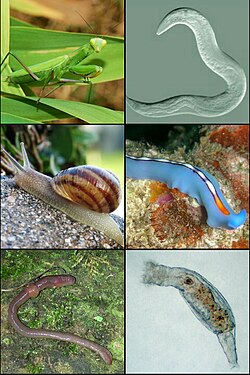
Key Facts
- Diversity: Protostomes account for approximately 95% of all extant animal diversity.
- Major Phyla: Includes Arthropoda (the most species-rich phylum) and Mollusca.
- Development: Typically characterized by schizocoely, where the body cavity forms by splitting solid embryonic tissue.
- Classification: Divided into two primary subgroups: Ecdysozoa and Spiralia.
- Temporal Range: Present from the Ediacaran period through to the modern era.
The Science of Protostomy
To understand what makes a protostome, we must look at the earliest stages of embryonic development. In animals as complex as earthworms, the embryo develops a small indentation called the blastopore. This indentation deepens to create the archenteron, which eventually becomes the digestive tube.
Blastopore Fate
In the sister-clade, the deuterostomes (meaning "second-mouth"), the blastopore becomes the anus, and the mouth forms later at a second opening. In contrast, it was traditionally believed that in protostomes, the blastopore always becomes the mouth. While researchers now recognize that the fate of the blastopore is extremely variable among different protostome species, the evolutionary distinction between the two clades remains scientifically valid.
Coelom Formation
Beyond the mouth, these animals differ in how they develop their coelom (the secondary body cavity). Protostomes generally undergo schizocoely, a process where the coelom forms from a solid mass of embryonic tissue that splits away from the rest of the body. This differs from the enterocoelic pouching seen in deuterostomes, where the cavity buds off from the walls of the gut.
Evolution and Classification
The sheer scale of protostome evolution is evident in the numbers. With over 20 extant phyla, they dominate the animal kingdom in terms of species count. The most prominent among these are the Arthropoda, with roughly 1.165 million described species (representing 87% of all living protostomes), and the Mollusca, with over 117,000 species.
Modern phylogenetics divides the protostomes into two major evolutionary lineages:
- Ecdysozoa: Animals that molt their exoskeletons, such as arthropods and nematodes.
- Spiralia: Animals characterized by a spiral cleavage pattern during early development, including molluscs, annelids, flatworms, and rotifers.
| Feature | Protostomes | Deuterostomes |
|---|---|---|
| Blastopore Fate | Typically becomes the mouth (variable) | Becomes the anus |
| Coelom Formation | Schizocoely (splitting of tissue) | Enterocoely (gut pouching) |
| Example Phyla | Arthropoda, Mollusca, Annelida | Chordata, Echinodermata |
| Global Diversity | ~95% of extant animal species | Small minority of animal species |
Frequently Asked Questions
What does the word "Protostome" actually mean?
The term comes from the Greek words prōto (first) and stóma (mouth), referring to the embryonic development where the first opening (the blastopore) was thought to always become the mouth.
Are all protostomes invertebrates?
Yes, the protostome clade consists of invertebrates, including well-known groups like insects, spiders, snails, and earthworms.
What is the difference between Ecdysozoa and Spiralia?
Ecdysozoa are animals that shed their outer cuticle or exoskeleton (molting), while Spiralia are grouped based on the spiral arrangement of cells during early embryonic cleavage.
Why is the name "protostome" considered disputable by some scientists?
It is considered disputable because modern research has shown that the blastopore does not always become the mouth in every protostome species; the developmental process is more variable than the name suggests.
Which phylum has the most protostome species?
The phylum Arthropoda is the most speciose, containing approximately 1.165 million described living species, which accounts for about 87% of all living protostomes.