Tardigrades: The Indestructible Water Bears of the Animal Kingdom
Tardigrades, colloquially known as water bears, are microscopic animals renowned for their ability to survive the most extreme conditions imaginable. From the vacuum of outer space to the crushing pressures of the deep ocean, these resilient creatures challenge our understanding of biological limits. Despite their fame for indestructibility, they are complex organisms with a unique evolutionary history and a specialized body plan.
Key Facts
- Size: Most range from 0.05 to 0.5 mm, with the largest reaching 1.3 mm.
- Resilience: Capable of surviving the vacuum of space, solar ultraviolet radiation, and extreme pressure.
- Body Plan: Four pairs of hollow, unjointed legs and a body composed of approximately 1,000 cells.
- Survival Mechanism: Enter a dehydrated state called a tun to survive extreme stress.
- Classification: Belong to the phylum Tardigrada within the superphylum Ecdysozoa.
Anatomy and Biological Structure
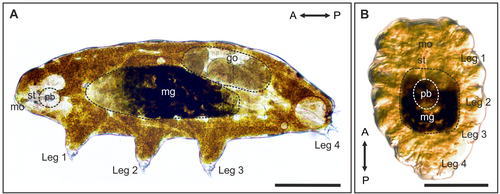
Tardigrades possess a short, plump body characterized by four pairs of hollow, unjointed legs. Depending on the species, these legs may end in claws or specialized sticky pads; marine species often feature telescopic legs for movement. Their body is covered by a cuticle—a non-calcified layer containing chitin and sclerotised proteins—which they must moult to grow.
Internally, tardigrades lack lungs, gills, and blood vessels. Instead, they rely on simple diffusion through the cuticle and their body cavity for gas exchange. Their circulatory system is an open haemocoel, filled with a colorless fluid that distributes nutrients throughout their small frame.
![Tardigrade anatomy[3]](/images/19/1a/191ac0f6a34282fbfeae18fed39a5711a0b18ca4727e307c2d66367be8b1608f.webp)
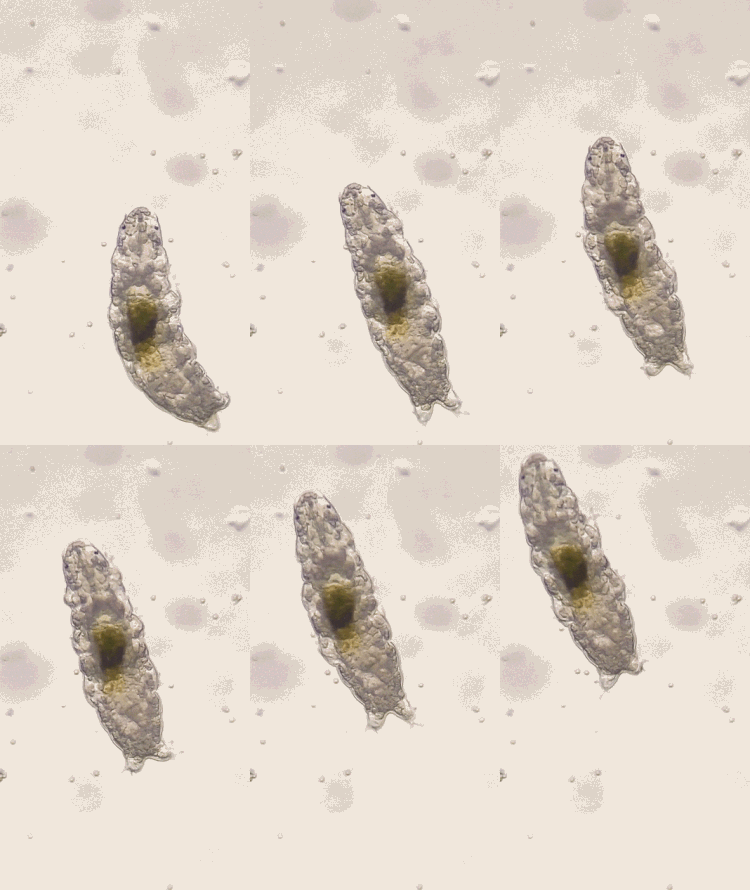
Locomotion and Senses
The movement of a water bear is slow and deliberate, resembling the gait of a bear, which contributed to their common name. Their simple nervous system allows them to navigate their microscopic environments and respond to external stimuli.
Life Cycle and Reproduction
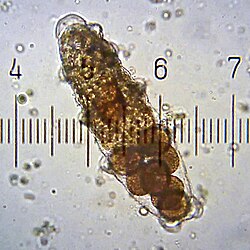
Tardigrades exhibit diverse reproductive strategies. Some species produce eggs that are released within the shed cuticle during the moulting process. These eggs, typically around 50μm across, allow the species to propagate across various environments.
Environmental Tolerance and the 'Tun' State
The most remarkable feature of the tardigrade is its ability to enter a state of suspended animation. When faced with extreme desiccation (drying out), the animal contracts into a dried-out ball known as a tun. In this state, metabolism nearly stops, allowing them to survive conditions that would be lethal to almost any other animal.
Surviving Extreme Physical Stress
Beyond dehydration, tardigrades can withstand staggering physical forces. They have been shown to survive impacts of up to 900 meters per second and momentary shock pressures reaching approximately 1.14 gigapascals (165,000 psi). This resilience is supported by specialized damage protection proteins that shield their DNA from hydroxyl radicals and other stressors.
Exposure to Space
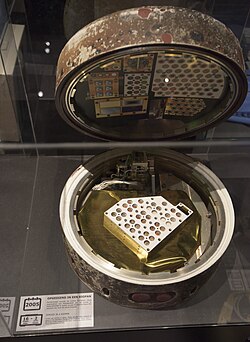
Tardigrades are a primary subject of study in astrobiology—the study of life in the universe. During the 2007 FOTON-M3 mission, the BIOPAN payload exposed tardigrades to the vacuum of space and solar ultraviolet radiation. The results confirmed their ability to survive the harsh environment of low Earth orbit.
Evolution and Genomics
Tardigrades belong to the superphylum Ecdysozoa, a group of animals that moult their exoskeletons. Interestingly, genomic research reveals that tardigrades have lost a significant portion of the standard ecdysozoan body plan, including the middle section and its associated Hox genes, leading to their compact size.
![Tardigrade body plan compared to arthropods, onychophora, and annelids. Tardigrades have lost the whole middle section of the ecdysozoan body plan, and its Hox genes.[69][68]](/images/67/35/67352a75b9a7f14b4ed1069ef3db4f8a99f69bed3dec4551f132db53e844ede8.webp)
Their evolutionary history spans from the Turonian period to the present. Fossil evidence, including specimens found in Dominican amber, provides insight into how these creatures have remained relatively unchanged over millions of years.
Tardigrades in Culture
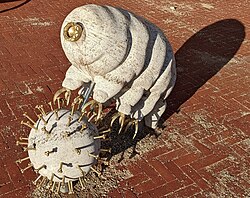
Due to their extraordinary capabilities, tardigrades have transitioned from scientific curiosities to pop-culture icons. They have inspired large-scale art, such as the Noah's Ark 3.0 sculpture in the Netherlands, and have appeared in science fiction, such as the 'Ripper' creature in Star Trek: Discovery, which attributes its powers to horizontal gene transfer.
![The 'Ripper' in Star Trek: Discovery is a recognisably tardigrade-like creature enlarged to monstrous size, with extraordinary capabilities said in the TV series to have been acquired by horizontal gene transfer.[83]](/images/bf/72/bf7247931d852fbacc06f11d141403810e214d373b7b35e50df787b817d35b37.jpg)
Summary of Tardigrade Characteristics
| Feature | Detail |
|---|---|
| Average Length | 0.05 mm to 0.5 mm |
| Cell Count | Approximately 1,000 cells |
| Respiration | Diffusion through cuticle |
| Key Survival State | Tun (dehydrated state) |
| Max Impact Survival | ~900 m/s |
| Max Pressure Survival | ~1.14 GPa |
Frequently Asked Questions
What is a tardigrade tun?
A tun is a dormant, dehydrated state that tardigrades enter to survive extreme environmental stress. By curling into a ball and expelling most of their body water, they can survive extreme temperatures, radiation, and the vacuum of space.
How do tardigrades breathe?
Tardigrades do not have lungs or gills. They perform gas exchange through simple diffusion, where oxygen and carbon dioxide pass directly through their cuticle and body cavity.
Can tardigrades really survive in space?
Yes. Experiments, including the FOTON-M3 mission, have demonstrated that tardigrades can survive exposure to the vacuum of space and intense solar ultraviolet radiation.
What makes tardigrades different from arthropods?
While they share the Ecdysozoa superphylum, tardigrades have a more compact body plan. They have lost the middle section of the body plan and the corresponding Hox genes found in arthropods, onychophorans, and annelids.
How large can a tardigrade grow?
While most are between 0.05 and 0.5 mm, some of the largest known species can reach up to 1.3 mm in length.