Cellular Respiration: How Cells Convert Nutrients into Energy
Every living cell requires a constant supply of energy to perform essential functions, from muscle contraction to DNA replication. This energy is provided by cellular respiration, a sophisticated set of metabolic reactions that oxidize biological fuels to produce adenosine triphosphate (ATP). ATP serves as the primary chemical energy currency of the cell, storing energy in a form that is biologically accessible.
At its core, cellular respiration is a catabolic process, meaning it breaks down large, complex molecules into smaller ones to release energy. While this process is technically a combustion reaction, it differs from burning fuel in a fire because it occurs through a series of slow, controlled biochemical steps, ensuring that energy is captured efficiently rather than lost as heat.
Depending on the availability of an inorganic electron acceptor, this process is categorized into three main types: aerobic respiration (using oxygen), anaerobic respiration (using other inorganic molecules), and fermentation (which does not use an external electron acceptor).
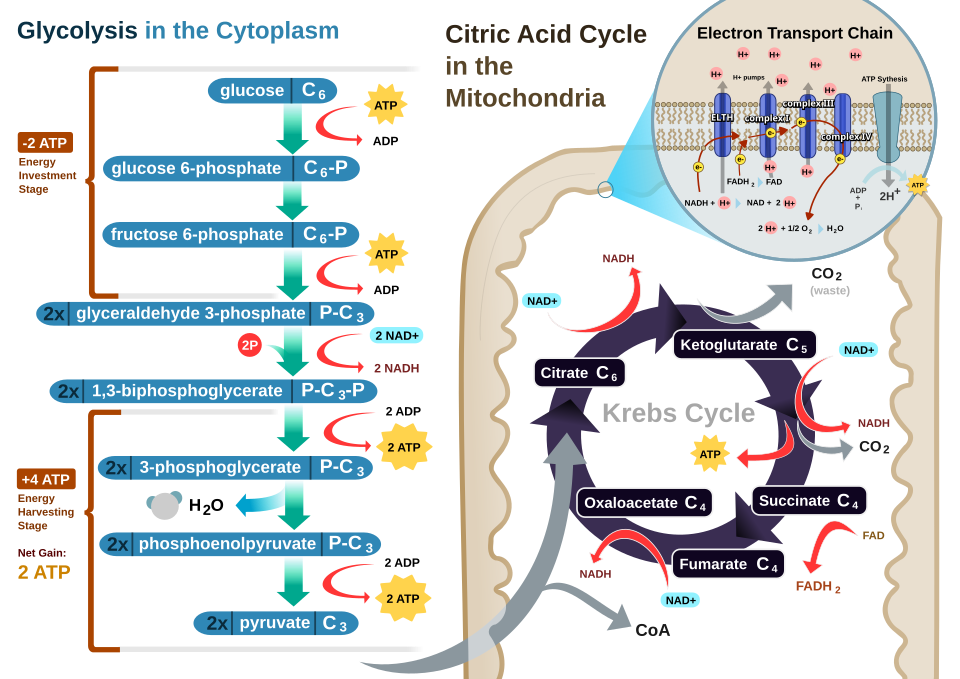
Key Facts
- Primary Goal: To transfer chemical energy from nutrients (like glucose) into ATP.
- Aerobic Efficiency: Aerobic respiration is up to 15 times more efficient than anaerobic metabolism.
- ATP Yield: While theoretical yields are 38 ATP per glucose, actual yields in humans are typically 29 to 32 ATP.
- Waste Products: The primary byproducts of aerobic respiration are carbon dioxide (CO2) and water (H2O).
- Location: In eukaryotes, the process begins in the cytoplasm and is completed within the mitochondria.
Aerobic Respiration
Aerobic respiration is the most efficient method of energy production and requires oxygen (O2) to function. While the cell can consume fats and proteins, carbohydrates are the preferred source for producing pyruvate during the initial stages.
The global chemical reaction for the oxidation of glucose is represented as:
C6H12O6 (s) + 6 O2 (g) → 6 CO2 (g) + 6 H2O (l) + energy (ΔG = −2880 kJ per mol)
This process occurs in several distinct stages, moving from the cell's cytoplasm into the mitochondrial matrix and across the inner mitochondrial membrane.
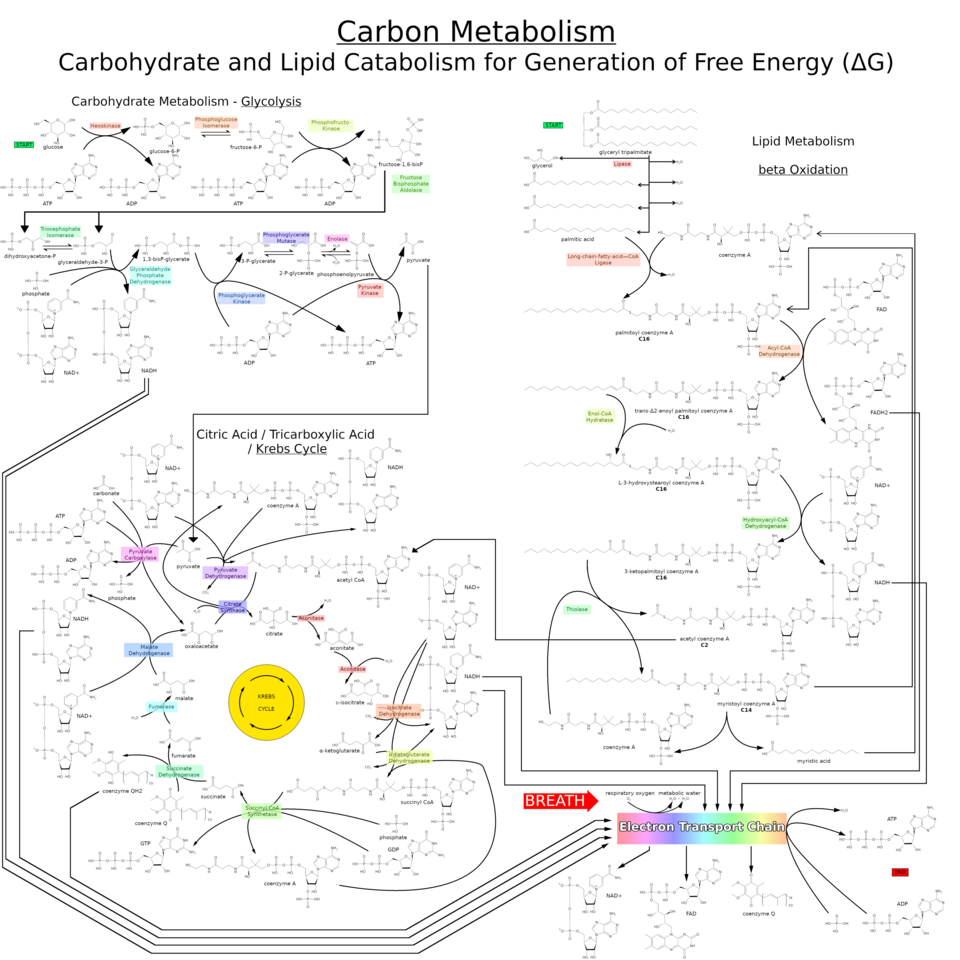
1. Glycolysis
Glycolysis is the first step and occurs in the cytoplasm. It begins with glucose, which is phosphorylated using two ATP molecules to create glucose 6-phosphate and eventually fructose 1,6-bisphosphate. This molecule is then split into two three-carbon chains that are degraded into pyruvate. The net gain from glycolysis is 2 ATP and 2 NADH molecules.
2. Oxidative Decarboxylation of Pyruvate
Pyruvate is transported into the mitochondria, where the pyruvate dehydrogenase complex (PDC) oxidizes it into acetyl-CoA. This step releases one molecule of CO2 and produces one molecule of NADH per pyruvate.
3. The Citric Acid Cycle (Krebs Cycle)
Also known as the tricarboxylic acid cycle, this 8-step process takes place in the mitochondrial matrix. Acetyl-CoA combines with oxaloacetate to form citrate, which is then systematically oxidized. Through a series of enzyme-driven reactions, the cycle produces CO2 as waste and captures energy in the form of NADH, FADH2, and GTP (which can be converted to ATP).
For every molecule of glucose (which produces two pyruvates), the Krebs cycle yields 6 NADH, 2 FADH2, and 2 ATP.
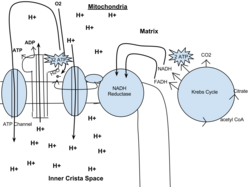
4. Oxidative Phosphorylation
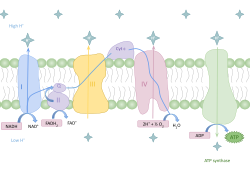
The final and most productive stage is oxidative phosphorylation. This involves the electron transport chain (ETC), where NADH and FADH2 donate electrons. As electrons move through the chain, protons (H+ ions) are pumped across the inner membrane, creating a chemiosmotic potential.
This proton gradient drives ATP synthase, an enzyme that converts ADP and inorganic phosphate into ATP. This process is the primary source of the cell's energy yield.
ATP Production Efficiency
While textbooks often cite a maximum of 38 ATP per glucose molecule, the actual yield is lower (approximately 30–32 ATP). This discrepancy is due to the energy cost of transporting pyruvate and ADP into the mitochondrial matrix, as well as the fact that mitochondrial membranes are slightly "leaky" to protons.
In some cases, cells use thermogenin, an uncoupling protein that allows protons to bypass ATP synthase. Instead of producing ATP, the energy from the proton gradient is released as heat, a process vital for brown fat thermogenesis in hibernating mammals and newborns.
![Stoichiometry of aerobic respiration and most known fermentation types in eucaryotic cell. [16] Numbers in circles indicate counts of carbon atoms in molecules, C6 is glucose C6H12O6, C1 carbon dioxide CO2. Mitochondrial outer membrane is omitted.](/images/d4/ad/d4ad324cf40ac1be6e4d3bca936d5f875b43f573155fb549ff70f47bb2a0cf9e.gif)
| Step | Coenzyme Yield | ATP Yield | Source of ATP |
|---|---|---|---|
| Glycolysis (Preparatory) | 0 | −2 | ATP consumption |
| Glycolysis (Pay-off) | 2 NADH | 3 to 5 | Substrate-level & Oxidative phosphorylation |
| Pyruvate Decarboxylation | 2 NADH | 5 | Oxidative phosphorylation |
| Krebs Cycle | 6 NADH, 2 FADH2 | 20 | Substrate-level & Oxidative phosphorylation |
| Total | - | 30 to 32 | Complete Oxidation |
Anaerobic Processes: Fermentation and Anaerobic Respiration
Fermentation
Fermentation occurs when oxygen is absent and pyruvate is not transported to the mitochondria. Instead, it is reduced to ethanol or lactic acid in the cytoplasm. This process is far less efficient, yielding only 2 ATP per glucose. However, it is much faster than aerobic respiration, allowing muscle cells to produce energy during short bursts of strenuous activity, such as sprinting.
Anaerobic Respiration
Unlike fermentation, true anaerobic respiration uses an electron transport chain but employs an inorganic electron acceptor other than oxygen, such as sulfate (SO42-), nitrate (NO3-), or sulfur (S). This process is used by specialized microorganisms (bacteria and archaea) found in extreme environments, such as hydrothermal vents or anoxic soils. For example, sulfur-breathing organisms have been discovered 2,400 meters below the surface in Canada's Kidd Mine, consuming minerals like pyrite.
Frequently Asked Questions
What is the difference between anaerobic respiration and fermentation?
Anaerobic respiration uses an electron transport chain with an inorganic electron acceptor other than oxygen (e.g., nitrate or sulfate). Fermentation does not use an electron transport chain or an external electron acceptor; it simply reduces pyruvate to products like lactic acid or ethanol.
Why is the actual ATP yield lower than the theoretical maximum of 38?
The yield is lower because energy is spent transporting pyruvate, ADP, and phosphate into the mitochondria. Additionally, the inner mitochondrial membrane is slightly leaky to protons, which reduces the efficiency of the proton gradient.
What is the role of NADH and FADH2 in cellular respiration?
These molecules act as electron carriers. They capture high-energy electrons during glycolysis and the Krebs cycle and deliver them to the electron transport chain, where they fuel the production of the majority of the cell's ATP.
How does thermogenin affect energy production?
Thermogenin acts as a channel that allows protons to leak back across the mitochondrial membrane without passing through ATP synthase. This "short-circuits" the process, converting the potential energy of the proton gradient into heat instead of ATP.
Where does the Krebs cycle take place in different cell types?
In eukaryotic cells, the Krebs cycle occurs within the mitochondrial matrix. In prokaryotic cells, which lack mitochondria, these reactions take place in the cytoplasm.