Redox Reactions: The Chemistry of Electron Transfer
At the heart of countless chemical processes—from the energy powering your smartphone to the biological mechanisms that keep you alive—lies a fundamental concept known as redox. A portmanteau of reduction and oxidation, a redox reaction is a chemical process in which the oxidation states of reactants change through the movement of electrons.
In the simplest terms, redox is a balancing act. One substance loses electrons while another gains them. Because electrons cannot exist freely in these reactions, oxidation and reduction must occur simultaneously; one cannot happen without the other.
Key Facts
- Oxidation is the loss of electrons or an increase in oxidation state.
- Reduction is the gain of electrons or a decrease in oxidation state.
- Oxidants (oxidizing agents) cause other substances to be oxidized while they themselves are reduced.
- Reductants (reducing agents) cause other substances to be reduced while they themselves are oxidized.
- Redox reactions can occur via electron transfer (single electron flow) or atom transfer (movement of an entire atom).
The Mechanics of Redox: Terminology and Processes
To understand redox, it is essential to distinguish between the agents involved. The reductant transfers electrons to the oxidant. Consequently, the reductant is oxidized, and the oxidant is reduced.
Half-Reactions and Redox Pairs
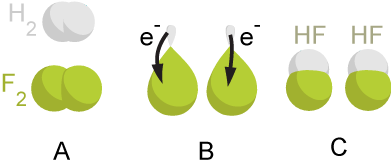
Because oxidation and reduction happen together, chemists often split a full reaction into two half-reactions. For example, in the reaction between hydrogen and fluorine (H2 + F2 → 2HF), the oxidation half-reaction converts hydrogen to protons, while the reduction half-reaction converts fluorine to fluoride anions. When combined, these half-reactions form the complete chemical equation.
A redox pair consists of the oxidizing and reducing agents involved in a specific reaction. A redox couple refers to a reducing species and its corresponding oxidizing form, such as Fe / Fe3+.
Oxidants and Reductants
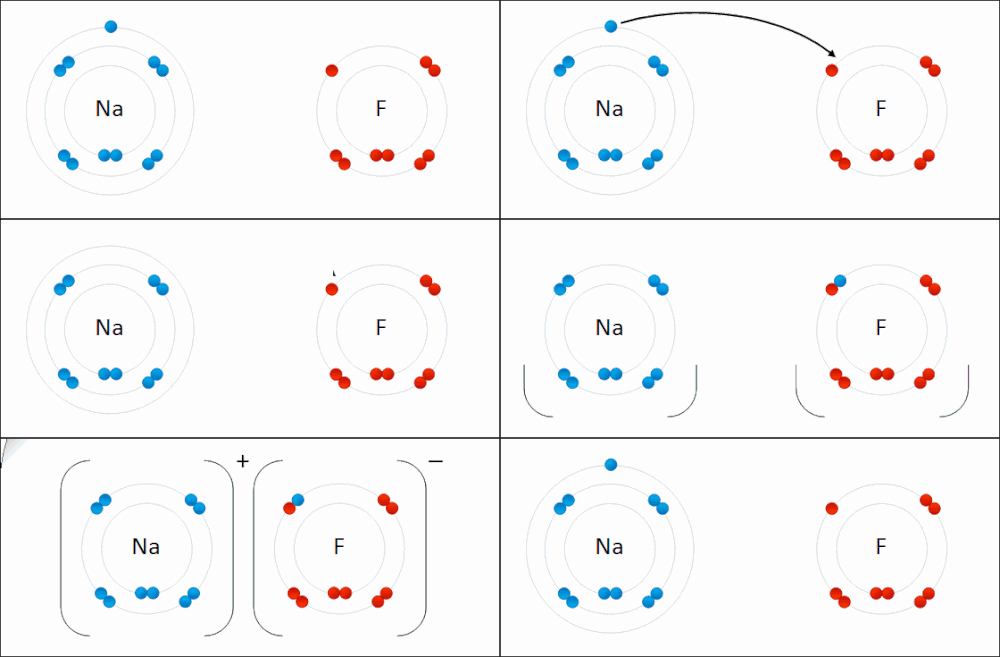
Oxidants are electron acceptors. They are typically highly electronegative elements (like fluorine or oxygen) or substances with elements in high oxidation states. Conversely, reductants provide electrons. Some reductants, such as NaBH4 and LiAlH4, operate via hydride transfer, moving a hydride (H-) atom to reduce carbonyl compounds into alcohols.
![Example of a reduction–oxidation reaction between sodium and chlorine, with the OIL RIG mnemonic[1]](/images/fc/8a/fc8a048964a4e4f2084fd8fad882e492def72a196b0c3ffa6652b33d94eb68dd.webp)
Rates, Energies, and Electrode Potentials
Not all redox reactions occur at the same speed or with the same intensity. The pathway of electron transfer generally falls into two categories: inner-sphere transfer, where reactants share a bridging ligand, and outer-sphere transfer, where electrons move between reactants with intact coordination shells.
The rate of outer-sphere transfer is explained by Marcus theory. Developed by Nobel laureate Rudolph A. Marcus, this theory relates activation energy to the standard free-energy change and the reorganization energy required to distort reactants and solvents into the product configuration.
Standard Electrode Potentials
The tendency of an oxidizing agent to be reduced is measured by its reduction potential (Ered). By convention, the potential for the reaction H+ + e- → 1/2 H2 is zero. Stronger oxidizing agents, like fluorine, have positive potentials, while weaker ones, like zinc, have negative potentials.
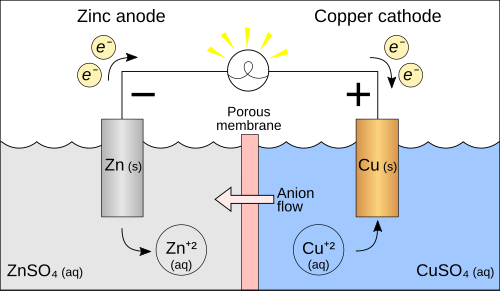
In an electrochemical cell, the total cell potential is calculated as the difference between the cathode and anode potentials: Ecell = Ecathode – Eanode.
Real-World Examples of Redox Reactions
Corrosion and Geology
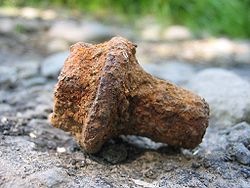
One of the most common redox reactions is the rusting of iron. In this process, iron is oxidized to form iron(III) oxide (Fe2O3), while oxygen is reduced. This is a form of corrosion that affects infrastructure globally.
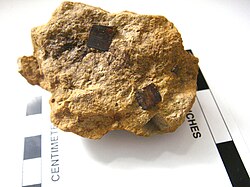
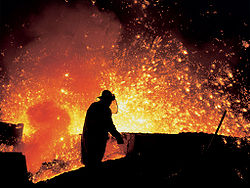
In geology, most minerals are oxidized derivatives of metals. To obtain pure metals, these ores must be reduced. In blast furnaces, iron oxides are heated with coke (carbon) to produce molten iron through the reaction: Fe2O3 + 3CO → 2Fe + 3CO2.
Biology and Nature
Redox reactions are the engine of life. Aerobic cellular respiration involves the oxidation of glucose and the reduction of oxygen to water to release energy. Conversely, photosynthesis uses light energy to reduce carbon dioxide into glucose.
Another biological example is enzymatic browning, the redox reaction responsible for the discoloration of sliced fruits and vegetables.

Special Cases: Metal Displacement and Disproportionation
- Metal Displacement: A more reactive metal can displace another from a solution. For instance, zinc metal can displace copper from copper sulfate (Zn + CuSO4 → ZnSO4 + Cu).
- Disproportionation: A unique reaction where a single substance is simultaneously oxidized and reduced. An example is the reaction of thiosulfate ions in acid to form both elemental sulfur and sulfur dioxide.
| Term | Action | Electron Movement | Oxidation State |
|---|---|---|---|
| Oxidation | Loss of electrons | Out of substance | Increases |
| Reduction | Gain of electrons | Into substance | Decreases |
| Oxidizing Agent | Causes oxidation | Accepts electrons | Decreases |
| Reducing Agent | Causes reduction | Donates electrons | Increases |
Frequently Asked Questions
What is the easiest way to remember the difference between oxidation and reduction?
Common mnemonics include "OIL RIG" (Oxidation Is Loss, Reduction Is Gain) and "LEO the lion says GER" (Loss of Electrons is Oxidation, Gain of Electrons is Reduction).
Can oxidation happen without reduction?
No. Oxidation and reduction always occur simultaneously because electrons must be transferred from one species to another; they cannot exist independently in these reactions.
What is the difference between an inner-sphere and outer-sphere electron transfer?
In inner-sphere transfer, the two reactants share a bridging ligand that allows the electron to pass. In outer-sphere transfer, the electron moves between reactants while their coordination shells remain intact.
How does a blast furnace use redox chemistry?
A blast furnace uses carbon (coke) as a reducing agent to remove oxygen from iron ores (like hematite), reducing the iron oxide back into molten elemental iron.
What is a disproportionation reaction?
A disproportionation reaction is a specific type of redox reaction where the same chemical species acts as both the oxidant and the reductant, resulting in two different products with different oxidation states.