Carbonic Acid: Properties, Stability, and Environmental Impact
Carbonic acid (H2CO3) is a chemical compound that plays a fundamental role in the biological and geological processes of Earth. While often discussed as a simple byproduct of carbon dioxide dissolving in water, it is a complex molecule with distinct properties that vary significantly depending on its environment—whether it exists as a pure gas, a solid, or in an aqueous solution.
For decades, scientific textbooks suggested that carbonic acid could not exist independently outside of a solution. However, research conducted since approximately 1990 has confirmed that H2CO3 is a real molecule with a distinct Raman spectrum and a first-order lifetime of about 20 milliseconds at 37 °C. Its interconversion with carbon dioxide is central to the breathing processes of aerobic organisms and the acidification of the world's oceans.

Key Facts
- Chemical Formula: H2CO3
- Molar Mass: 62.024 g·mol
- Nature: A diprotic Brønsted acid (can donate two protons).
- Stability: Metastable in pure form; water acts as a catalyst for its decomposition into CO2 and H2O.
- Biological Role: Essential for pH regulation in biological fluids and the respiratory cycle.
- Environmental Role: Primary driver of ocean acidification due to increasing atmospheric CO2.
Chemical Properties and Structure
Carbonic acid is characterized as a diprotic Brønsted acid, meaning it can release two hydrogen ions (protons) in successive steps. In its pure, anhydrous form, it is expected to be a kinetically stable gas at room temperature. The molecule can exist in three conformational isomers: cis–cis, cis–trans, and trans–trans.
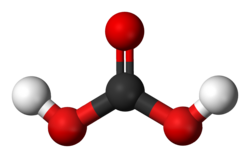
Physical Constants
The physical behavior of carbonic acid is highly dependent on its state. While it is a colorless gas in its pure form, it sublimes at −53 °C and decomposes at a boiling point of 127 °C. When isolated as a solid under high pressure (1.85 GPa), it forms a monoclinic crystal structure where molecules are planar and joined by strong hydrogen bonds into dimers.
| Property | Value/Description |
|---|---|
| Preferred IUPAC Name | Carbonic acid |
| CAS Number | 463-79-6 |
| Melting Point | −53 °C (sublimes) |
| Boiling Point | 127 °C (decomposes) |
| pKa1 (hydrous) | 6.35 |
| pKa2 | 10.33 |
| Conjugate Bases | Bicarbonate, Carbonate |

Stability and Synthesis
The history of carbonic acid is marked by the challenge of isolating it. Early chemists, including Lavoisier, initially named CO2 "carbonic acid" because it produced acidic results in litmus tests. It was later realized that H2CO3 is the actual acid formed when CO2 reacts with water.
Pure carbonic acid is metastable. Transition state theory suggests that at 300 K, its half-life is theoretically around 10 years. However, in the presence of just two water molecules, this half-life drops to approximately one minute, as water catalyzes its decomposition. To produce anhydrous carbonic acid, scientists use specialized methods such as the reaction of hydrogen chloride and potassium bicarbonate at 100 K in methanol, or the proton irradiation of solid carbon dioxide.
Behavior in Aqueous and Biological Solutions
In water, carbonic acid exists in a delicate equilibrium with dissolved carbon dioxide. The hydration equilibrium constant at 25 °C indicates that the majority of CO2 at air-water interfaces remains as dissolved gas rather than converting to H2CO3. This process is relatively slow without catalysts.
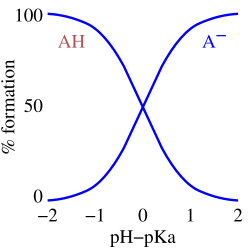
In biological systems, such as the cytosol (extracellular fluid) with a pH of approximately 7.2, carbonic acid is almost 50% dissociated. This equilibrium is vital for maintaining the pH balance of the body.
Planetary Interiors
Under extreme pressures (multiple gigapascals), significant amounts of molecular H2CO3 can exist. Such conditions are found in the cores of large icy satellites like Ganymede, Callisto, and Titan. Because pure carbonic acid is denser than ice, it is theorized to sink beneath ice layers, potentially separating them from the rocky cores of these moons.
Environmental Impact: Ocean Acidification
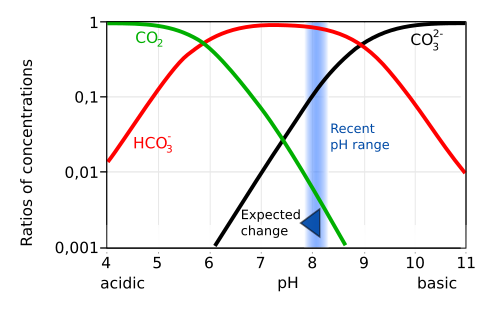
The relationship between atmospheric carbon dioxide and carbonic acid is a primary driver of ocean acidification. As anthropogenic CO2 concentrations increase in the atmosphere, more CO2 dissolves into seawater, forming carbonic acid. This shifts the chemical speciation of carbonates in the ocean, lowering the pH and affecting marine life.
Frequently Asked Questions
Is carbonic acid the same as carbon dioxide?
No. Carbon dioxide (CO2) is a gas. Carbonic acid (H2CO3) is the compound formed when carbon dioxide reacts with water. While they exist in equilibrium, they are distinct chemical species.
Why is carbonic acid difficult to isolate?
Carbonic acid is metastable and decomposes rapidly into water and carbon dioxide. This decomposition is heavily catalyzed by water, meaning that in the very environment where it is most commonly found, it is least stable.
What are the conjugate bases of carbonic acid?
As a diprotic acid, carbonic acid has two conjugate bases: the bicarbonate ion (HCO3−) and the carbonate ion (CO32−).
How does carbonic acid affect the oceans?
Increased atmospheric CO2 leads to more carbonic acid formation in seawater. This increases the acidity (lowers the pH) of the ocean, which can interfere with the ability of marine organisms to build calcium carbonate shells.
Can carbonic acid exist as a solid?
Yes. Solid anhydrous carbonic acid has been isolated through methods such as the irradiation of CO2 and H2O ice mixtures at very low temperatures (20 K) or under high pressure.