Climate Change Impacts: From Rising Temperatures to Global Societal Risks
Climate Change Impacts: From Rising Temperatures to Global Societal Risks The effects of climate change are well-documented and increasingly visible across Earth's natural environments an...
Climate Change Impacts: From Rising Temperatures to Global Societal Risks
The effects of climate change are well-documented and increasingly visible across Earth's natural environments and human societies. As the global climate system shifts, we are witnessing an overall warming trend, altered precipitation patterns, and a rise in extreme weather events. These changes do not occur in isolation; they trigger a chain reaction of environmental shifts, such as intense forest fires, thawing permafrost, and desertification, which can become irreversible once certain tipping points—thresholds that, when crossed, lead to permanent changes—are reached.
The primary causes[5] and the wide-ranging impacts[6][7][3]: 3–36 of climate change. Some effects act as positive feedbacks that amplify climate change.[8]: The primary causes[5] and the wide-ranging impacts[6][7][3]: 3–36 of climate change. Some effects act as positive feedbacks that amplify climate change.[8]
Key Facts
The Arctic is warming faster than most other regions due to climate feedbacks.
Oceans have absorbed nearly 90% of the excess heat accumulated on Earth.
Global sea levels have risen approximately 250 mm since 1880.
The rate of ice loss has increased by 57% since the 1990s.
Climate change impacts include ocean acidification, extreme heat, and threats to food security.
Temperature and Weather Extremes
Changes in temperature are a fundamental driver of climate instability. Surface air temperatures over land are increasing at roughly twice the rate of temperatures over the ocean, contributing to more frequent and intense heat waves. While these temperatures might stabilize if greenhouse gas emissions were brought under control, the thermal inertia of the planet means that oceans and ice sheets continue to absorb vast amounts of heat, delaying and then accelerating long-term effects.
Over the last 50 years the Arctic has warmed the most, and temperatures on land have generally increased more than sea surface temperatures.[15]: Over the last 50 years the Arctic has warmed the most, and temperatures on land have generally increased more than sea surface temperatures.[15]
Beyond simple warming, the climate system is experiencing more volatile weather. This includes shifts in rainfall patterns that lead to both severe droughts and intense storms. Such volatility affects the land through increased wildfire risks and changes in soil stability, potentially impacting seismic and volcanic activity in complex ways.
The rate of global tree cover loss has approximately doubled since 2001, to an annual loss approaching an area the size of Italy.[149]: The rate of global tree cover loss has approximately doubled since 2001, to an annual loss approaching an area the size of Italy.[149]
Oceanic Shifts and Sea Level Rise
The world's oceans act as a massive heat sink, absorbing almost 90% of the excess heat generated by global warming. This absorption leads to several critical issues: ocean stratification (the layering of water that prevents mixing), deoxygenation, and changes in ocean currents. Furthermore, as the ocean absorbs carbon dioxide from the atmosphere, it undergoes ocean acidification, a drop in pH levels that threatens marine life.
Oceans have taken up almost 90% of the excess heat accumulated on Earth due to global warming.[92]: Oceans have taken up almost 90% of the excess heat accumulated on Earth due to global warming.[92]
Climate change causes a drop in the ocean's pH value (called ocean acidification): Time series of atmospheric CO2 at Mauna Loa (in parts per million volume, ppmv; red), surface ocean pCO2 (μatm; green) and surface ocean pH (blue) at Ocean Station ALOHA in the subtropical North Pacific Ocean.[93][94]: Climate change causes a drop in the ocean's pH value (called ocean acidification): Time series of atmospheric CO2 at Mauna Loa (in parts per million volume, ppmv; red), surface ocean pCO2 (μatm; green) and surface ocean pH (blue) at Ocean Station ALOHA in the subtropical North Pacific Ocean.[93][94]
Rising temperatures also drive sea level rise. This is caused by both the melting of land-based ice and the thermal expansion of seawater. Since 1880, the global average sea level has risen by about 250 millimetres (9.8 in), creating a higher baseline for high-tide flooding and storm surges.
The global average sea level has risen about 250 millimetres (9.8 in) since 1880,[102] increasing the elevation on top of which other types of flooding (high-tide flooding and storm surge) occur.: The global average sea level has risen about 250 millimetres (9.8 in) since 1880,[102] increasing the elevation on top of which other types of flooding (high-tide flooding and storm surge) occur.
Long-term sea level rise occurs in addition to intermittent tidal flooding. NOAA predicts different levels of sea level rise for coastlines within a single country.[103]: Long-term sea level rise occurs in addition to intermittent tidal flooding. NOAA predicts different levels of sea level rise for coastlines within a single country.[103]
The Decline of Ice and Snow
The cryosphere—the frozen parts of our planet—is in rapid decline. Between 1994 and 2017, Earth lost 28 trillion tonnes of ice. The melting of grounded ice, such as glaciers and ice sheets, has contributed significantly to sea level rise. Notably, the rate of ice loss has risen by 57% since the 1990s, moving from 0.8 to 1.2 trillion tonnes per year.
Earth lost 28 trillion tonnes of ice between 1994 and 2017, with melting grounded ice (ice sheets and glaciers) raising the global sea level by 34.6 ±3.1 mm.[112] The rate of ice loss has risen by 57% since the 1990s−from 0.8 to 1.2 trillion tonnes per year.[112]: Earth lost 28 trillion tonnes of ice between 1994 and 2017, with melting grounded ice (ice sheets and glaciers) raising the global sea level by 34.6 ±3.1 mm.[112] The rate of ice loss has risen by 57% since the 1990s−from 0.8 to 1.2 trillion tonnes per year.[112]
Melting of glacial mass is approximately linearly related to temperature rise.[113]: Melting of glacial mass is approximately linearly related to temperature rise.[113]
Sea ice is also experiencing dramatic shifts. Recent observations in the Antarctic have suggested a potential "regime shift," where traditional patterns of sea ice variability may no longer dominate.
Reporting the reduction in Antarctic sea ice extent in mid 2023, researchers concluded that a "regime shift" may be taking place "in which previously important relationships no longer dominate sea ice variability".[123]: Reporting the reduction in Antarctic sea ice extent in mid 2023, researchers concluded that a "regime shift" may be taking place "in which previously important relationships no longer dominate sea ice variability".[123]
Ecosystems and Biodiversity
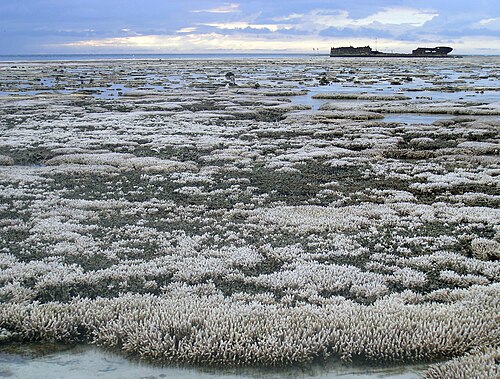
Terrestrial and marine ecosystems are under immense pressure. On land, changing climates affect forest health and contribute to habitat loss. In the oceans, rising temperatures and marine heatwaves lead to events like coral bleaching, which can devastate reef ecosystems.
Part of the Great Barrier Reef in Australia in 2016 after a coral bleaching event (partly caused by rising ocean temperatures and marine heatwaves).: Part of the Great Barrier Reef in Australia in 2016 after a coral bleaching event (partly caused by rising ocean temperatures and marine heatwaves).
Coral reefs are particularly vulnerable to the combined effects of sea level rise, altered ocean circulation, and the increased intensity of tropical storms. These changes do not just affect marine life; they also impact the essential goods and services these ecosystems provide to humans.
Climate change will affect coral reef ecosystems, through sea level rise, changes to the frequency and intensity of tropical storms, and altered ocean circulation patterns. When combined, all of these impacts dramatically alter ecosystem function, as well as the goods and services coral reef ecosystems provide.[153]: Climate change will affect coral reef ecosystems, through sea level rise, changes to the frequency and intensity of tropical storms, and altered ocean circulation patterns. When combined, all of these impacts dramatically alter ecosystem function, as well as the goods and services coral reef ecosystems provide.[153]
Societal and Economic Consequences
The human cost of climate change is vast, affecting health, food security, and water security. As extreme heat becomes more common, it overlaps with high-population areas, increasing the risk to human life. Furthermore, changes in precipitation can lead to food shortages, impacting calorie consumption per capita and increasing the population at risk of hunger.
Projected changes in average food availability (represented as calorie consumption per capita), population at risk of hunger and disability-adjusted life years under two Shared Socioeconomic Pathways: the baseline, SSP2, and SSP3, scenario of high global rivalry and conflict. The red and the orange lines show projections for SSP3 assuming high and low intensity of future emissions and the associated climate change.[183]: Projected changes in average food availability (represented as calorie consumption per capita), population at risk of hunger and disability-adjusted life years under two Shared Socioeconomic Pathways: the baseline, SSP2, and SSP3, scenario of high global rivalry and conflict. The red and the orange lines show projections for SSP3 assuming high and low intensity of future emissions and the associated climate change.[183]
Overlap between future population distribution and extreme heat in a high emission scenario[198]: Overlap between future population distribution and extreme heat in a high emission scenario[198]
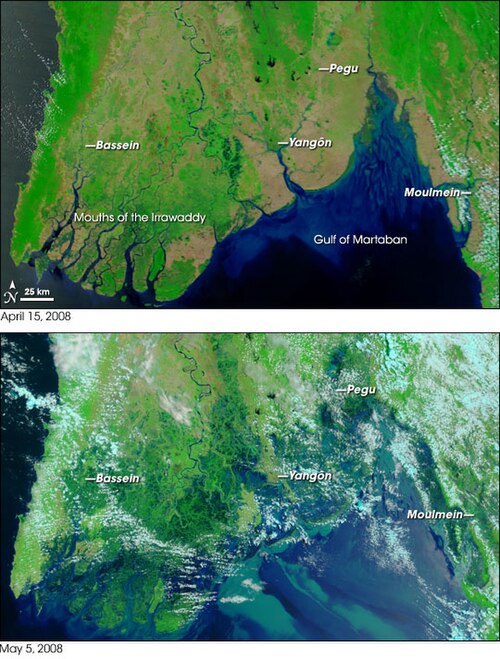
Societal stability is also at risk. Climate-driven displacement and migration, particularly in low-lying coastal regions, can lead to increased conflict and, in extreme scenarios, the possibility of societal collapse. Economic impacts are also profound; damage to global GDP is expected to rise, with some models suggesting significant regional economic hits by 2050.
Floodplains and low-lying coastal areas will flood more frequently due to climate change, like this area of Myanmar which was submerged by Cyclone Nargis.: Floodplains and low-lying coastal areas will flood more frequently due to climate change, like this area of Myanmar which was submerged by Cyclone Nargis.
Estimates of damage to GDP vary widely, and even this approach to predicting damage does not consider impacts of climate tipping points, climate-driven extreme events, human health impacts, resource or migration-driven conflict, geopolitical tension, nature-driven risks, or sea level rise.[216]: Estimates of damage to GDP vary widely, and even this approach to predicting damage does not consider impacts of climate tipping points, climate-driven extreme events, human health impacts, resource or migration-driven conflict, geopolitical tension, nature-driven risks, or sea level rise.[216]
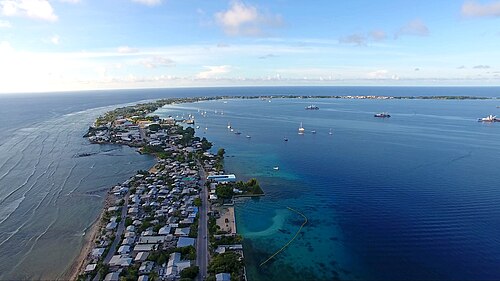
Sea level rise at the Marshall Islands, reaching the edge of a village (from the documentary One Word): Sea level rise at the Marshall Islands, reaching the edge of a village (from the documentary One Word)
Overlap between state fragility, extreme heat, and nuclear and biological catastrophic hazards[198]: Overlap between state fragility, extreme heat, and nuclear and biological catastrophic hazards[198]
Regional median economic impacts predicted due to global warming by 2050 compared to present.[265]: Regional median economic impacts predicted due to global warming by 2050 compared to present.[265]
Non-linear growth in the global warming effect of accumulating long-lived greenhouse gases contributed to economic damages over a 60-year period estimated to be over five times as large as that of a 30-year period (shown in chart). A Nature article estimated future damages from past emissions to be at least an order of magnitude larger than historical damages from the same emissions.[266]: Non-linear growth in the global warming effect of accumulating long-lived greenhouse gases contributed to economic damages over a 60-year period estimated to be over five times as large as that of a 30-year period (shown in chart). A Nature article estimated future damages from past emissions to be at least an order of magnitude larger than historical damages from the same emissions.[266]
Rich nations have done the most to fuel climate change.[276]: Rich nations have done the most to fuel climate change.[276]
Tipping Points and Irreversibility
One of the most concerning aspects of climate change is the existence of tipping points. These are critical thresholds where a small change can push a system into a completely different state, often through self-reinforcing feedback loops that make the change irreversible.
There are a number of places around the globe which can pass a tipping point around a certain level of warming, and eventually transition to a different state.[159][160]: There are a number of places around the globe which can pass a tipping point around a certain level of warming, and eventually transition to a different state.[159][160]
Why is the Arctic warming faster than other regions?
The Arctic experiences faster warming due to climate change feedbacks, which amplify the initial warming effect in that specific region.
What is ocean acidification?
Ocean acidification is the drop in the ocean's pH value caused by the ocean absorbing carbon dioxide from the atmosphere.
How does melting ice contribute to sea level rise?
The melting of grounded ice, such as glaciers and ice sheets, adds water to the oceans, directly raising the global sea level.
What are climate tipping points?
Tipping points are specific levels of warming where a system can transition to a different, often irreversible, state.
How does climate change affect food security?
Climate change impacts food security through changes in precipitation, extreme weather events, and shifts in temperature that affect crop availability and calorie consumption.
Are the economic impacts of climate change predictable?
Estimates of damage to GDP vary widely, and current models often do not account for all factors like tipping points, extreme events, or migration-driven conflict.
![The primary causes[5] and the wide-ranging impacts[6][7][3]: 3–36 of climate change. Some effects act as positive feedbacks that amplify climate change.[8]](/images/c0/b4/c0b4ce01dea8863c52950c48fd3d189e2f62def88f6c7bd8a3f8822d4e3df362.webp)
![Over the last 50 years the Arctic has warmed the most, and temperatures on land have generally increased more than sea surface temperatures.[15]](/images/93/0d/930dd963e3a21e4768f7d8c6f4f9e6b1fdce4ee083a37be19f846ab0c3194e73.webp)
![The rate of global tree cover loss has approximately doubled since 2001, to an annual loss approaching an area the size of Italy.[149]](/images/7f/a5/7fa55c366354a9c1a6c412277facfe5c6ae6faebf15465f3b5899c09af3d80e5.webp)
![Oceans have taken up almost 90% of the excess heat accumulated on Earth due to global warming.[92]](/images/f1/cd/f1cdf937867fbf2114e60cfea59cb9aa359844de13e9dfb62b160b36d58ca76b.webp)
![Climate change causes a drop in the ocean's pH value (called ocean acidification): Time series of atmospheric CO2 at Mauna Loa (in parts per million volume, ppmv; red), surface ocean pCO2 (μatm; green) and surface ocean pH (blue) at Ocean Station ALOHA in the subtropical North Pacific Ocean.[93][94]](/images/93/e0/93e0de7d3e2e90f5208a7a2a05f03293695e8760f29fafa4c29bc0919ec3bb71.jpg)
![The global average sea level has risen about 250 millimetres (9.8 in) since 1880,[102] increasing the elevation on top of which other types of flooding (high-tide flooding and storm surge) occur.](/images/71/e3/71e3edf0096acc8890ad1df9751208c0e317b58eb4dbfeda8cf1a25f262644fa.webp)
![Long-term sea level rise occurs in addition to intermittent tidal flooding. NOAA predicts different levels of sea level rise for coastlines within a single country.[103]](/images/07/a9/07a91af4f53ce8deccb7e22f59173502fbf85171e9ebd7e51309c7cde6922e03.webp)
![Earth lost 28 trillion tonnes of ice between 1994 and 2017, with melting grounded ice (ice sheets and glaciers) raising the global sea level by 34.6 ±3.1 mm.[112] The rate of ice loss has risen by 57% since the 1990s−from 0.8 to 1.2 trillion tonnes per year.[112]](/images/2d/80/2d80222521b1c745976497dff41059429da78a91cd36e73d0dee04e34f11c033.png)
![Melting of glacial mass is approximately linearly related to temperature rise.[113]](/images/d9/50/d950e323c6dd3201b7662542d7841c9fe4b9f398963e37c55106592c1f4dbd8b.webp)
![Reporting the reduction in Antarctic sea ice extent in mid 2023, researchers concluded that a "regime shift" may be taking place "in which previously important relationships no longer dominate sea ice variability".[123]](/images/e8/fa/e8fab28837d3db586e71f9b83e8ba430a8d7e258e5db0c66ec3b2d940bf4b34a.png)
![Climate change will affect coral reef ecosystems, through sea level rise, changes to the frequency and intensity of tropical storms, and altered ocean circulation patterns. When combined, all of these impacts dramatically alter ecosystem function, as well as the goods and services coral reef ecosystems provide.[153]](/images/ab/76/ab760b6742aafd79f31a8d9250c1fbd90c6a4e4cc3bd238c19cac382fcee08ed.png)
![Projected changes in average food availability (represented as calorie consumption per capita), population at risk of hunger and disability-adjusted life years under two Shared Socioeconomic Pathways: the baseline, SSP2, and SSP3, scenario of high global rivalry and conflict. The red and the orange lines show projections for SSP3 assuming high and low intensity of future emissions and the associated climate change.[183]](/images/8d/c2/8dc2171d92a0e875fda9894be1e96f004fdc69d10843133e516b5044baaab429.png)
![Overlap between future population distribution and extreme heat in a high emission scenario[198]](/images/7c/37/7c37ff558a041ea5996200e6b16b7559948618a002666ee094035b117ec3dea4.jpg)
![Estimates of damage to GDP vary widely, and even this approach to predicting damage does not consider impacts of climate tipping points, climate-driven extreme events, human health impacts, resource or migration-driven conflict, geopolitical tension, nature-driven risks, or sea level rise.[216]](/images/07/56/0756fbfca9d745dc7a4d3f745633ad4275dc721c92ed37f1c731c98389399300.webp)
![Overlap between state fragility, extreme heat, and nuclear and biological catastrophic hazards[198]](/images/27/a9/27a9cfbf3d14ce26785a6438377101fa9ea94fc16d679f9028c8439c999036a3.jpg)
![Regional median economic impacts predicted due to global warming by 2050 compared to present.[265]](/images/fe/f9/fef9232a4a1ef355ea35820f04c53d5d5b757ebf466d36f6b8bcccb39acd6d05.png)
![Non-linear growth in the global warming effect of accumulating long-lived greenhouse gases contributed to economic damages over a 60-year period estimated to be over five times as large as that of a 30-year period (shown in chart). A Nature article estimated future damages from past emissions to be at least an order of magnitude larger than historical damages from the same emissions.[266]](/images/c9/3e/c93eed1b238e16e0b7dd2f7ca901d2005c6c138756b46ae9fcc1e5ea4fb6e57d.webp)
![Rich nations have done the most to fuel climate change.[276]](/images/ff/cf/ffcf894a8a516c3da05dd664f3bda34e6bba7991da95e65e57dc849682027680.webp)
![There are a number of places around the globe which can pass a tipping point around a certain level of warming, and eventually transition to a different state.[159][160]](/images/22/cd/22cddb0f7366154ec8994881cb8c3aeca49aa68ac015088cdbafa8094367ff62.jpg)