Caltech: A Legacy of Scientific Excellence and Innovation
The California Institute of Technology, widely known as Caltech, stands as one of the world's most prestigious private research universities. Located in Pasadena, California, this institution is defined by its small student body, immense research output, and a relentless pursuit of knowledge guided by its motto, "The truth shall make you free."
From its humble beginnings as a vocational school to its current status as a global leader in science and engineering, Caltech has consistently pushed the boundaries of human understanding. Its commitment to rigorous academic standards and cutting-edge research has made it a cornerstone of the global scientific community.
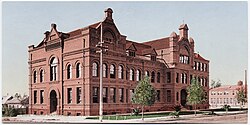
Key Facts
- Established: September 23, 1891, by Amos G. Throop.
- Location: A 124-acre campus in Pasadena, California.
- Student Population: 2,430 students (2024–25), comprising 987 undergraduates and 1,443 postgraduates.
- Endowment: $4.32 billion as of 2025.
- Admissions: Highly selective, with a recent undergraduate admit rate of 2.6%.
- Mascot: Bernoulli the Beaver.
Evolution and History
Caltech's journey began with the founding of Throop University in 1891. Over the following decades, the institution underwent several name changes as its focus shifted toward technical and scientific mastery. It was known as the Throop Polytechnic Institute and Manual Training School (1907–1913) and later the Throop College of Technology (1913–1920) before evolving into the modern California Institute of Technology.
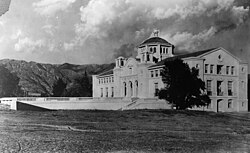
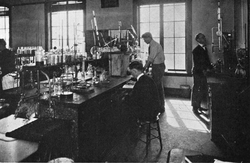
The early 20th century marked a period of rapid physical and academic expansion. The construction of the Norman Bridge Laboratory of Physics in 1921 signaled the university's commitment to high-level experimental science.
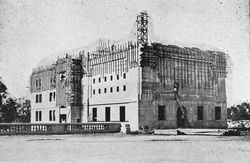
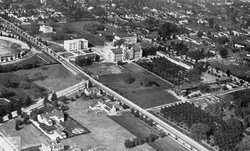
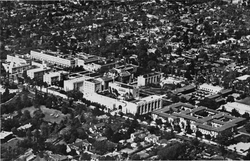
By the 1920s, the campus had grown into a hub of scientific activity, as seen in early aerial surveys of the Pasadena grounds.
Throughout the mid-20th century, Caltech became a magnet for the world's greatest minds. The campus hosted legendary figures such as Albert Einstein and J. Robert Oppenheimer, fostering an environment of intellectual rigor that contributed to some of the most significant breakthroughs in physics and chemistry.
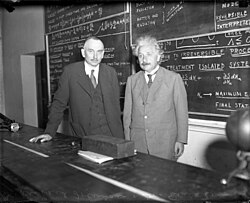
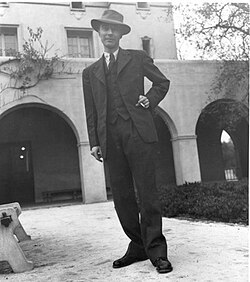
The university's growth continued through the World War eras and the post-war period, eventually leading to the development of modern facilities and the expansion of its research capabilities into the 21st century.
Academic Excellence and Rankings
Caltech is renowned for its extremely selective admissions process and its focus on the fundamental sciences. For the entering class of 2028, the admit rate was just 2.6%, with a middle 50% SAT range of 1530–1570 and ACT composite scores of 35–36.
The institution's academic prowess is reflected in its global rankings. Caltech consistently ranks in the top 10 globally across various metrics, including the Academic Ranking of World Universities (ARWU) and Times Higher Education (THE). Specifically, its programs in Chemistry and Earth Sciences are ranked 1st nationally.
| Category/Program | National Rank | Global Rank |
|---|---|---|
| Overall University (THE/ARWU) | 11 (US News) | 7 (THE) / 8 (ARWU) |
| Chemistry | 1 | 10 |
| Earth Sciences / Geosciences | 1 | 1 |
| Physics | 3 | 6 |
| Biological Sciences | 4 | 29 |
| Engineering | 4 | 52 |
Campus Life and Culture
Despite its intense academic environment, Caltech maintains a vibrant student culture. The university utilizes a unique House system for student living and is known for its spirited (and often complex) tradition of pranks and a friendly but fierce rivalry with the Massachusetts Institute of Technology (MIT).
Athletics are a part of campus life, with the "Beavers" competing in NCAA Division III within the Southern California Intercollegiate Athletic Conference (SCIAC).

The campus is home to world-class facilities, including the Beckman Auditorium, the Broad Center for Biological Sciences, and the Cahill Center for Astronomy and Astrophysics. These spaces support a faculty of 300 professorial members who mentor a diverse student body.
Notable Alumni and Contributions
Caltech's impact on the modern world is perhaps most evident in its alumni. The institution has produced pioneers who shaped the digital and space ages:
- William Shockley: Co-inventor of the solid-state transistor and a key figure in the birth of Silicon Valley.
- Gordon Moore: Co-founder of Intel and author of Moore's Law.
- John McCarthy: Inventor of the Lisp programming language.
- Harrison Schmitt: The only geologist to have walked on the Moon.
- Donald Knuth: Creator of the TeX typesetting system and a pioneer in algorithm analysis.
Frequently Asked Questions
What is the current admission rate for Caltech undergraduates?
For the entering class of 2028, the admit rate was 2.6%, making it one of the most selective universities in the United States.
Who is the current president of Caltech?
Ray Jayawardhana is the president of the institute, having succeeded Thomas F. Rosenbaum.
What are Caltech's highest-ranked academic programs?
Caltech is ranked 1st nationally in both Chemistry and Earth Sciences, and it holds the top global spot for Space Science and Geosciences.
What is the student-to-faculty ratio like at Caltech?
With approximately 2,430 students and 300 professorial faculty, Caltech maintains a very low student-to-faculty ratio, facilitating close mentorship and research collaboration.
What is the significance of the "Beavers" at Caltech?
The Beavers are the university's athletic nickname, and the mascot is named Bernoulli the Beaver, honoring the mathematical legacy of the Bernoulli family.