Robert Millikan: The Physicist Who Measured the Electron
Robert Andrews Millikan was a towering figure in American experimental physics, best known for determining the fundamental charge of the electron. His meticulous approach to measurement and his leadership at the California Institute of Technology (Caltech) helped shape the landscape of modern scientific research in the United States.
Millikan's career was defined by a drive for precision. He is most celebrated for his work on the elementary charge—the smallest unit of electric charge—and his contributions to the study of the photoelectric effect, which earned him the Nobel Prize in Physics in 1923.
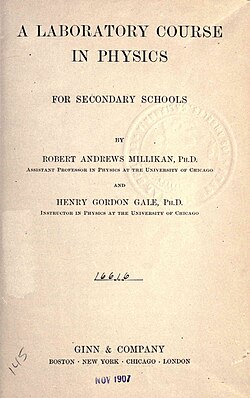
Key Facts
- Nobel Prize: Awarded the 1923 Nobel Prize in Physics for his work on the elementary charge and the photoelectric effect.
- Major Discovery: Conducted the oil-drop experiment to measure the charge of a single electron.
- Institutional Impact: Served as Chairman of the Executive Council at Caltech from 1921 to 1945.
- Education: Earned degrees from Oberlin College and a Ph.D. from Columbia University.
- Legacy: His work provided a foundation for modern particle physics, though his association with the eugenics movement has led to the renaming of several institutions in recent years.
Early Life and Academic Foundation
Born on March 22, 1868, in Morrison, Illinois, Robert Millikan was the son of the Rev. Silas Franklin Millikan and Mary Jane Andrews. His academic journey began at Oberlin College, where he earned a B.A. in 1891 and an M.A. in 1893. He later pursued doctoral studies at Columbia University, receiving his Ph.D. in 1895. His thesis focused on the polarization of light emitted from the surfaces of incandescent solids and liquids.
The Oil-Drop Experiment
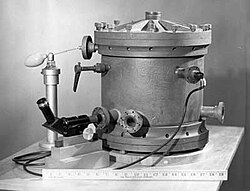
Millikan's most famous contribution to science was the oil-drop experiment. The goal was to determine the elementary charge, a fundamental physical constant. By suspending tiny, charged droplets of oil between two metal electrodes, Millikan measured the force acting on the droplets against gravity.
By calculating the electric field, he determined that the charge on each droplet was always an integer multiple of a common value: 1.592 × 10⁻¹⁹ coulomb. This value represented the charge of a single electron. While slightly lower than the modern accepted value of 1.602 176 53(14) × 10-19 coulomb, the discrepancy is attributed to an inaccurate value for the viscosity of air used at the time.
Controversies and Collaboration
The experiment was not without conflict. Millikan faced a scientific dispute with Felix Ehrenhaft, who published contradictory observations. Additionally, later historical accounts revealed that Millikan took sole credit for the work, while his student, Harvey Fletcher, claimed full authorship of a related result for his dissertation in a secret agreement that lasted until Fletcher's death.
The Photoelectric Effect and Theoretical Views
Millikan also conducted extensive research on the photoelectric effect—the emission of electrons when light hits a material. While this work was essential for the development of quantum mechanics, Millikan remained conservative regarding some 20th-century theoretical shifts. For instance, he continued to believe in the existence of the ether and remained noncommittal about Albert Einstein's theory of relativity in his textbooks as late as 1927.
Leadership at Caltech
In 1917, astronomer George Ellery Hale recruited Millikan to spend time at Throop College of Technology in Pasadena. By 1920, the institution was renamed the California Institute of Technology (Caltech). Millikan became the Director of the Norman Bridge Laboratory of Physics and served as Chairman of the Executive Council from 1921 to 1945.
Under his leadership, Caltech evolved from a small college into one of the world's premier research institutions. He mentored a generation of physicists, including Carl David Anderson and Ira Sprague Bowen.
Wartime Service and Public Life
During World War I, Millikan served as Vice Chairman of the National Research Council, contributing to the development of meteorological and anti-submarine devices. His career was not without scandal; an investigation by Inspector General William T. Wood suggested Millikan attempted to profit personally from another inventor's centrifugal gun design, though he was later exonerated by Frank McIntyre.
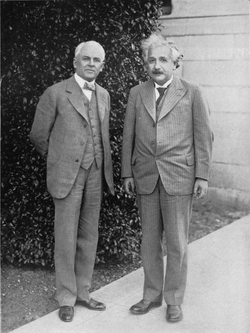
In his later years, Millikan was involved with the League of Nations' Committee on Intellectual Cooperation, working alongside peers like Marie Curie and Albert Einstein.
Personal Life and Recognition
Millikan married Greta Irvin Blanchard in 1902, and they had three sons: Clark, Glenn, and Max.
Throughout his career, Millikan received numerous prestigious awards, including the Comstock Prize, the Edison Medal, and the Medal for Merit. He passed away on December 19, 1953, at the age of 85.
| Year | Award | Organization | Reason/Citation |
|---|---|---|---|
| 1913 | Comstock Prize in Physics | National Academy of Sciences | — |
| 1922 | AIEE Edison Medal | AIEE | Experimental work in electrical science |
| 1923 | Nobel Prize in Physics | Royal Swedish Academy of Sciences | Elementary charge of electricity and photoelectric effect |
| 1923 | Hughes Medal | Royal Society | Determination of electronic charge and physical constants |
| 1949 | Medal for Merit | United States Government | — |
Modern Legacy and Renaming
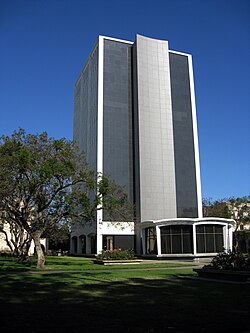
In recent years, Millikan's legacy has been re-evaluated due to his affiliation with the Human Betterment Foundation and the eugenics movement. This has led several institutions to remove his name from their campuses. In 2020, Pomona College renamed the Millikan Laboratory. In 2021, Caltech renamed the Millikan Library to Caltech Hall and renamed the Robert A. Millikan Professorship.
Frequently Asked Questions
What was the purpose of the oil-drop experiment?
The experiment was designed to measure the elementary charge of an electron by observing the motion of charged oil droplets suspended in an electric field.
Why did Millikan win the Nobel Prize in Physics?
He was awarded the prize in 1923 for his pioneering work on the elementary charge of electricity and his research into the photoelectric effect.
What was Millikan's role at Caltech?
Millikan served as the Director of the Norman Bridge Laboratory of Physics and as the Chairman of the Executive Council from 1921 to 1945, helping transform the school into a leading research institution.
Why have buildings named after Millikan been renamed?
Institutions like Caltech and Pomona College renamed buildings due to Millikan's historical association with the eugenics movement and the Human Betterment Foundation.
Did Millikan agree with Einstein's theories?
Millikan was conservative regarding new physics; while he acknowledged Einstein's success in explaining phenomena, he remained skeptical of the photon theory and continued to believe in the ether.