Cabinet Office: The Hub of United Kingdom Government Operations
The Cabinet Office serves as the central ministerial department and senior decision-making hub for the Government of the United Kingdom. Its primary mission is to provide critical support to the Prime Minister and the Cabinet, ensuring that the government's strategic objectives are coordinated and delivered across all departments.
Beyond its advisory role, the Cabinet Office acts as the corporate headquarters for the British Civil Service. It manages a diverse array of units that facilitate Cabinet committees and streamline the implementation of government policy. As of March 2026, the department employs over 5,385 staff, primarily civil servants based in Whitehall and Canary Wharf, including those working within the Prime Minister's Office at 10 Downing Street.
Key Facts
- Established: December 1916, evolving from the Committee of Imperial Defence.
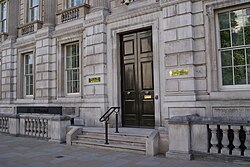
- Headquarters: 70 Whitehall, London.
- Leadership: Led by the Prime Minister and the First Secretary of State.
- Workforce: 5,385 employees as of March 2026.
- Core Purpose: Supporting collective government and coordinating national security and civil service reform.
Organizational Structure and Recent Reforms
Following the appointment of Andy Burnham as Prime Minister on July 20, 2026, the center of government underwent a significant reorganization. This led to the creation of the Office for the Prime Minister and Cabinet (OPMC). Led by Cabinet Secretary Dame Antonia Romeo, the OPMC integrates several key entities:
- The Prime Minister's Office at 10 Downing Street.
- The No. 10 North unit located at Heron House in Manchester.
- Core Cabinet Office functions and a newly established AI Taskforce.
To improve operational efficiency, many of the department's remaining administrative functions have been moved to the OneGov Delivery Agency. This arm's-length body manages essential services such as the Government Recruitment Service, Pensions, Shared Services, the Government Car Service, and Security Vetting.
Core Responsibilities
The Cabinet Office operates across several critical domains to ensure the stability and efficiency of the UK state:
Government Coordination and Reform
The department supports collective government—the principle that all ministers must publicly support government decisions—by coordinating policy development and implementation. It also drives efficiency through innovation, transparency, and improved procurement and project management.
National Security and Intelligence
The Cabinet Office supports the National Security Council and the Joint Intelligence Organisation. It is responsible for coordinating the government's response to national crises and managing the UK's cyber security infrastructure.
National Oversight
The department holds responsibility for several high-level functions, including:
- The Home Civil Service.
- The Independent Parliamentary Standards Authority.
- The Government Commercial Function and Organisation.
- The Government Digital Service, which manages the digital, data, and technology (DDaT) function.
- The What Works Network, which focuses on evidence-based public policy.
Historical Evolution
The Cabinet Office was formed in 1916 under Sir Maurice Hankey, the first Cabinet Secretary. While its primary role has always been facilitating collective decision-making, its scope expanded in 1981 after absorbing functions from the Civil Service Department.
Over time, the office has integrated specialized units, such as the Historical Section (founded 1906) for official histories, the Joint Intelligence Committee (founded 1936) for intelligence assessments, and the Ceremonial Branch (founded 1937), which now manages honours and appointments.
In recent years, the department's size grew due to the demands of Brexit and the Covid-19 pandemic. However, in 2025, the government announced a reduction in staff numbers aimed at saving £110 million annually by 2028.
Departmental Overview
The following table summarizes the key administrative and leadership details of the Cabinet Office.
| Category | Details |
|---|---|
| Headquarters | 70 Whitehall, London |
| Prime Minister | Andy Burnham |
| Minister for the Cabinet Office | Louise Haigh |
| Cabinet Secretary | Dame Antonia Romeo |
| Staff Count | 5,385 (as of March 2026) |
| 2011-12 Budget | £2.1 billion (current) / £400 million (capital) |
The Architecture of 70 Whitehall
The main headquarters at 70 Whitehall is a complex site that blends historical heritage with modern governance. The building connects three distinct properties and contains the remains of Henry VIII's 1530 tennis courts. The frontage was designed by Sir John Soane and completed by Sir Charles Barry between 1845 and 1847.
The site also includes Dorset House and William Kent's Treasury, the latter of which was built over a Tudor-era cockfighting pit and theatre. Following significant renovations between 2010 and 2016, the building now features open-plan offices and houses the famous Cabinet Office Briefing Rooms (COBR).
Frequently Asked Questions
What is the primary role of the Cabinet Office?
The Cabinet Office supports the Prime Minister and the Cabinet in coordinating government policy, managing national security, and overseeing the efficiency and reform of the British Civil Service.
What is the OPMC?
The Office for the Prime Minister and Cabinet (OPMC) is a reorganized unit created in 2026 that integrates the Prime Minister's Office at 10 Downing Street, the No. 10 North unit in Manchester, and core Cabinet Office functions.
Who is the current Cabinet Secretary?
Dame Antonia Romeo serves as the Cabinet Secretary and Head of the Civil Service.
What is the purpose of Cabinet Committees?
Cabinet Committees are designed to reduce the workload of the full Cabinet by handling specific business and ensuring that policies are thoroughly considered to maintain the principle of collective responsibility.
Where are the Cabinet Office Briefing Rooms located?
The Cabinet Office Briefing Rooms (COBR) are located at the department's main headquarters at 70 Whitehall in London.