Burgess Shale: A Window into the Cambrian Explosion
Deep within the Canadian Rockies of British Columbia lies one of the most significant paleontological treasures on Earth: the Burgess Shale. This fossil-bearing deposit is world-renowned for its exceptional preservation of soft-bodied organisms, providing a rare glimpse into marine life from approximately 505 million years ago during the middle Cambrian period.
Unlike most fossil beds, which primarily preserve hard shells and bones, the Burgess Shale contains imprints of delicate tissues, organs, and appendages. This allows scientists to study the anatomy of creatures that would otherwise have vanished from the geological record, making it a cornerstone for understanding the Cambrian Explosion—the rapid diversification of animal life.
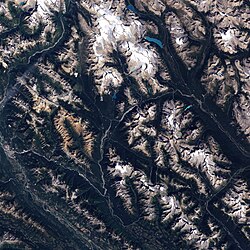
Key Facts
- Age: Approximately 505 million years old (Miaolingian stage of the Cambrian).
- Location: Yoho and Kootenay National Parks, British Columbia, Canada.
- Significance: Exceptional preservation of soft-tissue imprints.
- Geology: Part of the Stephen Formation, consisting primarily of black shale.
- Status: Registered as a UNESCO World Heritage Site (1980) and an IUGS Geological Heritage Site (2022).
Discovery and Scientific Evolution
The site was first discovered on August 30, 1909, by paleontologist Charles Doolittle Walcott. Recognizing the uniqueness of the finds, Walcott spent years excavating the flanks of Fossil Ridge, eventually amassing over 65,000 specimens. However, limited by the scientific paradigms of his era, Walcott attempted to force these strange creatures into existing modern taxonomic groups, which led many to view the fossils as mere curiosities.
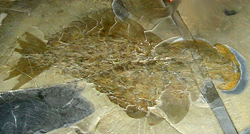
The perception of the Burgess Shale shifted dramatically in 1962 when Alberto Simonetta reinvestigated the fossils. Later, Harry Blackmore Whittington, Derek Briggs, and Simon Conway Morris conducted a thorough reassessment. They revealed a fauna far more diverse and bizarre than Walcott had imagined. Among the most famous discoveries were Opabinia, featuring five eyes and a vacuum-like snout, and Hallucigenia, a creature so strange it was initially reconstructed upside down.
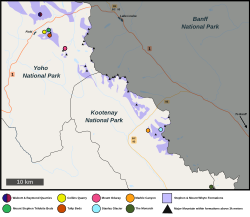
The Great Evolutionary Debate
In his 1989 book Wonderful Life, Stephen Jay Gould argued that the Burgess Shale proves that early life was far more disparate in form than today's animals, suggesting many unique lineages were "evolutionary experiments" that went extinct. Conversely, Simon Conway Morris argued that most of these organisms could actually be classified into modern-day phyla, suggesting a more direct lineage to current animal groups.
Geology and Preservation
The Burgess Shale is a unit of the Stephen Formation, characterized by dark, slightly calcareous mudstones. The fossils were deposited at the base of a 160-meter-tall cliff formed by the Cathedral Formation. This geological setting protected the beds from tectonic decompression, which is why fossils found in the Walcott Quarry are so well-preserved compared to those further away.
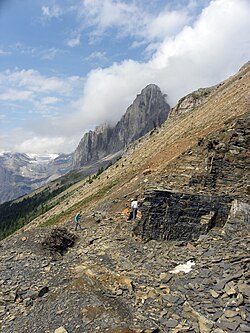
The process of preservation, known as taphonomy, involved organisms being rapidly entombed by sediment-rich water currents. This quick burial prevented decay and resulted in the fossils being preserved as carbonaceous films thinner than one micrometre. While it was once believed that the environment was anoxic (oxygen-free), recent research suggests oxygen was present in the sediment, with brine seeps potentially playing a role in the preservation process.
The Cambrian Ecosystem
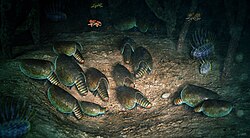
The biota of the Burgess Shale represents a complex middle Cambrian marine community. While hard-shelled organisms make up only about 14% of the community, they are proportional to other Cambrian sites, indicating that soft-bodied animals were just as common elsewhere, though rarely preserved.
- Benthic Organisms: The majority were bottom-dwellers, either moving (vagrant) or attached (sessile).
- Feeding Habits: Roughly two-thirds fed on organic matter in the mud (deposit feeders), while one-third filtered particles from the water.
- Predators: Less than 10% were predators or scavengers, though their larger size meant they accounted for a significant portion of the total biomass.
Summary of Site Characteristics
| Feature | Details |
|---|---|
| Stratigraphic Range | Miaolingian (c. 505 Ma) |
| Lithology | Black Shale |
| Thickness | 161 meters (528 ft) |
| Primary Location | Yoho National Park, Canada |
| Preservation Type | Carbonaceous films |
Climate and Future Research
Beyond paleontology, the site is a resource for paleoclimatologists. By studying the climate of the Cambrian explosion, researchers aim to predict Earth's long-term future. They analyze how a warming sun and declining oxygen and CO2 levels might eventually return Earth to temperatures similar to the Archean Eon, potentially signaling the eventual end of complex life.
Frequently Asked Questions
Why is the Burgess Shale so famous?
It is famous for the exceptional preservation of soft-bodied organisms, which allows scientists to see anatomy—such as guts and eyes—that is usually lost during fossilization.
Who discovered the Burgess Shale?
The site was discovered by paleontologist Charles Doolittle Walcott in 1909.
What is the Stephen Formation?
The Stephen Formation is the larger geological collection of dark mudstones to which the Burgess Shale belongs.
How were the fossils preserved?
Organisms were rapidly buried by sediment-rich underwater currents, which entombed them before they could decay, leaving behind thin carbon films.
What are some of the strangest creatures found there?
Notable examples include Opabinia, with its five eyes and hose-like snout, and Hallucigenia, which possesses a bizarre, symmetrical spine-covered body.