Brown v. Board of Education: The Landmark Ruling That Ended School Segregation
In the history of American jurisprudence, few cases have had as profound an impact on society as Brown v. Board of Education of Topeka. Decided on May 17, 1954, this landmark United States Supreme Court ruling declared that state laws establishing racial segregation in public schools were unconstitutional. By doing so, the Court struck a decisive blow against the systemic separation of students based on race, fundamentally altering the landscape of the American education system and the broader civil rights movement.
The core of the legal battle rested on the Equal Protection Clause of the Fourteenth Amendment, which prohibits states from denying any person the equal protection of the laws. The Court determined that segregating children in public schools based on race violated this clause, regardless of whether the physical facilities and resources provided to each race were equal in quality.
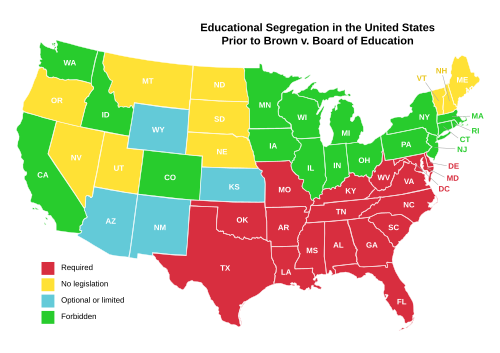
Key Facts
- Decision Date: May 17, 1954.
- Ruling: Unanimous 9–0 decision in favor of the plaintiffs.
- Legal Basis: The Fourteenth Amendment's Equal Protection Clause.
- Precedent Overturned: Partially overruled Plessy v. Ferguson (1896).
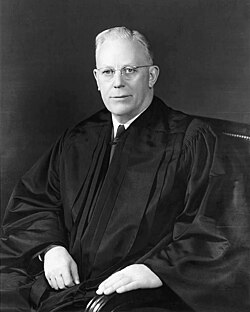
- Chief Justice: Earl Warren, who authored the majority opinion.
- Impact: Ended the legal justification for the "separate but equal" doctrine in public education.
The Legal Shift: From Plessy to Brown
To understand the significance of Brown v. Board of Education, one must first look at the precedent it overturned. In 1896, the Supreme Court ruled in Plessy v. Ferguson that racial segregation did not violate the Constitution as long as the facilities provided for each race were equal. This created the legal doctrine known as "separate but equal," which served as the foundation for Jim Crow laws across the United States for over half a century.
The Brown case challenged this notion, arguing that the very act of segregation created a sense of inferiority among minority students that could not be remedied by equalizing buildings or textbooks. The Court agreed, concluding that separate educational facilities are inherently unequal.
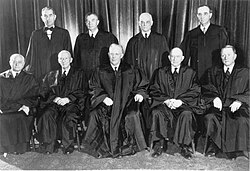
The Supreme Court's Decision
After arguments heard in December 1952 and re-argued in December 1953, the Court issued its unanimous ruling. Chief Justice Earl Warren wrote the opinion, which focused on the psychological and social impact of segregation. The Court noted that it had struggled to find a definitive historical conclusion on whether the Fourteenth Amendment was specifically intended to abolish segregation in education at the time of its adoption in 1868, but the current reality of segregation was clearly detrimental to the educational growth of children.
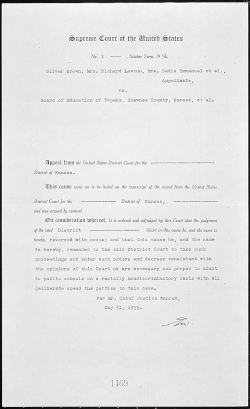
The final judgment and order formally mandated the end of state-sponsored segregation in public schools, providing a legal model for future impact litigation—lawsuits intended to bring about systemic social change.
Implementation and Resistance
While the ruling was a legal victory, the transition to integrated schools was fraught with difficulty. In Topeka, Kansas, the impact was less disruptive, as some schools had already been integrated since 1941 or 1871. However, in other regions, particularly the Deep South, the ruling met with "massive resistance."
A notable example of this resistance occurred in Prince Edward County, Virginia. Following a subsequent ruling known as Brown II, which suggested desegregation occur with "all deliberate speed," the county board of supervisors stopped funding public schools entirely from 1959 to 1964. While white students attended private academies funded by the county, Black students were left without any formal education. This practice ended only after the Supreme Court intervened in Griffin v. County School Board of Prince Edward County, declaring that the time for "deliberate speed" had expired.
Case Summary
| Feature | Details |
|---|---|
| Case Citation | 347 U.S. 483 (1954) |
| Primary Legal Issue | Racial segregation in public schools |
| Constitutional Basis | 14th Amendment (Equal Protection Clause) |
| Court Vote | 9–0 (Unanimous) |
| Key Outcome | Overturned "separate but equal" in public education |
Frequently Asked Questions
What was the "separate but equal" doctrine?
Established by the 1896 case Plessy v. Ferguson, this doctrine held that racial segregation was constitutional as long as the facilities provided to each race were equal in quality.
Why was the Brown v. Board decision unanimous?
Chief Justice Earl Warren worked to build a consensus among the justices to ensure the ruling had maximum legal and social authority, presenting a united front against segregation.
Did the ruling apply to private schools?
No, the Brown decision applied specifically to public schools. Later cases, such as Runyon v. McCrary (1976), addressed segregation in private institutions.
What was "Brown II"?
Brown II was a subsequent ruling that addressed the implementation of desegregation, famously stating that schools should integrate with "all deliberate speed," a phrase that was later criticized for allowing some districts to delay integration.
How did the ruling affect Topeka, Kansas?
In Topeka, the impact was relatively mild because some schools, including Topeka High School, had already been integrated for decades prior to the ruling.