Boxer Rebellion: The Conflict That Shook the Qing Dynasty
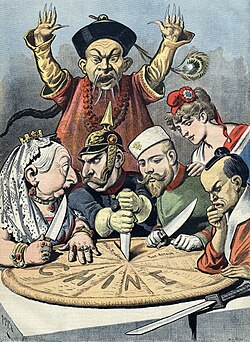
The Boxer Rebellion (1899–1901), known in Chinese as the Yìhétuán yùndòng (Militia United in Righteousness Movement), was a violent anti-foreign and anti-Christian uprising in North China. Driven by a combination of natural disasters, economic hardship, and resentment toward foreign imperialism, the movement sought to purge foreign influence from China, eventually leading to a massive international military intervention.
The conflict emerged following the First Sino-Japanese War, as villagers in North China grew fearful of expanding foreign spheres of influence. Tensions were exacerbated by Christian missionaries who often ignored local customs and used their political connections to protect converts in legal disputes. When severe droughts and Yellow River flooding struck in 1898, the Boxers attributed these calamities to foreign and Christian presence.
Key Facts
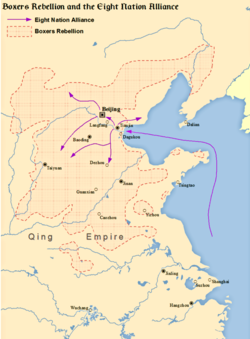
- Duration: September 17, 1899 – September 7, 1901.
- Primary Goal: To "Support the Qing government and destroy the foreigners."
- The Eight-Nation Alliance: A coalition comprising the UK, Russia, Japan, France, Germany, USA, Italy, and Austria-Hungary.
- Casualties: Approximately 100,000 total deaths, including 32,000 Chinese Christians and 200 Western missionaries in northern China.
- Outcome: Victory for the Eight-Nation Alliance and the signing of the Boxer Protocol.
The Rise of the Boxers
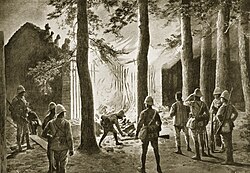
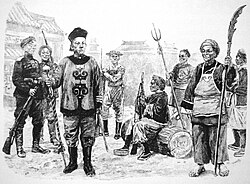
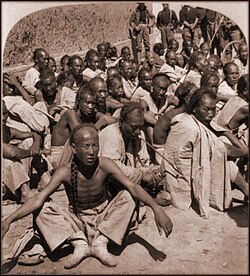
The movement began in Shandong and spread across the North China Plain. The Boxers were characterized by their belief in spiritual invulnerability; they claimed that initiation rituals made them immune to foreign bullets—a claim they "proved" to recruits using blanks, though it was quickly debunked in actual combat.
By June 1900, the Boxers converged on Beijing. Their violence targeted railroads, foreign property, and missionaries. The Qing imperial court, led by Empress Dowager Cixi, eventually shifted from suppressing the movement to supporting it, viewing the Boxers as a tool to expel foreign powers.
The Escalation and the Siege of Beijing
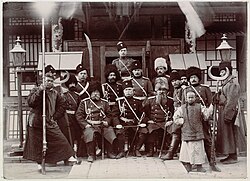
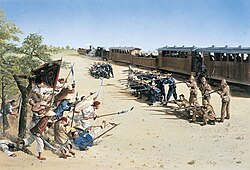
The crisis intensified on June 5, 1900, when Boxers cut the railway line to Tianjin, isolating Beijing. On June 11, the forces of General Dong Fuxiang attacked and killed Sugiyama Akira, the secretary of the Japanese legation, signaling a total breakdown of diplomacy.
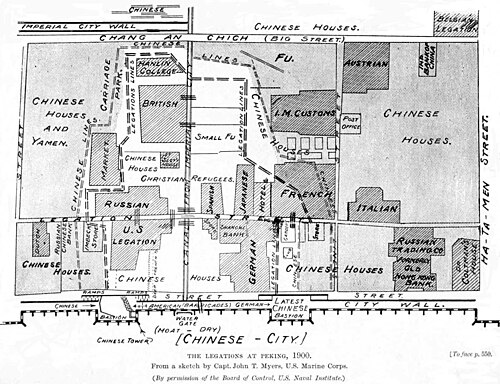
The foreign diplomatic legations in Beijing were soon besieged, with foreign nationals and their staff trapped inside the Legation Quarter. This led to a series of military responses from the Eight-Nation Alliance.
The Seymour Expedition
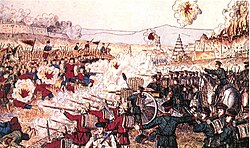
The first attempt to rescue the legations was the Seymour Expedition, consisting of roughly 2,100 troops. However, the force was surrounded by Imperial troops and Boxers. After being nearly overrun, they were rescued by a relief column of 1,800 men from Tianjin. Before retreating, the Seymour force destroyed a major arsenal, causing an estimated £3 million in damages.
The Gaselee Expedition and the Fall of Beijing
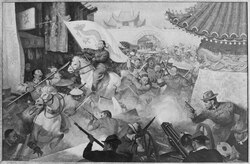
A second, larger force known as the Gaselee Expedition (approximately 18,000 troops) successfully fought its way into Beijing. As the Alliance forces closed in, Empress Dowager Cixi and the Guangxu Emperor fled the capital for Xi'an.
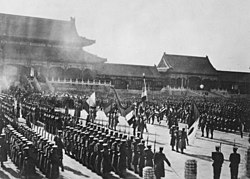
On November 28, 1900, foreign armies entered the Forbidden City, marking the effective end of the military phase of the rebellion in the capital.
Military Forces and Regional Impact
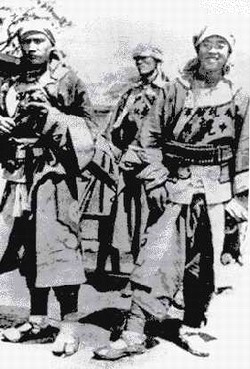
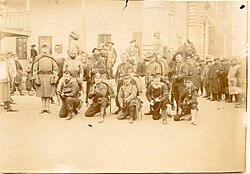
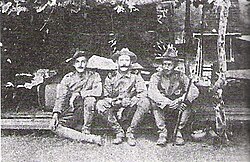
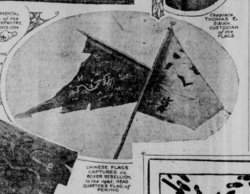
The conflict involved a complex array of military units. On the Chinese side, the Qing government deployed the Tenacious Army, the Resolute Army, and the Gansu Army (Muslim troops from Gansu known as the Gansu Braves). The Alliance forces were a multinational coalition of naval and army personnel.
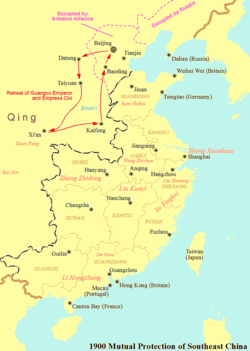
While North China and Manchuria (occupied by Russia) were the primary theaters of war, much of southern China remained unaffected. This was due to the Mutual Protection of Southeast China, where regional governor-generals like Li Hongzhang and Yuan Shikai refused to support the Boxer movement.
Aftermath and Consequences
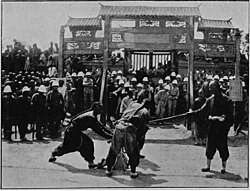
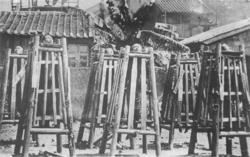
The rebellion ended with the signing of the Boxer Protocol. The aftermath was marked by severe indemnities imposed on the Qing government and the occupation of various Chinese provinces by Alliance forces.
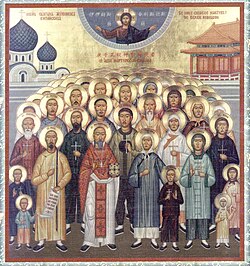
The human cost was staggering. Beyond the 100,000 total deaths, the uprising saw the massacre of 136 Protestant missionaries, 47 Catholic priests and nuns, and tens of thousands of Chinese Christians.
| Category | Details |
|---|---|
| Dates | 17 September 1899 – 7 September 1901 |
| Belligerents | Eight-Nation Alliance vs. Boxers & Qing Dynasty |
| Key Leaders (Alliance) | Alfred von Waldersee, Edward Seymour, Alfred Gaselee |
| Key Leaders (China) | Empress Dowager Cixi, Dong Fuxiang, Yuan Shikai |
| Estimated Strength | Boxers (100k–300k), Qing Troops (100k), Alliance (Various) |
| Result | Alliance Victory; Boxer Protocol signed |
Frequently Asked Questions
Who were the Boxers?
The Boxers were a secret society of peasants and villagers in North China who practiced martial arts and believed they were spiritually invulnerable to foreign weapons. They sought to eliminate foreign influence and Christianity from China.
Why did the Qing government support the Boxers?
Initially, the Qing government tried to suppress them, but Empress Dowager Cixi eventually saw the movement as a way to drive out foreign powers that were encroaching on Chinese sovereignty.
What was the Eight-Nation Alliance?
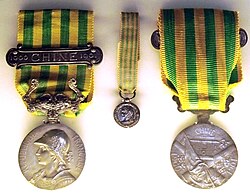
It was a military coalition consisting of the United Kingdom, Russia, Japan, France, Germany, the United States, Italy, and Austria-Hungary, formed to protect their citizens and interests in China.
What was the result of the Boxer Protocol?
The Boxer Protocol was the peace treaty that ended the conflict, requiring the Qing dynasty to pay massive financial reparations (indemnities) to the Alliance powers and accept foreign troops in Beijing.
Did all of China participate in the rebellion?
No. While North China was the center of the violence, the governor-generals of the south and east participated in the Mutual Protection of Southeast China, effectively ignoring the imperial court's call to join the Boxers.