Blaubeuren: A Gem of the Swabian Jura
Nestled at the foot of the Swabian Jura in Baden-Württemberg, Germany, Blaubeuren is a town that seamlessly blends prehistoric mystery, medieval architecture, and modern industry. Located just 16 kilometers west of Ulm, this charming community is defined by its striking natural landscapes and a rich cultural heritage that spans millennia.
From the deep blue waters of its famous karst spring to the ruins of ancient castles, Blaubeuren offers a unique glimpse into the geological and social history of the Alb-Donau-Kreis district.
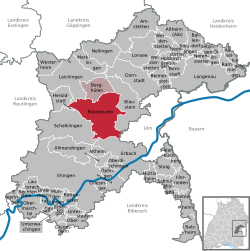
Key Facts
- Location: Alb-Donau-Kreis, Baden-Württemberg, Germany.
- Population: 12,719 (as of December 31, 2024).
- Primary Landmark: The Blautopf, one of Germany's largest and deepest karst springs.
- Archaeological Significance: Home to the Venus of Hohle Fels, the oldest undisputed depiction of a human in prehistoric art.
- Economy: Headquarters for the Merckle group (pharmaceuticals) and Centrotherm Photovoltaics.
Geography and Administration
Blaubeuren is situated at an elevation of 516 meters. The town is composed of the core city and 18 other villages, hamlets, and farms. Its constituent districts include Gerhausen, Altental, Asch, Beiningen, Pappelau, Beimerstetten, Sotzenhausen, Seißen, Wennenden, Sonderbuch, and Weiler.
The town is bordered by several communities: Suppingen and Berghülen to the north, Blaustein to the east, Ulm and Erbach to the south, and Schelklingen and Heroldstatt to the west.
Natural Wonders and Landmarks
The Blautopf
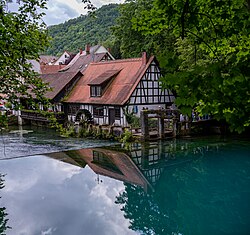
The most iconic sight in the town is the Blautopf, a karst spring—a spring where water emerges from a limestone cave system. Reaching a depth of 21 meters, it is one of the largest and deepest sources in Germany. Its water flow varies significantly, ranging from a minimum of 310 L/s to a maximum of 32,000 L/s, serving as the source of the river Blau.
Architecture and History
The town's skyline is marked by a mix of spiritual and defensive structures. The Blaubeuren Abbey, founded in 1085, stands as a testament to the town's monastic history. The old town remains picturesque with its numerous half-timbered buildings.
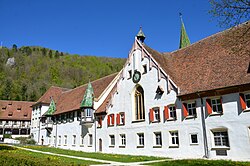
History enthusiasts can also explore the ruins of several castles scattered throughout the borough, including Ruck Castle, Blauenstein Castle, Hohengerhausen Castle, Günzelburg Castle, Burkartsweiler, Sirgenstein Castle, and Gleißenburg Castle.
For those visiting the heights of the town, the Ruckenkreuz is a prominent landmark. Erected in 1926, this 8.4-meter tall reinforced concrete memorial cross commemorates those who fell during the First World War.
Culture, Science, and Museums
Blaubeuren is a center for archaeological study. The Urgeschichtliches Museum Blaubeuren (Prehistoric Museum) houses the Venus of Hohle Fels, a world-renowned artifact representing the earliest known undisputed depiction of a human being in prehistoric art. The museum combines scientific findings with experimental archaeology.
Additionally, the former monks' bathhouse serves a dual purpose: the basement showcases historic bathing facilities, while the upper floors house the local museum, featuring traditional furniture and objects from the town's past.
Economy and Infrastructure
Despite its historic feel, Blaubeuren is an industrial hub. It serves as the headquarters for the Merckle group, a major player in the pharmaceutical industry, and Centrotherm Photovoltaics.
The town is well-connected via the Ulm–Sigmaringen railway, with regional express trains providing access to Ulm, Sigmaringen, Donaueschingen, and Titisee-Neustadt. Road access is provided by Bundesstraße 28 and Bundesstraße 492, with the Bundesautobahn 8 (connecting Stuttgart and Munich) located just 12 kilometers away.
Local Traditions and Notable Figures
One of the town's most unique traditions is the Patenterrennen (Patent Race) in Gerhausen. This annual sled race features teams of drivers and brakesmen competing with historic sleds.
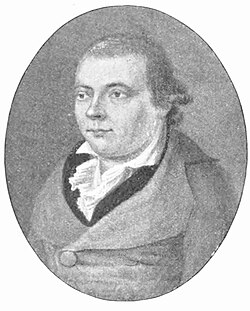
The town has been home to various influential figures, including philosopher Christoph Gottfried Bardili and poet Karl Philipp Conz, who attended the monastery school.
| Category | Details |
|---|---|
| State | Baden-Württemberg |
| District | Alb-Donau-Kreis |
| Total Area | 79.11 km² |
| Key Industry | Pharmaceuticals & Photovoltaics |
| Main Attraction | Blautopf Karst Spring |
| Famous Artifact | Venus of Hohle Fels |
Frequently Asked Questions
What is the Blautopf?
The Blautopf is a deep karst spring and the source of the river Blau. It is one of Germany's largest and deepest springs, known for its striking blue color and depth of 21 meters.
What is the significance of the Venus of Hohle Fels?
Found in the region and displayed at the Urgeschichtliches Museum Blaubeuren, it is recognized as the earliest known undisputed example of a human depiction in prehistoric art.
Which major companies are based in Blaubeuren?
The town is the headquarters for the pharmaceutical Merckle group and Centrotherm Photovoltaics.
What is the Patenterrennen?
The Patenterrennen is a unique annual sled race held in the district of Gerhausen, where teams compete using historic sleds.
How can visitors reach Blaubeuren?
Blaubeuren is accessible via the Ulm–Sigmaringen railway and is located on Bundesstraße 28. The A8 motorway is approximately 12 kilometers from the town.