Big Band Jazz: The Evolution of the Jazz Orchestra
A big band, historically known as a jazz orchestra, is a large musical ensemble that typically consists of ten or more musicians. Emerging in the early 1910s, these ensembles became the dominant force in jazz by the early 1940s, coinciding with the peak popularity of swing music. While the term "big band" often refers to a specific genre of music, it primarily describes the structural makeup of the ensemble itself.
The stylistic roots of the big band are diverse, drawing from jazz, blues, American marches, classical music, and various rhythmic social dances. Over time, this foundation gave rise to several derivative forms, including swing, progressive jazz, Kansas City jazz, and later, easy listening and traditional pop.
Key Facts
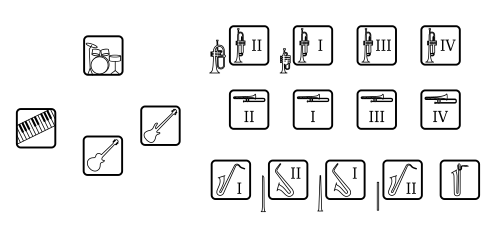
- Standard Composition: Usually features four sections: saxophones, trumpets, trombones, and a rhythm section.
- Peak Era: Dominated the music scene in the early 1940s during the Swing Era.
- Origins: Developed in the 1910s, moving away from the New Orleans jazz style toward structured dance music.
- Cultural Impact: Spread nationwide via radio broadcasts and early cinema.
Instrumentation and Ensemble Structure
The architecture of a big band is designed for power and versatility. Most ensembles are divided into four primary sections:
- Trumpets: Providing high-energy melodic leads.
- Trombones: Adding depth and harmonic richness.
- Saxophones: Often including alto, tenor, and baritone varieties.
- Rhythm Section: The heartbeat of the band, typically comprising piano, guitar, double bass, and drums, sometimes supplemented by a vibraphone.
Instrumentation evolved as bandleaders pushed creative boundaries. In the 1920s and 30s, bands typically used two to three trumpets and three to four saxophones. By the 1940s, Stan Kenton expanded his ensemble to include five trumpets and five trombones. Duke Ellington occasionally utilized six trumpets and frequently integrated the clarinet, often doubling it with tenor saxophone parts. Some leaders experimented with orchestral instruments; Boyd Raeburn added French horns and strings, while Shep Fields and Paul Whiteman incorporated the accordion.
The History of Big Band Music
The Rise of Dance Music
The transition toward the big band format began with leaders like Art Hickman in San Francisco around 1916. His arranger, Ferde Grofé, pioneered the technique of dividing the orchestra into sections that intermingled—a defining characteristic of the genre. Paul Whiteman later adopted these methods, labeling his style "symphonic jazz." These dance bands diverged from New Orleans jazz by incorporating elements of ragtime, vaudeville, Broadway, and Tin Pan Alley to meet the public demand for danceable music.
The Swing Era
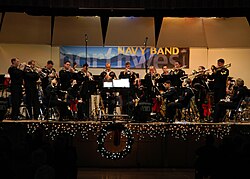
Swing music emerged in the early 1930s, characterized by a more supple rhythmic feel than early jazz. A key innovation of this period was the walking bass—a continuous quarter-note bass line—often credited to Walter Page, though earlier examples appear in the work of Wellman Braud with Duke Ellington in 1927.
By 1935, big bands became the primary vehicle for swing. While "black" bands like those of Duke Ellington, Count Basie, and Chick Webb were musically influential, "white" bands led by Benny Goodman, Artie Shaw, and Glenn Miller achieved greater commercial success. Between 1935 and 1945, the top four white bands secured 292 top-ten records, compared to 32 for the top four black bands.
Modern and Progressive Big Bands
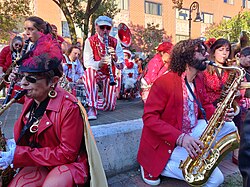
Following the swing era, big bands evolved into more experimental forms. Charlie Barnet's recordings in the early 1940s signaled the start of the bop era, while Stan Kenton championed "progressive jazz" in the 1950s, using his band to explore clashing elements and eclectic compositions. In the 1960s and 70s, Sun Ra and his Arketstra transformed the big band into a theatrical experience featuring costumes and dancers.
The influence of the big band also extended into rock music. Groups like Chicago and Blood, Sweat and Tears integrated horn choirs and jazz fusion into a "big band rock" sound. Simultaneously, artists like Gil Evans and John Coltrane brought cool jazz and free jazz into the large ensemble format.
Media and Cultural Reach
The Role of Radio
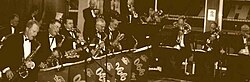
Radio was instrumental in the proliferation of big band music. Remote broadcasts from clubs and ballrooms brought the sounds of the "Pied Piper of Swing," Benny Goodman, into homes across America. Other notable broadcasts included Earl Hines in Chicago and Guy Lombardo's annual New Year's Eve celebrations. Radio also provided a platform for female-led orchestras, such as Gloria Parker's Swingphony and Phil Spitalny's Hour of Charm Orchestra.
Cinema and Film
From the 1930s through the 1960s, big bands frequently appeared in movies. While many appearances were brief cameos, some were more integrated, such as Shep Fields' animated performance in The Big Broadcast of 1938. Later, the 1950s saw the production of fictionalized biographical films about legends like Glenn Miller and Benny Goodman.
Summary of Big Band Evolution
| Era/Style | Key Characteristics | Notable Leaders |
|---|---|---|
| Symphonic Jazz (1910s-20s) | Classical influence, sectional arrangements | Paul Whiteman, Art Hickman |
| Swing Era (1930s-40s) | Walking bass, strong rhythmic groove | Benny Goodman, Duke Ellington, Count Basie |
| Progressive Jazz (1950s) | Experimental compositions, eclectic sounds | Stan Kenton, Woody Herman |
| Jazz Fusion/Rock (1960s-70s) | Integration of rock and soul horn choirs | Chicago, Blood, Sweat and Tears |
Frequently Asked Questions
What is the difference between a big band and a jazz combo?
A big band is a large ensemble typically consisting of ten or more musicians divided into specific sections (brass, reeds, and rhythm), whereas a combo is a smaller group, usually featuring fewer than ten musicians and focusing more on individual improvisation.
What is a "walking bass" line?
A walking bass is a style of bass playing where the musician plays a steady sequence of quarter notes, creating a continuous "walking" feel that provides a strong rhythmic and harmonic foundation for the band.
Who were the most influential big band leaders?
Some of the most influential leaders include Duke Ellington and Count Basie, who shaped the sound of African American jazz, and Benny Goodman, who helped popularize swing with wide audiences.
Did women lead big bands during the swing era?
Yes, several women led orchestras, including Gloria Parker, who conducted her Swingphony while playing the marimba, as well as B. A. Rolfe, Anna Mae Winburn, and Ina Ray Hutton.
How did big bands influence modern rock music?
In the 1960s and 70s, "big band rock" emerged as groups like Chicago and Tower of Power integrated jazz-style horn sections and fusion elements into progressive rock and soul music.